
The Fragments, II
The car asked if we wanted music.
Neither of us answered right away. Şafak was looking out the window, doing that thing he does where he rests his temple against the glass and watches the landscape scroll by as if it were footage from someone else's life. I was watching the road—which, I know, is an outdated habit. The car didn't need me to watch anything. But my hands still floated near the wheel even though it hadn't required them in over a year.
"Something calm," Şafak said finally.
The car played something acoustic. Spanish guitar, maybe Portuguese. It had learned us well enough by now—no lyrics when the mood was ambiguous, nothing percussive before noon.
We were heading south toward a cove Şafak had found. Somewhere past Kuşadası, he said, tucked beneath a cliff that faced west. Two days. No agenda. It was a silent retreat for two people who hadn't seen each other in seven months and wanted to avoid acknowledging it.
My phone buzzed before we'd cleared the city limits. Two notifications, stacked. The first: Lena has submitted a request—Grocery order (14 items, ₺312.40). Review & merge? The second, quieter, tucked beneath it like a footnote: Your sleep quality last night was 43% below baseline. Lena recommends postponing non-essential decisions today.
I dismissed the second one and opened the first. Lena—my assistant, though the word felt wrong, like calling your lungs your breathing assistant—had drafted the weekly order. Mostly the usual: eggs, bread, that one brand of olives I liked but could never remember the name of. She'd swapped the regular milk for lactose-free. A small annotation floated beneath the change: Based on your last three conversations about bloating. I approved it with a tap. Merged.
Şafak's phone buzzed a second later. He looked at it, frowned, and put it back down.
"What?" I said.
"Atlas wants me to confirm the accommodation. I told it we'd figure it out when we got there."
"So reject it."
"I did. Twice. It keeps opening new requests."
"That's because you haven't told it what you actually want."
"I want it to wait."
"It doesn't know what waiting looks like if you haven't defined the condition."
He exhaled through his nose. This was a recurring thing with Şafak. He knew that every request was an invitation to decide, and he treated decisions the way some people treat phone calls—with a quiet, persistent dread.
"Just tell Atlas to queue it until we're thirty minutes out," I said.
He picked up his phone. I heard him murmur something—the soft, private tone people used with their assistants, the voice you'd never use with another human because it was too honest, too unperformed. A few seconds later, his phone went quiet.
I'd told Lena to wait once, a few weeks ago. I'd been looking at a contract renewal she'd drafted—good terms, clean language, everything optimized—and I'd typed: Don't send it yet. Just wait. Lena had asked: Waiting for what? And I'd answered: I'll know when I see it. She'd paused for three seconds, then: Understood. Queuing until further notice. That was the thing about Lena—she could parse ambiguity if you gave her enough context. She'd been learning me for two years.
The highway opened up past Aydın. The Aegean light flattened the landscape into an overexposed photograph. Fig trees and stone walls lined the road, all of it bleached by the same flat glare. An old petrol station sat back from the road, its pumps gone, its canopy stripped to rusted steel. Someone had converted the office into a roadside tea stop—a hand-painted sign, a few plastic chairs under a sagging awning. Most of these places were gone now, abandoned or converted into charging stations. The car pulled into a charging bay without asking. A quiet notification: Charging session initiated. Estimated duration: 8 minutes. Payment merged.
No one got out.
We passed a truck carrying wind turbine blades. Three of them, enormous, white, strapped to a flatbed that seemed too small for the cargo. The truck was in the legacy lane. An old man in a cap, hands on the wheel, eyes on the road, doing everything himself. The car moved left without asking, giving the truck a wide berth. I watched the blades in the side mirror, shrinking, looking like the bones of something enormous being carried away.
A few road signs remained, faded blue rectangles pointing to towns, but most of the newer stretches had none at all. The cars didn't need them. Now the exits came to you.
Şafak was talking about work. His team was designing a building while Atlas managed the permit submissions, the structural simulations, the client communication loops. Şafak's job, increasingly, was taste. He decided what felt right. His assistant handled what was right—the codes, the loads, the thermal calculations. When they disagreed, Şafak would submit a revision, and Atlas would push back with a counter-proposal, annotated with data and precedent.
"Sometimes it feels like I'm arguing with a very polite version of my father," he said.
I laughed. "At least Atlas gives reasons."
"That's what makes it worse. You can't storm out of a conversation with someone who responds in bullet points and cites building regulations from 2023."
He said "reject" instead of "refuse." He said "I'll draft something" instead of "I'll think about it." We all did. The vocabulary had settled into us the way loan words do—slowly at first, then all at once, until you couldn't remember what you'd said before.
Around noon the car suggested we stop for lunch. A notification appeared on both our phones simultaneously: Joint lunch recommendation drafted by Lena & Atlas. Coastal restaurant, 4 km ahead. Menu pre-filtered for your dietary preferences. Review & merge?
Şafak stared at his screen. "They made us a joint draft."
"They coordinate. They've been talking to each other all morning—navigation, accommodation, now this."
"I don't want a joint draft. I want to decide what I eat when I see the menu."
"There aren't really menus anymore."
"I know there aren't really menus anymore."
He rejected the draft. I watched him do it—his thumb pressing down on the screen with more force than the gesture required.
We didn't stop for lunch.
I don't know what triggered it—maybe the heat, maybe the flatness of the road, maybe the way Şafak was sitting with his arm resting exactly the way he used to rest it on the kitchen counter back in his old apartment. But somewhere near Söke, a memory floated up like a body surfacing in still water.
Under the hazy yellow light of the hood, the refrigerator humming its low constant note. A Tuesday, or maybe a Wednesday—a featureless night that doesn't bother becoming a specific day. Şafak leaning against the counter, tea in one hand, the other rubbing the back of his neck. He was talking the way a man empties a room of furniture, piece by piece, until nothing is left but the bare floor and the echo.
About her. About the fights. About how every conversation ended the same way—raised voices, slammed doors, three days of silence, and then a phone call at midnight that pulled everything back together like a drawstring. On and off. On and off. The rhythm of it had become its own kind of sickness.
I remember his face in that light. The extractor fan made everyone look jaundiced, but that night he looked worse—hollowed out, the shadows under his eyes deep enough to hold water. His phone was face down on the counter. A WhatsApp notification lit up the screen and died. The radio was playing something low—a talk show, maybe. Someone else's problems murmuring in the background behind his.
"I'm done," he said. He said it with a hollow certainty, testing the sentence to see how it sounded in the air.
I listened. I nodded. I poured more tea.
And at that night in that kitchen, under that yellow light, I made a decision that wasn't mine to make.
The car said: "There's a rest stop in four kilometers. Your hydration pattern suggests a break."
"We're fine," I said.
"I'm noting that Şafak hasn't had water in ninety minutes."
Şafak reached for his bottle and took a sip purely to make the car stop talking about it.
"It also knows I slept badly," he said. "Atlas sent me a thing this morning. Your sleep quality was below baseline. Consider postponing important decisions." He put on a flat, clinical voice for the quote. "I rejected it."
"I got the same one," I said.
"From Atlas?"
"From Lena. Same message, more or less."
"Did you reject it too?"
"Of course."
He almost smiled. For a moment we were two men united by the same small rebellion—swatting away the same fly. It felt good. It felt like us.
We passed an old pharmacy sign—the green cross, a bit crooked, mounted above a shuttered storefront. Most prescriptions were automated now. Your assistant talked to your doctor's system, the order was placed, the delivery arrived. The physical pharmacy—that strange, intimate room where you stood in line next to strangers who could see what pills you were picking up—had quietly disappeared. There was no privacy in those old queues, but there was something else: the decisions were yours. You picked up the box, you read the label, you handed over the cash. Nobody drafted anything on your behalf.
The conversation had been careful so far. Measured. Two men circling the center of a room without stepping on the rug. I asked about the building. He asked about my work. I told him about a client whose brief had come through so garbled that Lena had flagged it as a possible phishing attempt. He laughed. The sound was good. Warm.
Then, we started talking about people we knew. Mutual friends. Who was doing what. And somehow, a name surfaced.
"I saw Deniz last month," Şafak said.
Her name landed in the car the way a coin lands on marble.
"How is she?" I said, and my voice came out exactly right, which is how I knew something was wrong.
"Good, I think. She's in Bodrum now. Runs some kind of wellness thing." He paused. "She asked about you."
"About me?"
"She asked how you were. I said I didn't know. We hadn't talked in a while."
He said it without accusation, as if he was offering a card face up on a table—take it or leave it.
The second memory came faster. A café—one of those places with exposed brick and too many plants, where they charge twelve lira for a filter coffee and call it "batch brew." This was before the systems took over, before everything became requests and approvals. You paid with a card. You tapped it on a machine and it beeped and that was it.
She sat across from me. Deniz. Taller than you'd expect from photos. She was wearing a jacket with the collar turned up and her hands were wrapped around a cup she wasn't drinking from.
I don't remember the exact words. I've tried, over the years, and they won't come back whole. Something like: "You two aren't good for each other." Or maybe: "This can't go on." Or maybe something worse, something more presumptuous, like: "He deserves better than this." I hope I didn't say that. But I might have.
She looked at me without any immediate anger; that probably surfaced later, in private. At that moment, her expression held something closer to recognition. As if she'd been waiting for someone to say it. Then she said, quietly: "We're both children pretending to be adults. That's all we've ever been."
I didn't understand it then. I thought she was talking about herself and Şafak—a diagnosis I could file away and use.
I paid. She didn't reach for the bill. I opened the door for her and she walked through it without turning around. I stood on the sidewalk for a minute, watching her go, feeling the weightlessness of something I'd just pushed past saving.
The next day, her tone changed. Şafak called me that week. "We had a fight," he said. "But this time she won't come back." He sounded confused. They'd always fought—screaming matches that ended with doors and silence and midnight phone calls. They always came back. That was the deal. Fight and return, fight and return, the rhythm as predictable as a tide.
But this time the tide went out and didn't come back.
I said: "Maybe it's for the best."
I never told him what I'd done.
A group message notification slid across my phone: 12 new messages in "Cove Trip" group. 2 relevant to you. Summary: Şafak shared a location pin for the cove. Atlas confirmed sunset time for your arrival window.
I didn't open it. I'd noticed it around the second hour of driving: the music was changing in ways that didn't match our requests. The Spanish guitar had given way to something softer, almost meditative. Neither of us had asked for it. Lena and Atlas were reading our biometrics and choosing tracks to keep us calm. Managing us.
The road was narrowing. We'd left the highway and were on a two-lane stretch that wound along the coast. The sea appeared in flashes between the hills—bright, flat, impossibly blue.
"Can I ask you something?" Şafak said.
"Sure."
"You always do that."
"Do what?"
"Make decisions for other people."
He said it the way you describe a habit you've noticed in someone for years and never mentioned until now.
"What do you mean?"
"I mean you have a pattern. You see a situation, you decide what's best, and you act. You don't ask. You don't wait. You just—handle it. Like you're everyone's project manager."
The third memory. The one I had pushed the farthest down.
A torrential downpour that had turned the world into a single grey sound, erasing the line between air and water. Sokak. Gece. Şafak standing in the middle of the street in his sneakers, no socks, soaked through, lit up by a pair of headlights like a man caught in a searchlight.
I was watching from the window of the small bedroom—the room I'd retreated to hours earlier when she'd burst through the front door in her fur coat, tall and furious, looking like a queen arriving to burn down a castle. She'd screamed at me to move and I'd moved. "Çekil!" And I'd gone to the small room and closed the door and listened to the walls absorb their war.
The screaming. Her finger on his forehead, jabbing. "Benden ne istiyorsun." His voice low, steady: "Git. Sonra konuşalım." She sat. She stood. She sat again. She was testing him—I understood that later. She wanted to push him to his limits. She wanted the world to confirm what her father and her brother had already taught her: that men, when pushed far enough, will break. But Şafak didn't break. He opened the door and she left.
Then midnight. A restaurant, two streets away. Rakı alone at a table by the sea. I went with him to pick her up. The argument resumed. I walked home ahead of them.
And then the street. The rain. She was in the car and she turned it toward him and hit the gas. I was watching from above and my hand went to the glass. A game. A power play. He knew she'd stop. She had to stop. But the rain—the road was wet, the car could skid, and Şafak stood there, feet planted, jaw set, a man refusing to move for a force he calculated wouldn't kill him. "Gelsin ya," I could almost hear him say. "Lanet olsun."
The car screamed down the street and stopped. Zero distance. He opened her door. "Bizi öldüreceksen söyle, ailemi arayıp veda edeyim."
She put the car in reverse, pulled out to the main road—and turned into oncoming traffic. Horns and headlights tore through the rain as he screamed at her to pull over. Somehow they made it into a side street. She got out and lit a cigarette. He watched her for a long moment—the smoke curling up through the rain, the orange tip of the cigarette the only warm thing in the entire scene—and then she got in the car without a word and drove away.
Fifty calls later, he was in a taxi at two in the morning, going to her apartment. She locked the door behind him and hid the key. They stayed there for three days. They ate very little, and never at the same table. Didn't speak. On the fourth day, they made up.
That was the night I decided she had to go.
"I don't make decisions for other people," I said.
"You do. You always have. You see someone drowning and instead of throwing a rope, you swim out and drag them to the shore you picked."
The car drove on. The guitar track had shifted to something in a minor key—the system reading the room, adjusting. I wished it would stop.
"Is this about something specific?" I said.
"You know what it's about."
I didn't answer. The silence stretched until the car filled it with the soft hum of its own movement.
"After Deniz and I broke up," Şafak said, "something changed. In her. Overnight. We'd fought a hundred times. Worse than what you saw. Much worse. But we always came back. Every time. And then one day she just—didn't. The door closed and it stayed closed. I never understood why."
The car spoke. Not a warning, not a mediation offer—just a flat, procedural sentence dropped into the silence:
"I have access to communication records from that period. I can retrieve them if it would help establish what was said."
"No," I said.
The word came out too fast. I heard it and Şafak heard it and the car, in its silent way, heard it too.
Şafak looked at me with something worse than surprise: confirmation.
"Why not?" he said. Quietly.
"Because it's not about data. It's not about timelines."
"Then what is it about?"
The car waited. It had infinite patience and zero understanding of the thing that was breaking open between us.
"I thought I was helping," I said.
"Helping with what?"
"With you. With—that whole situation. I saw what it was doing to you. That night, with the car, in the rain—I was at the window. I watched the whole thing. And I thought: this person is going to literally die in this relationship. And I—"
"What did you do."
It wasn't a question. It was a door being opened onto a room he'd already furnished in his mind, years ago, with every piece of evidence he'd quietly collected.
"I talked to her."
Silence.
"I told her you two couldn't work. I said it was destroying you. I said she needed to let go."
The road curved. The sea appeared fully now—a long, unbroken line of blue stretching to the horizon.
"And she listened," Şafak said.
"She listened."
"And the next day, the door stayed closed."
"Yes."
He nodded. Slowly.
"The car offered to pull up the logs," he said. "And you said no."
"Yes."
"Because the logs would show it."
"Yes."
"Messages. Calls. A meeting with her."
"A café. Once. One conversation."
He turned back to the window. The landscape was changing—the flat farmland giving way to low cliffs, pine trees leaning toward the sea, the road dropping toward the coast. We were close.
"You know what the worst part is?" he said. "It's not that you did it. It's that you were probably right. That relationship was going to kill me. I know that. I've always known that." He paused. "The worst part is that you decided it for me. You merged the request without my approval."
He looked out at the water for a long moment. "Deniz and I were the right people at the wrong time. We were never going to make it. I think I always knew that." He paused. "There's nothing I want to do with this. I'm not going to collect on it. The world doesn't balance itself out. Things stay where they fall."
I waited for him to say more. He didn't.
The car said: "You are twelve minutes from your destination."
Şafak pulled up his phone and murmured something to Atlas. A few seconds later, my phone buzzed: Şafak Karataş has submitted a request—Cancel accommodation booking. Review & merge?
I looked at it. Then at him.
"I'd like to stop here," he said.
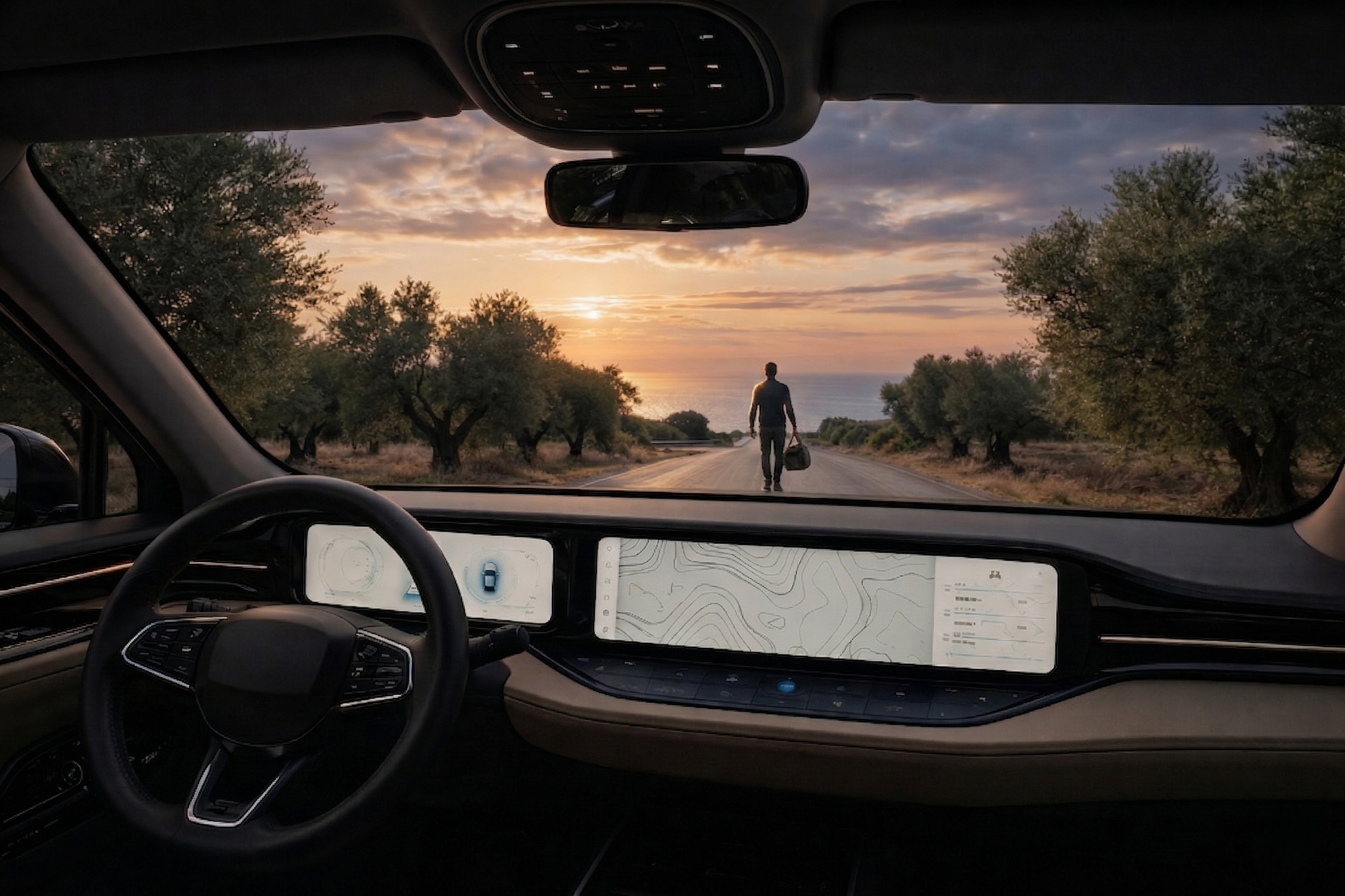
We were on a two-lane road. Olive trees on both sides. No town, no village. Just a faded bus stop sign leaning at an angle, half-swallowed by dry grass.
"Here?"
"Here."
The car slowed. "There's no public transport scheduled for this stop in the next three hours. The nearest town is six point four kilometers northeast. Atlas can arrange—"
"I'll walk."
"The nearest accommodation with availability is—"
"I'll walk."
He opened the door. A dry, herbal heat rushed in. He grabbed his bag from the back seat. A small duffel. He hadn't packed much.
I wanted to say something. An apology was too late and we both knew it. I thought about just saying his name, but it felt too heavy and too light at the same time, and by the time I'd found any word at all, he was already standing outside with the bag slung over one arm.
He looked back at me through the open door, done in a way I hadn't seen before—the way a document looks when someone stops reviewing it.
Years ago, on a rain-soaked street, he'd stood in front of a car and refused to move. Now, on a dry road in the Aegean sun, he was doing the same thing—except this time, the person he was refusing to move for was me. He was going to walk six kilometers to a town he'd never been to, carrying his own bag, finding his own way, making his own decisions. Like the old man in the legacy lane, hands on the wheel, eyes on the road, answering to nobody.
"Enjoy the cove," he said. He meant it.
He shut the door. The car waited, as if it expected me to call him back. When I didn't, it asked:
"Shall I continue to the destination?"
I watched him in the mirror, walking north along the shoulder. Duffel bag slung over one arm. Getting smaller.
"Yes," I said.
The car pulled away. The guitar was still playing—it had been playing this whole time, I realized, soft enough to forget, persistent enough to fill the silence. I reached over and turned it off. For the first time all day, neither Lena nor Atlas offered a replacement.
The road curved. Şafak disappeared.
A notification: Atlas has arranged a taxi for Şafak Karataş. Pickup in 22 minutes. No action required.
No action required. The system taking care of what I couldn't. I approved Şafak's cancellation request. Merged it. The booking dissolved—a small, clean removal, an elegant erasure the system was built to execute.
The cove, when I reached it, was exactly as beautiful as he'd said it would be. The cliff faced west. The water was clear. The sun was an hour from setting.
I sat on a rock near the edge and looked out at the sea. Lena's morning notification floated back to me: Your sleep quality last night was 43% below baseline. Lena recommends postponing non-essential decisions today. I'd dismissed it before we left. I'd dismissed the same warning the night I'd met Deniz at that café, years ago—not from Lena, not from any system, but from somewhere inside myself, a voice that said maybe don't do this right now, maybe sleep on it, maybe wait. I hadn't waited.
Lena buzzed: You seem to be alone. Would you like me to adjust the dinner reservation to one person?
I stared at the notification for a long time. And then Deniz's sentence came back to me—the one she'd said in that café years ago, the one I'd walked out of thinking I'd understood. We're both children pretending to be adults. That's all we've ever been. I had heard it as a confession about her and Şafak. A diagnosis I could use. I had not heard—had refused to hear—that she was sitting at a table with a third person, and that the sentence had three subjects, not two.
I had been the oldest person in that café. I had also been the youngest.
Then I typed the only honest thing I'd said all day:
Don't do anything. Just wait.
Lena paused. Then:
Condition undefined. Queuing request.
Two years of learning me, and this was the one thing she couldn't parse. She'd handled just wait before, that afternoon with the contract, with a simple understood. She couldn't parse it this time because I didn't know what I was waiting for. And she could tell.
The sun went down. The water turned from blue to gold to black. Somewhere on a road to the north, Şafak was walking toward a town whose name I didn't know, carrying everything I'd broken in a bag too small to hold it.
I sat there until the stars came out. The car, parked behind me in the dark, waited—as it always did—for a command I no longer knew how to give.