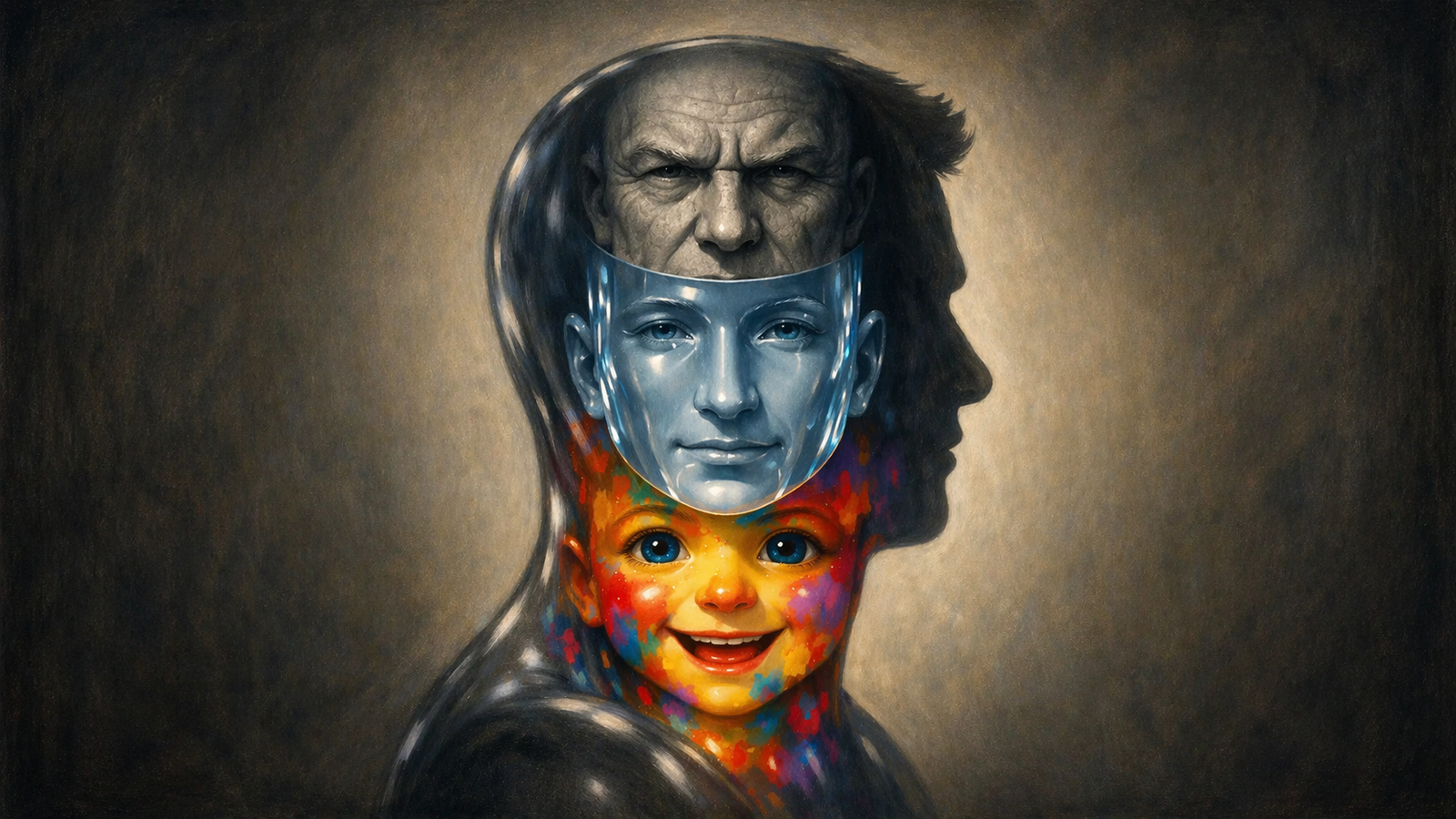
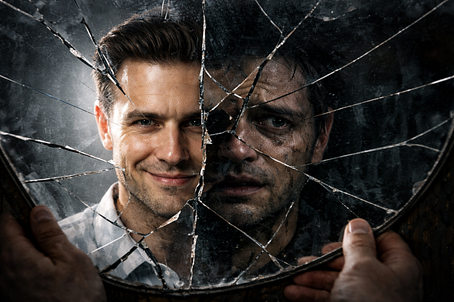
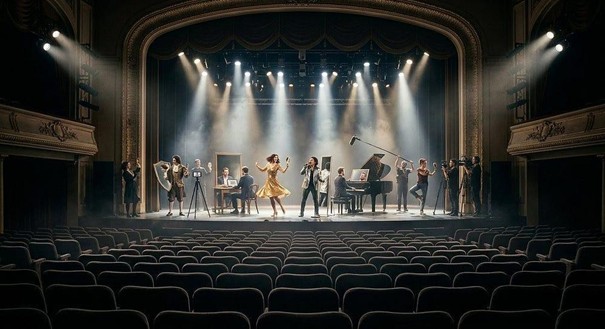
The hands that press the collar, the comb drawn through the hair — they hold a form against erosion. But there is something the ritual can't reach. Something that doesn't stay where the comb leaves it.
I—The Trigger
I walked into the concert. I'm forty-five. Stage lights hit my face and the bass guitar punched my stomach. My boots stuck to the floor. Spilled beer and dirt pulling at my soles with every step. Ten years ago this same song would have made my eyes close. Now they stay open. The sound lands as noise first, music second. Two friends beside me. One shouts, "Man, this is legendary!" The other films on his phone, the screen a small bright rectangle hovering over his head. I nod on reflex. Something inside me gives way — a hairline crack you only notice when you touch it.
The show ends at 1:17 a.m. The room releases us all at once. Heat and sweat and spilled beer. A damp jacket brushing my arm. Someone's elbow in my ribs. The exit sign flickering a little, as if it's tired too. "Let's grab something," a friend says. "Sure," I hear myself say. Refusing would have been a whole conversation. Outside, the night is still working. Traffic on the main road. Horns. Exhaust. A scooter threading between cars, engine whining like a mosquito. An ambulance tears past with its siren, so close it lifts the hair on my forearms.
We talk while we walk. The conversation keeps circling back to "the old days," like a tooth your tongue won't leave alone. Someone says, "Back then the night went on till morning after a show." We laugh. The laughter arrives on time and leaves early. There's a hollow space in it. No one turns toward it.
I reach home. Stairs. Key. The familiar resistance of the lock. The door closes. Complete silence. For three seconds my shoulders drop. On the fourth, a heavy ache blooms behind my temples. The aftershock of the kick drum still in my bones. I leave the lights off. Stand in the hallway long enough to hear the refrigerator click, then settle. Somewhere in the building a pipe ticks once, cooling. I pick up my phone without deciding to. Thumbprint. A blue-white wash on my face. YouTube. My fingers type the name of an old song like they've known the route for years. 2009. Same band. Same album.
The video loads. The first note lands. The room shifts around it. Basement apartment, summer of 2009. A fan in the corner pushing hot air in circles. Cigarette smoke caught in a shaft of streetlight from the blinds. Rakı in cloudy glasses. Someone laughing in the kitchen, a lighter flicking again and again because the first spark won't catch. A couch with a rip in the armrest, stuffing showing like bone. Back then nothing had to be enough. We hadn't learned that word yet, not in that way.
The song plays on. My eyes close. The headache stays, but it changes shape. It loosens. It starts to move, like a knot turning into a rope. The video ends. The screen goes black. I set the phone face down on the table. The silence of the apartment rushes back in, but it doesn't bite anymore. I stand there in the hallway a moment longer—the corridor dark in both directions, behind me and ahead—listening to nothing, and then I go to bed without pressing play again.
II—The Echo
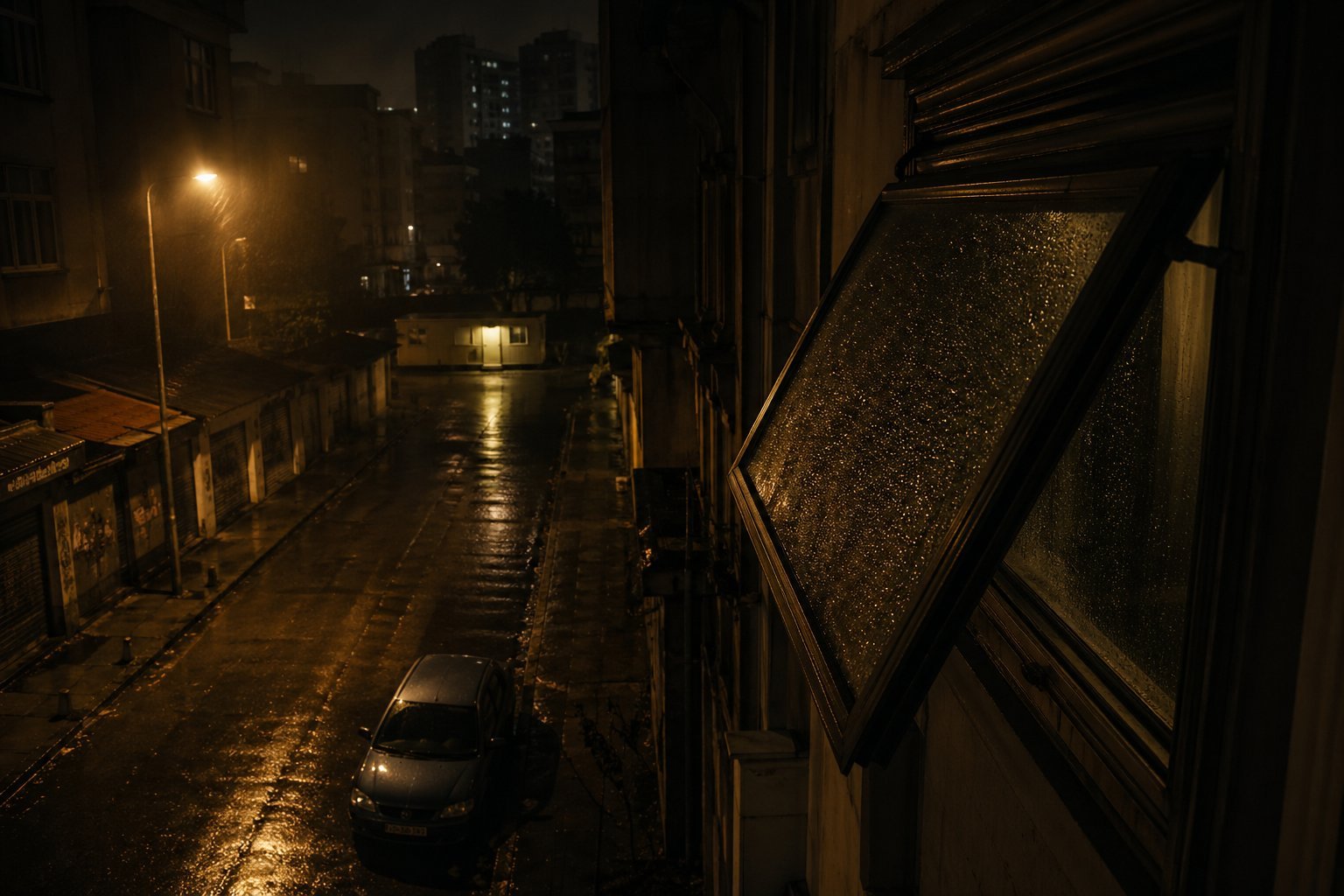
I sat in the barber's chair at 19:15. Outside, the Friday evening rush on Bağdat Caddesi was thick and loud. Headlights bleeding into the wet asphalt. A furious chorus of horns. But inside the shop, the heavy glass door sealed the chaos away. The noise became a murmur.
The barber was a quiet man in his sixties. Silver hair combed perfectly back, hands steady most of the time — though lately I'd noticed a faint tremor when he set the scissors down between cuts, something he seemed to know about and work around. Twenty years I'd been sitting in this chair — long enough that silence between us had become its own language, and when one of us spoke, it was never small talk. He draped the cape over my shoulders and pulled it tight around my neck. The fabric snapped like a small flag in the wind. I looked at the mirror. Forty-five. The harsh overhead light unforgiving on the lines around my eyes. The gray at my temples. I closed my eyes as the metal clippers touched the nape of my neck. A cold, steady vibration.
From a small radio on the counter, a song drifted into the room. 1997. Sezen Aksu. The volume was so low it felt more like a memory of a song than the song itself. The clippers stopped. I opened my eyes. The barber was looking at me in the mirror. He wasn't smiling, but the lines around his mouth had softened. "When I was younger, this song used to tear me apart," he said, his voice just barely above a whisper. He picked up the scissors. Snipped the air twice. "Now, I play it when the shop is empty. When I'm tired." I watched his reflection. "Doesn't it make you miss those years?" He shook his head slowly. The scissors went back to work, a sharp, rhythmic snip-snip near my ear. "I cut the same heads for thirty years. The face changes. The man in the mirror gets older. But when this song plays, I see the kid who first held these scissors. He's still here. Steadier now." He paused, dusting a few stray hairs from my collar with a soft brush.
The song faded into an advertisement. The spell broke, but the echo remained. The haircut finished. I paid, put on my coat, and stepped out into the rain. The city noise hit me instantly. The rush, the horns, the friction. But I didn't brace myself against it. As I walked down the crowded pavement, the melody stayed with me — a thin, strong line holding the weight of the night.
III—The Fuel
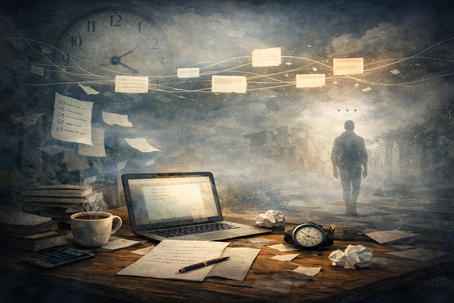
The last bell had rung hours ago. Summer afternoon. The classroom was an oven, but I had Leonard Cohen playing on the computer. Famous Blue Raincoat. The slow, acoustic guitar and that deep, heavy voice. I sat at the teacher's desk. Doing the two things that always made the noise stop: being in my classroom and writing. I wasn't alone. I was spending the afternoon with my two favorite people. Little Hakan and his grandfather. They were sitting right there, inside the glowing white document on my screen.
I typed.
My grandfather was hoeing the earth beneath the flowers in the garden again. It was a warm, quiet afternoon, I remember.
"A new girl joined our class yesterday, Grandpa."
"How nice."
"No, it's not nice. She's just a fatty. And a bit stupid, I think."
…
"What is that at the base of the flower, Grandpa?"
"The flower is a honeysuckle, and what's at its base is manure. Go on, smell it."
"It doesn't smell at all."
"If your nose is blocked, you won't smell the flower, nor the manure. The whole point is to understand."
"Understand what?"
"Everything."
"I don't understand anything."
"To understand, you must manage to hold the eyes you look with, the ears you hear with, the tongue you taste with—all your old learnings—at a distance from yourself."
"What does that even mean?"
"Look at everything with brand-new eyes. Eyes without memory, unstained by past recollections."
"Üf, Grandpa, what's a memory?"
"A memory is the accumulated knowledge of the past inside us, and sometimes it can seem more real than reality itself. If you look through your old learnings, you don't see the thing you're looking at; you only see what you used to know."
"How so?"
"Because eyes can only see things as they truly are if they look purified from everything they have seen before."
"What does it mean to be purified?"
"To be washed clean."
"Can't I see?"
"You see with what you have learned. What you have learned is your prison."
"Üf, Grandpa."
"Is something dirty inherently bad?"
"Of course it's bad."
"But is it always bad?"
"It is."
"Look at the flower. Honeysuckle… It grows out of the dirt, but it smells so entirely different from the dirt."
I stopped typing. The classroom was entirely still. Outside the window a bird called once, then stopped. A call that sounds like a question and doesn't wait for an answer. I held my breath.
When I let it out, I felt a sudden, quiet lightness spread through my chest. I saved the document. Closed the laptop. I stood up. Turned off the lights. The switch snapped softly.
The school corridor stretched ahead of me—long, polished, lit by the last daylight coming through the windows at the far end. Behind me, the dark classroom. Ahead, the glass doors and the street beyond. I walked.
My footsteps sounded different on the linoleum.
Lighter. Smaller. Younger.
The corridor was still there. But for a moment, I had stopped building.