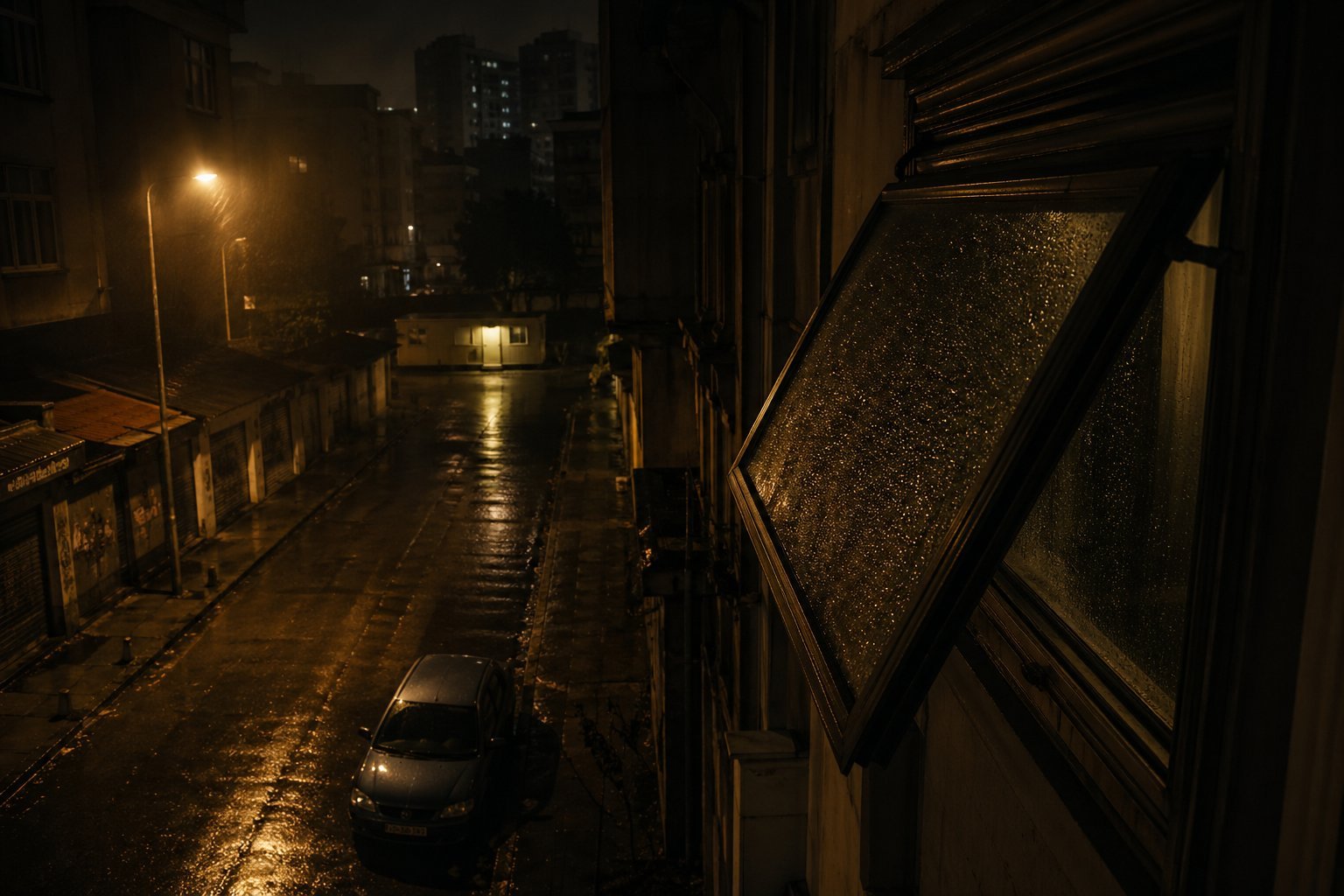














We are sitting at a table by the window. Outside, the rain has just stopped; the pavement is gleaming. Two coffees, both gone cold. My friend is talking. I am listening.
Her eyes fill with tears. She pauses. She grabs a napkin and crumples it under the table—trying not to show she is crying, but her voice has already broken.
"I did everything right," she says. "Everything. And it still wasn't enough."
I almost say something useless. Something about time. A sentence that closes a conversation instead of keeping it open. I can feel the words forming, and I know they're wrong before they arrive. So I stop. I don't know the right thing to say. I just know it wouldn't help.
A silence. Then something comes out—almost on its own:
"Maybe it wasn't your fault that it wasn't enough. Some things are out of your hands, no matter how right you get them."
Something in her face shifts. Her shoulders drop. She takes a breath. "I needed to hear that," she says.
I smile. Something in me feels certain—the way you feel certain about other people's lives from a distance.
The waiter arrives. We order two more coffees. The topic drifts. We even laugh at one point. Evening falls. We say our goodbyes. I walk home.
And on the way, the sentence comes back. Exactly, word for word: "Maybe some things are out of your hands, no matter how right you get them." But this time it's pointed at me.
The strange thing is: nothing happens. The same words, the same construction, the same logic. But when I say them to myself, they're hollow. That relaxation doesn't come. That breath doesn't arrive. And I find myself wondering—did I mean those words at all, or did I just find the shape of what my friend needed and fill it?
At the cafe, I summarized my friend's life in three sentences. I saw what hurt, I saw where she was stuck, I showed her the way out. Or at least I think I did—maybe I just simplified what I didn't understand, and the simplification looked like clarity.
Because in my own life, I can't simplify anything. I know every detail. Every "but," every "what if," every exception to every rule I try to set for myself. I can't leave anything out. And what I can't leave out, I can't see clearly.
My friend's life is a map—I look at it from above, I see the paths. My own life is a forest. I am inside it. The trees block everything.
Last Tuesday, I was writing. A character I've been working on for months—a woman who keeps rebuilding the same relationship with different people, each time convinced it will be different. I wrote her a moment of realization. She's sitting in her car after another fight, engine off, and she understands it the way you understand things you've been avoiding—that she is terrified of being still.
The sentence came easily. I wrote it in one pass. I sat back and thought: that's exactly right.
Then I closed my laptop. And I realized the woman in the car was me. The fear of being still was mine. I had written my own way out, handed it to a fictional person, and watched her walk through the door. I was still standing on the other side.
Bakhtin had a word for this—outsideness. You can see someone else because you are outside their story. You can never be outside your own.
Moris meets me at the door. He flops down right in front of me, blocking the way—then gets up, rubs against my legs, walks toward the kitchen, and looks back. "Time for food," he says with his big green eyes. I fill his bowl. I sit next to him.
Moris has never understood me. He doesn't know what I write. He doesn't ask how my day went. He doesn't say, "Is everything alright?" He just looks. That's all.
But there's something strange: even as I listened to my friend at the cafe today, there was a tension inside me. Was I going to say the right thing? Was it going to work? Was I going to be enough? Even empathy had turned into a performance.
Next to Moris, that tension is gone. And tonight, right in this moment, I realize I don't need someone to understand me. I just need a silence that doesn't ask questions.
I remember the relaxation on my friend's face at the cafe. "I needed to hear that," she said. I found the right words for her. Or maybe I just found words that were the right shape—and maybe that's all the right words ever are.
Moris rests his head on my knee. He starts to purr. He understands nothing. He solves nothing.
And exactly because of that—tonight, this is enough.