Emre came to Kaş because of Cem.
They had been friends for ten years. Cem had spent the first of those years in an office in İstanbul and the rest of them regretting it. One spring he quit, bought a pension in Kaş, and never fully explained the decision, least of all to himself. He kept a flat in the city and went back when the season ended. Emre came every summer for the sea and let Cem have the rest.
The pension had a door with blue paint peeling near the handle. Cem met him at it and handed him a key on a wooden block.
Room four, Cem said. The good cat comes to that window.
Emre climbed the stairs. He set his bag on the bed. He opened the window.
The sea was there. No cat.
He went down to the courtyard. Cem was already in a chair, talking to a German guest about a dive. Emre lit a cigarette. A cat sat on the wall. He watched the cat.
You came all this way to watch a cat, Cem said.
It is a serious cat, Emre said.
Cem laughed and went back to the German.
Breakfast was at eight. Tomatoes, cheese, bread, the things Cem put out himself because he trusted no one else with them. A woman sat down and said her name was Defne. She was from İstanbul. Cem said he was too, once. By the end of breakfast they had traded neighborhoods. By the end of the day they had traded numbers. This was how it went around Cem. The world arranged itself near him, and Emre sat at the edge of the arrangement and buttered his bread.
On the third morning a taxi stopped outside. A woman got out. She wore white shoes. The suitcase wheels caught on the cobblestones. She lifted it and carried it in.
Room seven.
Emre was in the courtyard. He smoked. She passed him. She climbed the stairs. She looked away.
At breakfast she sat two seats from him. Defne asked her name. She said Zeynep. Defne asked where she came from. She said İstanbul. In Kaş that was a password, not a fact. By noon she was one of them. Cem had folded her into the group without asking.
Emre said nothing to her. He passed her the cheese when she reached for it. Their hands did not touch.
They went to the beach in Cem’s car. Defne sang in the front to a song she half-knew. Cem corrected the words, wrongly. Emre and Zeynep sat in the back. He looked out his window. She looked out hers.
Emre, tell her you write, Cem said.
I don’t, really, Emre said.
He does. He just won’t say what, Cem said.
Zeynep did not turn from the window. Emre looked at the back of Cem’s head.
This was the shape of the days. Cem spread the blanket. Defne lay in the sun. Emre took a towel to the left, Zeynep to the right, two meters of sand between them that neither closed. She read. He swam. When he came back she was still reading, and he lay down and shut his eyes and listened to Cem and Defne laughing in the shallows.
On her third evening Cem brought out a guitar. He played badly and well. Defne sang. Two guests clapped. Zeynep sat with a glass of wine and tapped her foot. Emre sat on the steps below her.
He looked at her hand on the glass. The glass caught the light.
Emre, sing, Cem called.
I’d clear the terrace, Emre said.
So Defne sang instead. Emre kept looking at the glass. Zeynep let it catch the light. Neither of them said anything to the other at all.
At the harbor the next evening a man sold corn from a cart. Cem bought four and handed them down the wall. When Emre passed Zeynep hers, his fingers came close to hers. Neither crossed the gap. They ate. They looked at the water. Cem talked about a boat he would buy and never buy.
On the fifth day the rain came, not as a storm but as a decision. They gathered under the terrace. Cem dealt cards. Defne made tea. Zeynep held a cup and blew on it. Emre stood in the doorway and watched her hands, and when she looked up he looked at the rain.
That was Zeynep’s last full day. She was leaving in the morning. She had said so to Defne, something about work, something she did not explain.
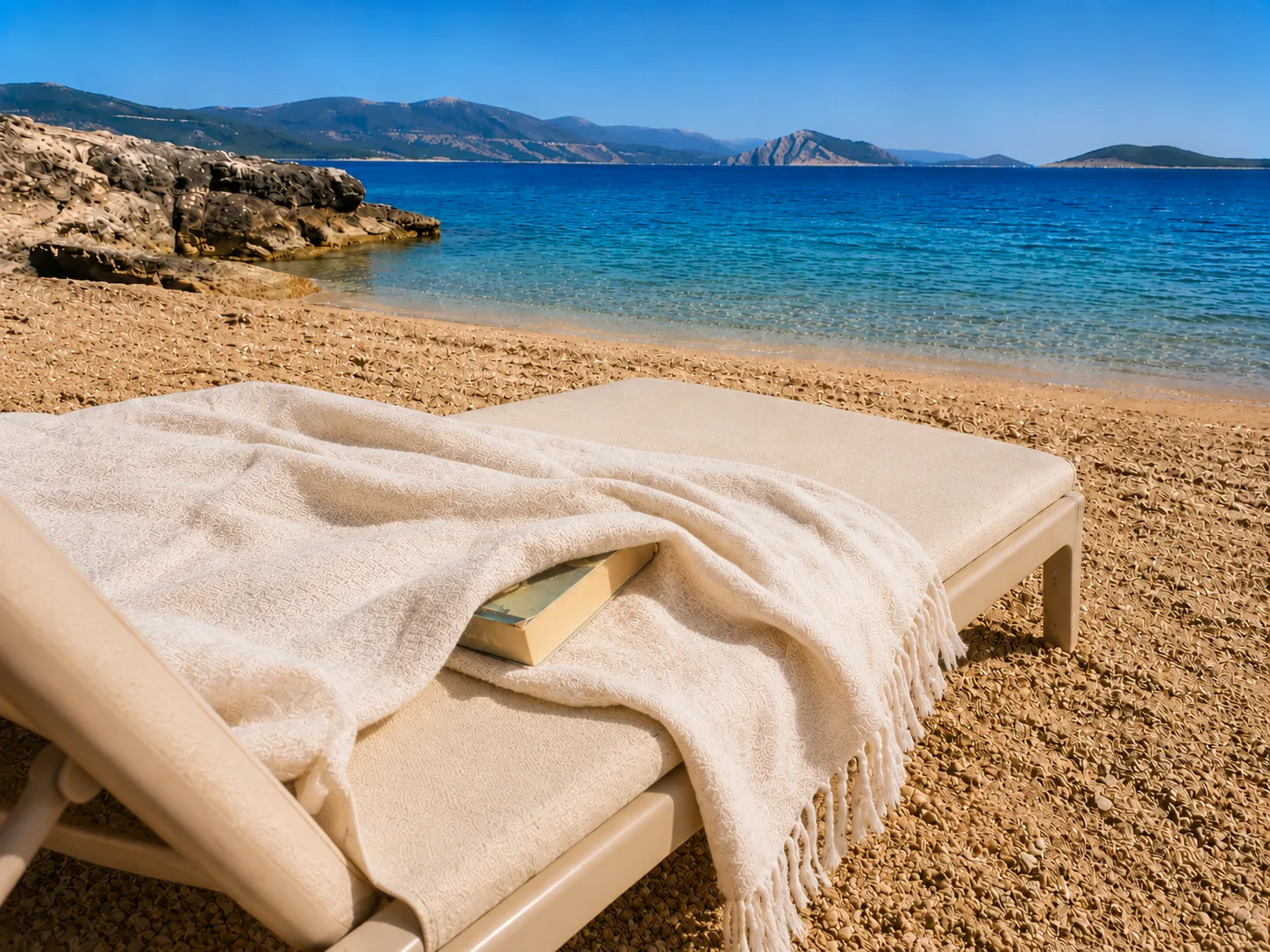
In the afternoon the rain cleared and they went back to the beach a final time. Zeynep brought her book to the sunbed. She read a little. She swam with Defne. When she came back her hair dripped, and she picked up the book with a wet hand and held it a moment, and then she set it down again, half under the cushion, out of the sun.
The next morning a taxi took her to the square. Emre was at breakfast. He heard the wheels on the cobblestones. He did not get up.
That afternoon they went to the same beach. Emre took the lounger Zeynep had taken. He felt something under the cushion and pulled it out.
The book.
He read the cover. He opened it. Inside, in pencil, a name in her own hand.
Zeynep.
Between two pages near the middle there was a photograph. A Polaroid, soft at the corners. A family on a balcony, squinting at whoever held the camera. A woman who might have been her mother. He did not know the faces. He looked at them and learned nothing. He slid the photograph back where it had been.
There was a faint stain dried into the cover. A pale half-circle. Seawater, he thought. He thought nothing else.
He kept the book.
That evening he asked Cem for Zeynep’s number. He said he wanted to return her book. Cem looked at him a moment too long, then asked Defne, and Defne sent it.
The holiday ended. Emre packed his bag. He took the bus. He returned to İstanbul.
He lived in Erenköy. He worked from home. Each morning he walked to a café on his street, ordered tea, and answered email.
A week after he got back, he called. She picked up on a weekday afternoon. There was noise behind her, voices, a door closing. He said he had her book. She said oh, that book, as if she had set it on a shelf and forgotten which one. She thanked him. She said she could not talk. She said she would write.
She wrote that evening. A café in Erenköy. A time. Three days from then.
She arrived twenty minutes late, in the same white shoes. He had the book on the table. He pushed it across. She opened the cover and saw her own name, and the photograph still inside, and something moved across her face and then closed.
He ordered tea. She ordered coffee and stirred it long after it was mixed. She asked what he did. He said he wrote. She asked what. He said nothing important. She checked her phone, turned it face down, and asked about Kaş. He said it was hot. She agreed.
She finished her coffee. She stood. She said she had to go.
He asked if they could meet again.
She put the book in her bag.
She said no.
She walked out. He sat at the table. The waiter cleared her cup.
Emre opened his laptop. He created a new document. He named it after her.
He wrote the first sentence.
The woman arrived at a pension. She wore white shoes. She looked away.
He wrote every evening, in the café, with his tea. In the story the character read on the beach and left her book, and he returned it, and she loved him for it. He gave her a name in pencil, in her own hand, because he had seen it and it was true. He did not give her the photograph. He had held it and it had told him nothing, so he left it out, the way you leave out a word in a language you do not speak.
The character fell in love with the narrator. The narrator doubted it. The character stayed. She laughed at his jokes. She reached for his hand. He wrote these scenes. He read them. He deleted them. He wrote them again.
One evening he could not write. He closed the laptop and walked down the street. A man was washing the pavement in front of a bakery. Water ran along the curb.
At the corner a woman stepped out of a pharmacy. She wore white shoes.
Emre stopped.
His heart moved hard once, then again. The woman turned her head. Her hair was shorter. Her face belonged to someone else. She crossed the street with a plastic bag in one hand. Emre watched the shoes until they disappeared behind a parked car.
A driver honked. Emre stepped back onto the pavement. He felt foolish. Then he felt something worse. He had been standing there waiting for the world to agree with him.
He went home. He opened the document. He wrote a scene in which the woman came back from the pharmacy and found the narrator waiting at the corner.
He read it.
He deleted the pharmacy.
He kept the white shoes.
He wrote through the winter. The document grew. He printed it. He bound it. He left it on his shelf.
He told no one.
One evening Cem came to Erenköy and brought Defne. The season had ended and Cem was in the city again. Emre made tea. They sat.
Defne walked the room, touching things. She stopped at the shelf. She took down the bound pages.
What is this, she said.
Nothing important, Emre said.
She opened it. She read standing up. Emre watched her find the white shoes on the first page. He watched her keep reading.
She needs to see this, Defne said.
No, Emre said.
Defne turned a page. She did not put it down.
It is not for her, Emre said.
It is only for her, Defne said.
Emre held out his hand for the pages. Defne did not give them back. She looked at Cem.
Cem had said nothing. He looked at Emre a second longer than the moment needed. He had looked at him like that when Emre asked for the number.
Give it to her, Cem said.
Emre lowered his hand.
One afternoon Defne called Zeynep. She said she had something to give her. They met at a park. Defne handed her a paper bag.
She said: Emre wrote this.
Zeynep held the bag by the top.
Defne said: I thought you should see it.
Zeynep said: Did he ask you to give it to me.
Defne shook her head.
Zeynep looked into the bag. She saw the stack of paper inside.
Defne said nothing else.
Zeynep took the pages home. She did not read them on the ferry. She kept one hand on the bag. The paper bent against her knee.
At home she placed the pages on the low table. She washed and dried her hands. Then she sat on the couch. The room was quiet. Her shoes were by the door.
She turned the first page.
The woman arrived at a pension. She wore white shoes. She looked away.
Zeynep stopped. She looked at the shoes by the door. She looked back at the page.
She turned another page.
There was the courtyard. There was the cat on the wall. There was the breakfast table, the beach, the book. Her hand moved from page to page. Sometimes she read quickly. Sometimes she stopped with one finger under a line.
At first she smiled.
Then she found a sentence in which the woman loved him for returning the book.
The smile left her face.
She read the sentence again. She put the page down. She went to the kitchen and filled a glass with water. She came back without drinking it.
The woman on the page stayed when Zeynep had left. The woman laughed when Zeynep had been silent. The woman reached for his hand.
Zeynep looked at her own hand. It was flat on the paper. The edge of one page pressed a line into her palm.
She read until the room darkened. She kept the lamp off. The pages became grey. She moved closer to the window and read the last pages in the last light.
At midnight she closed the stack.
She sat with both hands on top of it.
After a while she opened the first page again.
The woman arrived at a pension. She wore white shoes.
Zeynep placed one finger on the sentence. She kept it there until the paper warmed under her skin.
Cem called the next day. It was his birthday. He had rented a bar in Karaköy. He invited everyone from Kaş.
Emre went. He stood near the door. He held a beer.
Zeynep arrived with Defne. She wore black. She saw Emre. She looked away. Then she walked toward him.
She stood close. She held a drink. Her fingers were tight around the glass.
She said: You wrote me.
Emre said nothing. He looked at the door.
She said: I read it.
He looked at her. She looked at the floor.
She said: I was angry. Then I was curious. Then I was angry again. Then I stopped.
He looked at her hand. A little wine had touched her thumb. She rubbed it against the side of the glass.
She said: You made me better than I was.
Emre said: I know.
She looked up then. She did not look away.
She said: That was not kind.
He looked at her eyes.
In his story he had written her eyes differently. He had written them soft and almost grateful. He had written them as if she had crossed the city because she had finally understood.
The woman in front of him did not have that look.
She was afraid. She was trying to be brave. Being there had cost her something.
But the look was not there.
Emre saw it clearly.
He had put it there himself.
Zeynep said: I want to try.
Emre put his beer on the counter. He looked at her white shoes. They were new. He looked at his hands.
He said: In the story, when you came back, you looked at me as if I had been right to wait.
Zeynep said: What?
He said: You do not look at me like that.
She swallowed.
She said: Maybe I do not know how.
He shook his head.
He said: No. I put that look there.
Zeynep gripped the glass harder.
She said: I am here.
Emre said: I know.
Her grip eased. Her hand was steady.
She said: Then let me be here.
He looked past her. Cem was watching them from the other side of the room. Defne turned away when he looked.
Emre said: The writer made you stay. The man waited for someone else.
Zeynep set her drink down.
She said: I am not the character.
Emre said: I know. That is the problem.
She said: Rewrite it.
Emre said: I tried.
She said: Then don’t. Be here instead.
He looked at her face. He tried to imagine the sentence.
Zeynep stood in front of him. Zeynep asked him to be there. She was real. Any sentence he wrote for her now would take something from her again.
He said: I cannot write you into this.
She said: I know. I am asking you not to.
He closed his eyes for a second.
When he opened them, she was still there.
He said: I do not know how.
He took his phone from his pocket. He looked at it, then at her, and put it back without a word.
Zeynep stepped back. Her hand left the glass. A wet half-circle remained on the counter.
Emre walked to the door. He looked back. She stood at the counter. Cem approached her. Defne reached for her arm. Zeynep did not move.
Emre went outside.
He walked to the ferry. He sat on the deck. The water moved black under the lights.
He took out his phone. He opened the document. He scrolled to the scene where she stayed.
She looked at him as if he had been right to wait.
He read the sentence twice.
He selected it. He deleted it.
The paragraph broke.
He scrolled to the end. He read the last line.
The woman closed the door.
He deleted the file.
The ferry reached the pier. He put the phone in his pocket. He stood with the others. When the gate opened, he walked off with them.
—Z.
The Man in the Room
The sea that morning had swallowed the horizon so completely that sky and water seemed to share a single breath, expanding and contracting in a rhythm older than the cobblestones under my suitcase wheels, and as I lifted the bag over the threshold of the pension I saw the smoke rising from the courtyard, a thin grey thread strung between the oleander and the cat on the wall, like the first sentence of a story written before I arrived.
A man took the suitcase from my hand at the door. He owned the place—Cem, who ran the pension and seemed to run the people in it too, who folded strangers into his afternoons before they had decided to stay. He had left some colder life in İstanbul to stand in a courtyard in Kaş and hand out belonging like bread. By noon I had a room, a chair, and a table where everyone already knew everyone. That was his gift, and it asked nothing of me, which was why I let it work.
From the landing window I saw the other one. Not Cem’s kind. He sat with his back to the wall, a cigarette burning down between his fingers, his eyes on the cat as if the cat were the only creature alive that could keep a secret.
I looked away before he could look up. Some people are better watched in silence. Speech scatters them like birds.
But I knew his name already. Defne had said it. Emre. I said it once, to myself, to see if it fit in my mouth. It did.
Emre buttered his bread. He did not look at me. I did not look at him.
But I could have drawn his hands from memory.
He talked, though. Not to me. He gave Cem dry little answers across the courtyard, and Cem laughed at them, and I understood then that the silence aimed at me was not shyness. He had words. He was keeping them from one person in particular, and I was the person, and there is a kind of attention in that which is louder than any sentence.
We went to the beach in Cem’s car, Defne singing in front, Emre and I in the back with a seatbelt and everything unsaid between us. The glass held both of us, and one afternoon our eyes met in the reflection.
One evening Cem played guitar. I watched Emre’s hand on his knee, half-curled around something he could not set down. The glass in my hand caught the light and threw it at him.
I did not move it. I let it catch.
On my last full day it rained—enough to tell me the summer was over. Emre stood in the doorway, his knuckles white on the frame. I blew on my tea. I drank. He looked away.
I was leaving the next morning. The summer had a shape and I could feel it closing, and I am not someone who waits to be asked.
So on the last afternoon I carried my book to the sunbed and did not read it. I swam. I came back with the sea still on me, and I picked the book up with a wet hand and held it, and then I set it down again, half under the cushion, out of the sun, and I left it there.
I will not pretend, now, that I do not know what I was doing. But I did it lightly. I had already decided not to think about it.
I went back to İstanbul, to my apartment, to my furniture, to an autumn that was waiting for me with its arms full.
Two weeks passed before he called, and by then the summer had run out of me like water from a cracked glass. The city had its own weather. I was carrying something that season—a bad stretch I kept to myself—and when the phone rang on a grey afternoon and a voice said it had my book, I had to reach for the name. For a moment I could not place which face it belonged to. Then I could. I said I would write. I am not sure I meant to.
I wrote that evening anyway. Some doors you open before you have decided to.
I came twenty minutes late, in the same white shoes. He pushed the book across. My name was there in my own hand, and the photograph was still inside.
He had kept the photograph. He had held it—the corner was bent the other way now—and he had put it back and kept the book safe and dry for me, and I hated, a little, that he had been careful.
I asked what he wrote. He said nothing important.
I knew he was lying. I wanted him to lie better.
I finished my coffee. I stood. He asked if we could meet again. I put the book in my bag. I said no—small and sharp, a key turning. It was not about him. There was no room in me that autumn for a man who had found my book on a beach. I had a life he had no part in, and that season it was asking everything of me.
I walked out. I did not look back. But my white shoes, the whole way down the street, carried the weight of his eyes, and I hated them for it.
Then came the pages. Defne handed me a paper bag in a park. Emre wrote this, she said.
He had written that I forgot the book. I did not forget it. I left it for him, on the last day, with the sea still on my hand—the way you leave a door open a finger’s width. He came through. And he wrote it as an accident I was grateful for. He got the door wrong. He got everything wrong that he could not see. And the worst of it, the part I could not forgive that night, was that by the time he found it I had already half forgotten I had left it. I had opened the door and walked away. He did come, that autumn, when everything in me was closed. Then he went home and wrote a door he could hold open alone.
Between the pages he had found the photograph and left it. My mother and the others on a balcony, squinting into a summer I do not explain to people. I keep it in whatever I am reading, so it travels with me and is never on a shelf for anyone to ask about. He had held it and learned nothing, and he had kept it out of his book. That was the single thing he understood: that it was mine, and that he could not use what he could not read.
I read until the room went dark and did not turn on the lamp, and for a moment the woman on the page and the woman in the room breathed once together.
I did not cry. I have always been good at that.
Cem’s birthday, a bar in Karaköy. I wore black. I saw Emre near the door, looked away, then walked toward him. My fingers were tight around the glass.
I said: I was angry. Then I was curious. Then I was angry again. Then I stopped.
Stopping felt like setting down a stone I had carried from the harbor.
I said: You made me better than I was. He said: I know. I said: That was not kind.
In his story my eyes had been soft, almost grateful. The woman in front of him did not have that look. She was afraid. She was trying to be brave.
He looked at my white shoes. They were new. I had bought them for that night.
He looked past me. And in the looking-past I saw it: he was not seeing me. He was seeing the one who stayed.
I asked him to try. He said he could not—that to write me would be to take something from me. He said it gently.
The woman on the page had asked nothing of him. I was asking. He chose the one who asked nothing, and called it mercy.
I stepped back. My hand left the glass. A wet half-circle stayed on the counter.
I did not go home. I walked to the ferry. The water moved black under the lights—the same water that had carried him across an hour before.
I took out my phone. I opened a blank document. I named it after him.
The man sat in the courtyard. He smoked. He never looked up.
But he had. He had looked at nothing else—at my hands, at the glass, in rooms he had already left. I had looked up too. I had seen him see me.
I wrote it the other way.
Emre read the sentence twice. He selected it. He deleted it. Then he deleted the file. Deleting was the one thing he could do alone.
I could keep it. I had been the woman on the page. I knew exactly what it would take.
I took it anyway.
I read the sentence twice. I did not delete it.
The ferry reached the pier. I put the phone in my pocket. I stood with the others. When the gate opened, I walked off with them.
—Z.