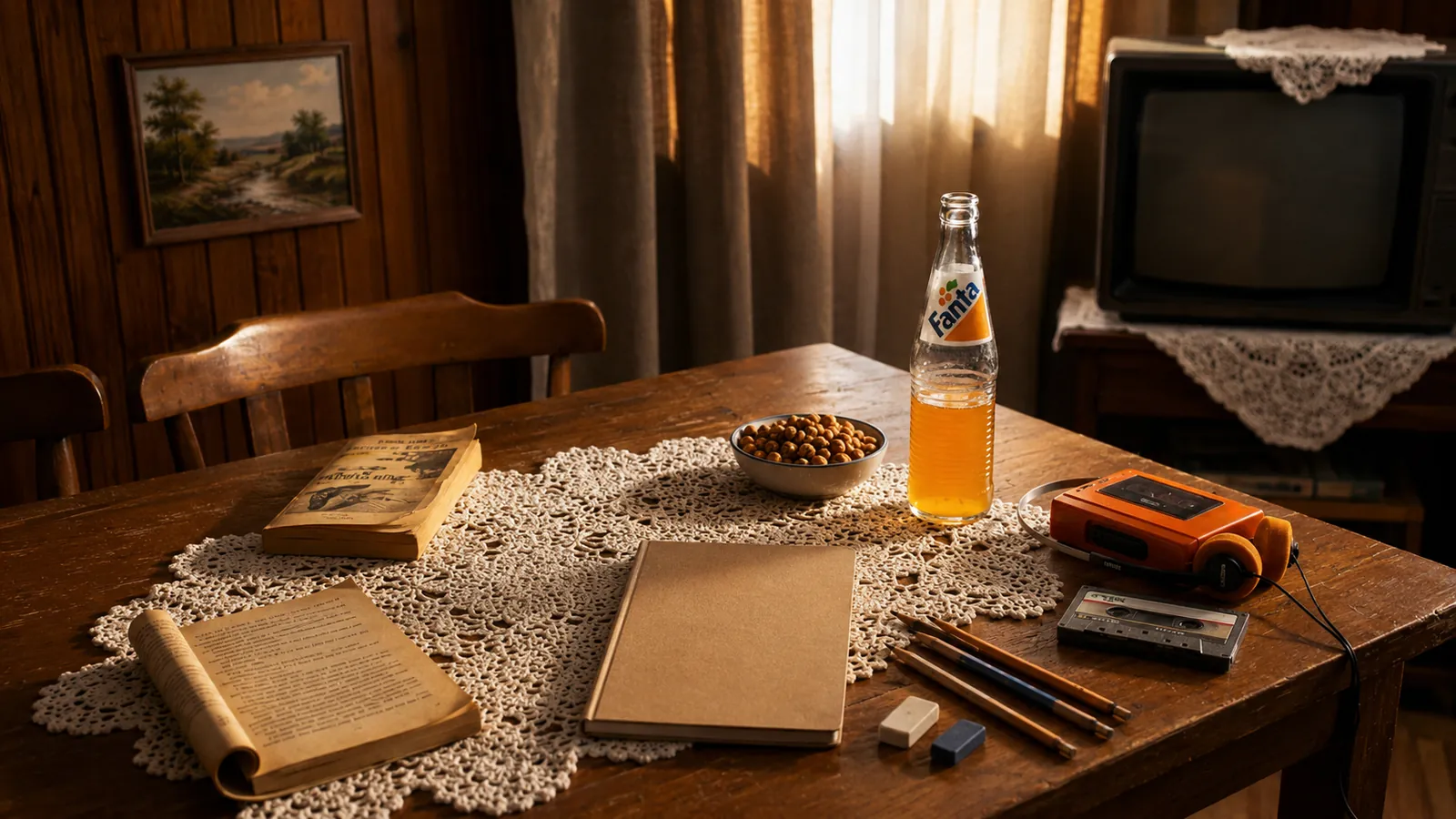
The kitchen. Under the hazy yellow light of the hood, I noticed the watch on his wrist.
“You’re the only one I know who still wears an analog watch.”
Şafak looked down at it, smiled. The kettle clicked off behind him. He turned the watch a quarter-turn around his wrist, an unconscious habit.
At the other end of the table, Moris lifted his head. He looked at the watch. He looked at Şafak. Then he looked at me—that long, patient look from somewhere very far inside himself, the one that says I have seen everything in this room a thousand times. He set his chin back down on his paws.
“There’s actually a story behind this one.”
He poured. He sat down. He started.
“The last day of school smelled like warm asphalt and cheap erasers. June had already started doing its work on the city—heat so thick it made the tar on the roads go soft under your sandals and turned every apartment balcony into a stage for drying laundry and slicing watermelon. It was the early nineties, and summer began with my report card.
It was perfect. Pekiyi across the board. All A’s, every single line. I held the thin card in both hands like a winning lottery ticket, careful not to crease it, and walked out of the school gates into the blinding afternoon sun. My dad was waiting by the car—a boxy sedan with vinyl seats that would brand your thighs if you sat down too fast. He glanced at the card, nodded with that quiet, satisfied look fathers had back then, and said the words I’d been waiting to hear all week:
“Haydi, kasetçiye gidelim.”
A small, dimly lit place squeezed between a bakkal and a tailor, its walls lined floor to ceiling with VHS cases—their plastic spines faded from sunlight, their cover art promising worlds I could barely imagine. Action heroes with impossible muscles. Spaceships hovering over alien landscapes. The cases on the shelves were empty. Display copies only, their hollow plastic lighter than they should have been. The actual tapes lived behind the counter, and if someone else had rented the one you wanted, all you could do was stare at the cover and wait. Sometimes for days. Sometimes for weeks.
And there, right at eye level, as if the universe had placed it there just for me: Superman IV.
The film had come out years before—but in those days, everything reached us a few summers late.
The cover alone was enough to stop my heart. Christopher Reeve, cape billowing, fist raised toward the sky. I grabbed the case off the shelf and brought it to the counter with the urgency of a man delivering an organ transplant. The shop owner checked behind him. The tape was there. It was available. It was mine.
My dad exchanged a few words with the owner—adults always had to talk, even when the most important movie in the world was being held hostage on the counter—and finally, mercifully, we walked out with it.
Excitement that makes your legs move on their own, that turns every sidewalk curb into a launchpad. I hopped off steps and swung my arms. I looked up at the sky and calculated the exact trajectory I would take if I could fly. All I was missing was the cape. The red one. I made a mental note to negotiate with my mom about a towel later that evening.
Report card: perfect. Superman: in the bag. I was, by every measure available to a seven-year-old, on top of the world.”
Şafak took a sip of tea. He was smiling at something only he could see—his own seven-year-old, probably. Then the smile went out, and he went on.
“But we didn’t go straight home.
My dad pulled the car over on a side street I didn’t recognize, outside an apartment building with a rusty garden gate and a vine-covered balcony. ‘I just need to stop by a friend’s for five minutes,’ he said—a sentence that, in the language of fathers, could mean anything from five actual minutes to the rest of the afternoon.
We went upstairs. The friend was a large man with a mustache—they all had mustaches—sitting in a living room that smelled like cigarette smoke and strong tea. There were small glass cups on a brass tray. The TV was on, showing something boring. The two men fell into conversation instantly, as if they hadn’t seen each other in years and had never stopped talking.
I sat on the edge of a chair that was too big for me, the VHS tape on my lap, the report card folded neatly in my back pocket, and waited.
Then the man turned to me.
He leaned in with that big, friendly face, reached over, and gave my cheek one of those pinches—adults in the eighties considered them affectionate, children considered them an act of war. He squeezed and smiled, then asked:
‘Yakışıklı, senin nasıl gidiyor bakalım? Kaç manitan var?’
I was seven. I knew about Superman. I knew that if you mixed Fanta with milk it tasted weird but you’d still drink it because someone dared you. What I did not know was what a ‘manita’ was.
The word rolled around in my head for a moment. Manita. Manita. It sounded vaguely academic. Official, even. Like something that belonged on a report card.”
Outside, a ship sounded on the Marmara. A seagull flickered. He was still inside the pause. I waited with him.
“And the man had asked ‘how many.’ So I did what any seven-year-old with a perfect report card would do.
I straightened up in my chair. I answered:
‘Hiç yok amca. Hepsi pekiyi.’
For three seconds, the room went silent. On the fourth, it exploded.
My dad threw his head back and laughed—really laughed, mouth open, shoulders shaking, the whole thing. I’d never heard him laugh like that. He was a quiet man, my dad. He smiled plenty, but this was something else entirely. The friend grabbed his knee and the tea nearly went with it. They fed off each other, the way two men do when something catches them completely off guard, and the laughter just kept going.
I smiled along. Clearly I had said something brilliant… I was a cute kid. People laughed. I didn’t mind. I had things to do—and right now, the thing to do was get home and press play.”
Moris had moved at some point. He was now along the edge of the table, paws tucked under, eyes half-closed. Şafak smiled, quietly, and went on.
“That evening, after the cape had returned to being a towel and the Fanta had gone flat in its bottle, my father called me to the kitchen. He had a small box in his hand.
‘Karne hediyen,’ he said.
A silver watch. Analog. Too big for my wrist.
‘Evladiyelik,’ he said, and helped me with the clasp.
I wore it the rest of the summer.”
Şafak put his cup down. The refrigerator hummed. The balcony door was open and the warm air came in carrying the sound of someone watering plants downstairs. I poured him more tea. He reached for the cup with his right hand. The silver watch slid forward on his wrist the way it must have been doing for thirty years.