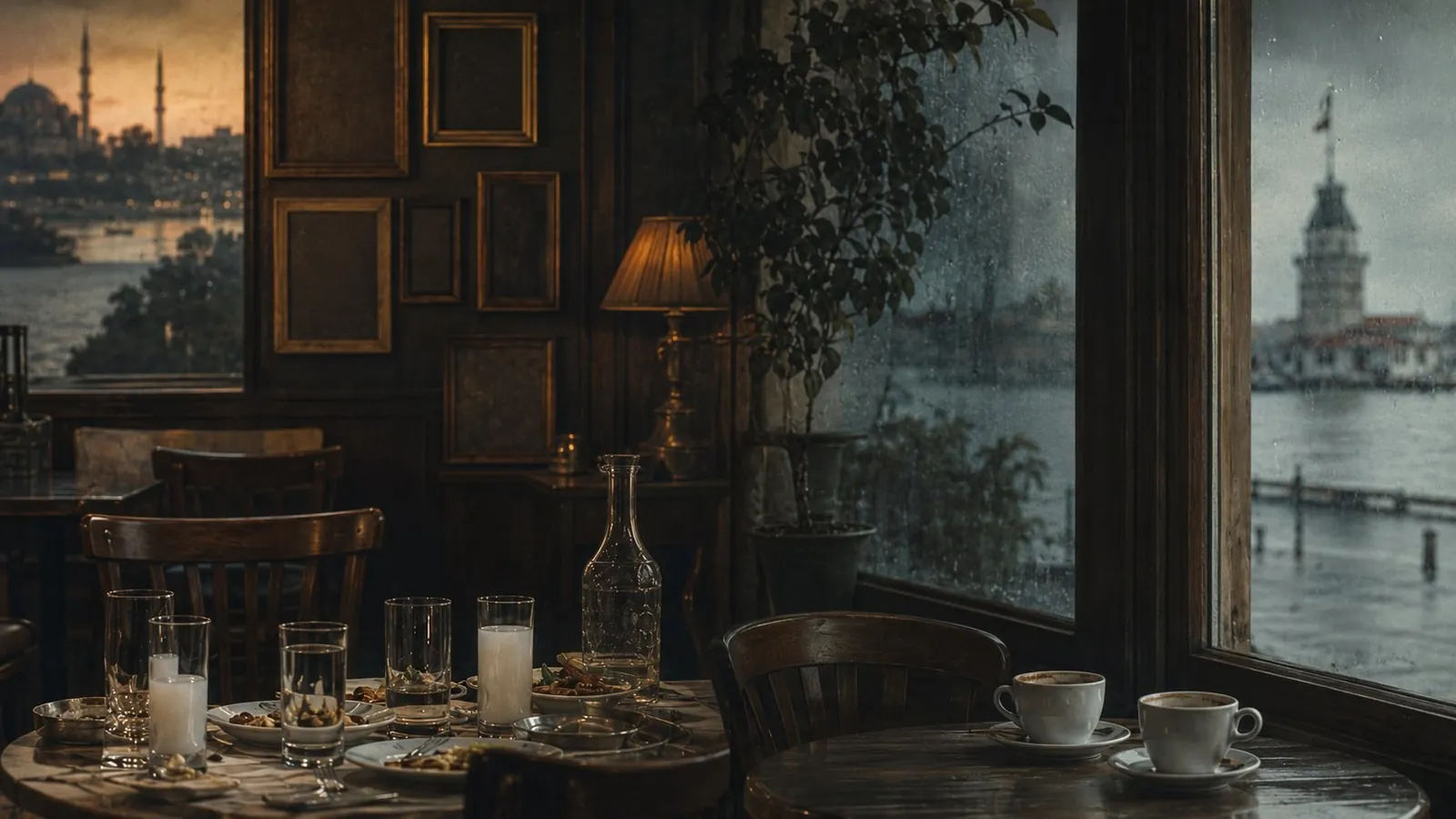
He belonged to İstanbul—or to an İstanbul that is mostly gone now.
White hair, neatly combed back. Thin glasses. A jacket that had not been chosen to impress anyone, which made it more impressive.
He drank cognac before dinner. Later, with the others, he drank rakı.
By the second glass, the table had begun to turn toward him. It would always happen gradually, almost politely. Someone leaned back to hear him better. Someone else stopped telling a story halfway through because his had begun. A chair moved. Then another. By the time the plates were being cleared, the table had accepted the arrangement it had wanted from the beginning: he would speak, and the rest of us would listen.
He simply spoke, and the memories came back as if they had never left.
His wife came into the stories often. Sometimes she was only a sentence from the kitchen, a hand placed on the back of a chair, a disagreement about the right way to cook fish, a glance across a room full of people. But when he named her, something in his face changed.
He still smiled as he spoke of her, and for a moment you could see the life they must have had. Then the smile would pass, and his face would return to the place where grief had left it.
When he remembered her, he grew heavier, and the room grew quiet with him. The quiet seemed to embarrass him; he would smile again and reach for his glass, as if he had not meant to bring all this to the table.
But he had brought it. Or perhaps it had followed him.
A few weeks later, I heard that he had died while walking with a friend. Suddenly, they said. One moment he was there, the next he was on the ground, and he had already gone.
I like to think he went to his wife.
I met a friend in a café. We hadn’t seen each other in a while. Once we would sit until the dark turned blue and we knew we were out of time.
We were sitting by the window. Two coffees between us. She had been talking for almost an hour, and I knew not to interrupt her too early. She spoke as if she needed the thing inside her to become clear in the air before anyone touched it.
“I know how it sounds,” she said.
She always said this before saying something honest.
Outside, people moved past the glass with the confidence worn by strangers. Inside, we talked.
“I know it sounds ungrateful. I know it sounds cold. But sometimes I think I would be better off alone.”
She looked at me quickly, to check if I had misunderstood her already.
“I don’t mean happier,” she said. “That’s the problem. I don’t even know what happier means anymore. I mean more myself. More able to move.”
She looked toward the street.
“When I read, I feel fed. When I walk, I come back to myself. When I work, I want to work in my own time. If today I can sit for twenty hours with one thing and not be interrupted, that is a good day for me. Tomorrow I might want to do nothing but walk. I don’t know this in advance. I don’t want to explain it in advance. I want to follow the shape of the day as it comes.”
She smiled a little.
“That sounds beautiful when you say it like that, doesn’t it? In real life it is just inconvenient.”
The waiter passed by and glanced at our cups.
“He says I disappear,” she continued. “And maybe I do. But I need to. And I disappear into the place where I can still hear myself. He says it is almost impossible to drag me out of where I’ve gone.”
I said nothing.
“He’ll come in when I am in the middle of something and say, ‘You haven’t looked at me all day.’ And he’s right. I have been inside a page, or inside a thought, or inside some narrow tunnel that only fits one person. Then suddenly I have to come out and become good again.”
“Good?”
“Present. Warm. Available.”
She laughed without much humor.
“I don’t know how people do that. I don’t know how they leave a thought halfway and return to it later as if nothing happened. When I leave, it closes. Or I close.”
Then she told me about one morning.
She woke up at five. Because the house still belonged to no one then. The rooms were quiet. The phone had not begun. No one wanted anything from her yet.
“I made coffee,” she said. “Very quietly. Like a thief in my own life. I used the phone’s flashlight to see my way.”
She looked down at her hands.
“And then the door opened.”
“He stood there half asleep and said, ‘I wanted to be with you.’”
“What can you say to that?” she asked. “It is a beautiful sentence. It should make me happy. Someone wakes up because they want to be with me. There are people who would give anything for that.”
She pressed her thumb against the edge of the saucer.
“But I had woken up at five so I could be alone.”
She stopped turning the cup.
The café had grown louder around us. Cups, chairs, a child near the door, the machine behind the counter releasing steam with a violence that seemed too large for coffee.
Then she looked at me properly.
I nodded, because there was nothing else to do.
“There is a price I pay when I stay. I pay it when I leave. I pay it when I say yes and become resentful. I pay it when I say no and become cruel. Everyone talks as if the choice is between love and freedom. It isn’t. It’s between two kinds of cost.”
Her coffee had gone completely cold. She lifted it anyway and took a sip, more out of habit than desire.
“I envy people who can be interrupted and still remain themselves,” she said. “I envy people who are made larger by being needed. I am not always made larger. Sometimes I am made smaller. Sometimes I become one narrow, angry thing protecting a morning.”
Outside, the light had changed. The people passing the window had become darker.
After a while, she said, “And still, when he is gone too long, I miss him.”
She said this almost irritably, as if love had once again failed to choose a side.
It was dark now. We said goodbye at the door, and I wanted the walk home. My phone buzzed. I didn’t answer. I would, once I had become good again.