I have never been good with weddings.
Still, I went.
I went because Esra, the bride, was a dear friend. We had not seen each other in years, and there are friendships that survive badly in daily life but remain intact in memory, waiting without resentment until one person gets married, loses someone, leaves the country, returns, or sends a message that begins with a name you have not seen on your screen for too long.
I saw her first near the entrance, surrounded by white fabric, perfume, camera light, relatives, and the stunned glow of a person being looked at by everyone at once. She was beautiful. She looked like someone the years had carried carefully. I was happy for her.
The groom stood beside her. He was truly handsome, and held himself like a man who had never let himself slip. I liked him.
She saw me. Her face opened before she moved, and then she was coming toward me with both arms out, pulling me into the white orbit of her dress. “Hakan,” she said. We held on a little too long. “I’m so happy you came,” she said. “Welcome. We saved you a seat.” She pointed toward a table near the side of the garden. “That one,” she said. “I am sure you are going to like everyone. Just one thing: promise me you will tell me all about the table later. You can’t know how much I would like to sit with all of you tonight.”
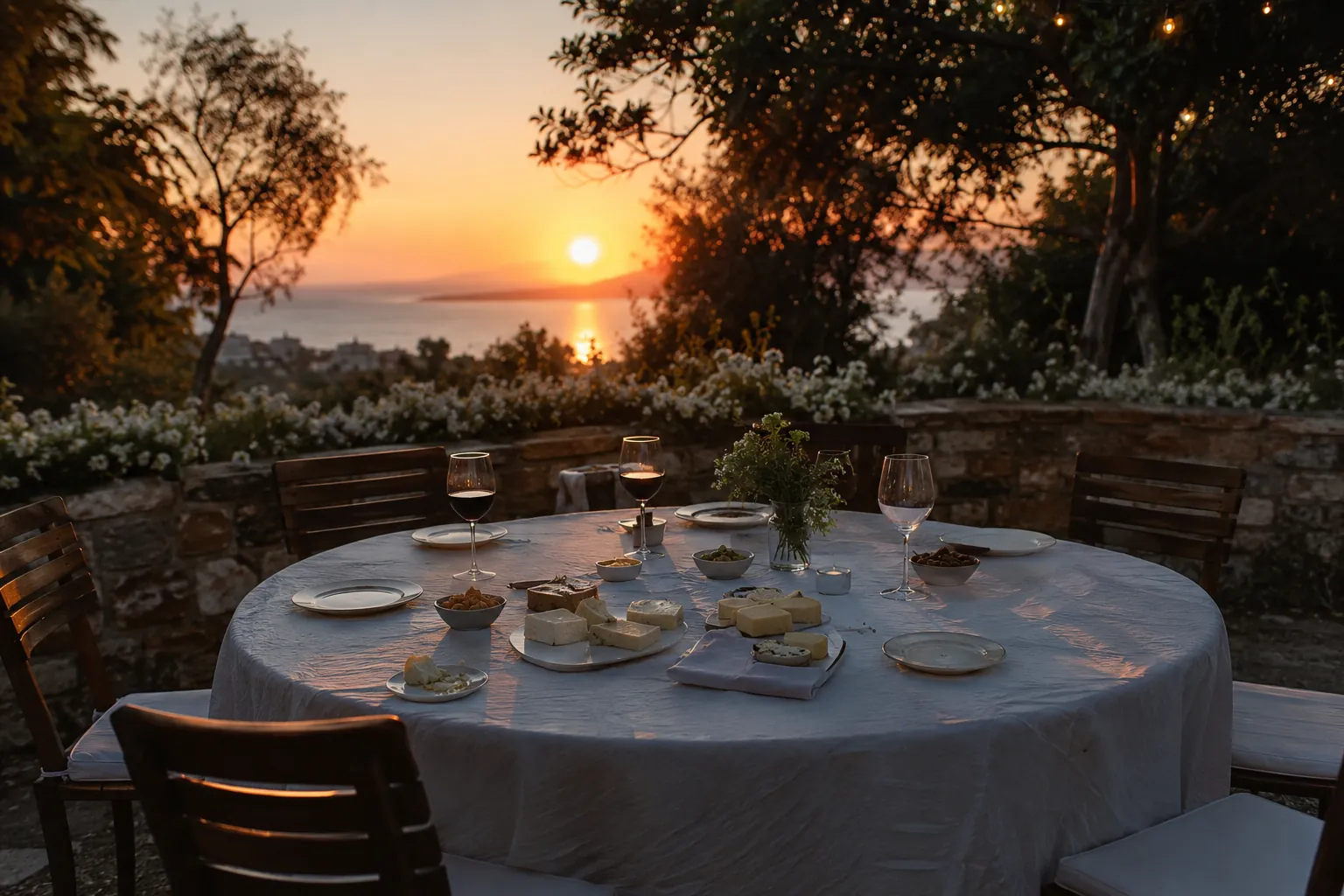
I knew that the table had been reserved for the miscellaneous friends. It was near a low stone wall at the edge of the garden. Someone had lined white flowers along it. Five chairs. Four taken.
I sat in the last one, facing the sun. For the first few minutes I could not see the people I was sitting with. I could only hear them.
The first voice I registered came from directly across the table. A man, mid-story. His sentences were precise and unhurried. Each one sounded like it had been considered for a long time before being released. But the sentences had nothing to do with each other. One was about a ferry. The next was about the consistency of tahini. Then a cousin who had moved to Cologne. Then silence. Then, from somewhere on his body, a small clean sound. A click arriving from nowhere, followed by the next unrelated sentence. I never learned where the sound came from. I called him Çıtçıt before the salads arrived.
To his left sat a man who looked like he had been cast for the evening, in a dark suit and a white shirt that he had left open at the collar, no tie, the whole thing worn with the ease of a man who has decided not to look like he tried. He was a yoga instructor. Someone at the table asked him the obvious question—why yoga, with a face like that, a frame like that, when he could have done anything. He smiled without opening his mouth. “Come to a class,” he said. “Just one class. Then we talk.” He said it like a man who had said it a thousand times and still believed it. Yogacı.
Next to me sat a man with a kaytan mustache, thin and waxed, curling slightly upward at the ends like a signature he had spent years perfecting. He had bicycled across the country. He had acted in a film no one at the table had seen. He had sold watches on a sidewalk in Kadıköy. He had written a book he described only as “short but important” before changing the subject. Every story was vivid and none of it felt like his. Çok Amaçlı.
The last chair, the one closest to the wall, belonged to a woman I recognized. We had met a few times, years ago, briefly: very little happened, and neither person fully forgot. She did not speak to the table. She watched, and whatever she caught went straight into the ear of the man beside her and never reached the rest of us. Gözetmen—a lecturer at a university.
He had come with her, on a chair pulled over from the next table, a tall man whose loudness made the table glad to have him, and he was already deep in some joke with Çıtçıt that I had missed the start of. Whatever she gave him he carried straight to the table, her observation already in his mouth, offered as his own. Sometimes she tightened and said his name once, low. He never caught it. He was already turning back to us with the next thing she had handed him, while she looked at a point just past his shoulder and said nothing. İletken.
The wine was Kavaklıdere Yakut. The cheese came from Kars, from the groom’s family—his father had been making cheese in the east for forty years, and tonight the table carried the weight of that. Aged kaşar that crumbled when you looked at it. A soft white cheese so fresh it was still cold. I had come to a wedding I had no part in, been seated at a table of strangers, and this was where I ate the best cheese of my life.
Somewhere behind us the wedding went on without our help, the music starting and breaking off while a man kept testing a microphone that never quite came on, and every so often the bride passed along the far edge of things, moving from one table to the next inside the white orbit of her dress.
Çıtçıt went first. He set down his glass, which I had learned to read as a beginning, and started a story. Each sentence was perfect. A boat. A summer. Someone’s uncle. A debt that turned out not to be a debt. Each one arrived sure of itself and finely made, and none of them had anything to do with the one before, so that the longer he talked the less you could have said what he had actually told you. But this time they were aimed at something. You could feel an ending gathering. He took a breath for the part that would tie it together—
and the waiter arrived with the cheese.
A whole board of it. Aged kaşar, two whites, something blue, a hard yellow wheel with a name none of us caught. “A little more?” he said. We took some. Of course we took some. By the time the board had gone around the table, no one remembered that Çıtçıt had stopped mid-sentence. He didn’t remind us. He looked content. Wherever the story had been going, it didn’t go there.
Çok Amaçlı picked it up. Or picked something up. He had sold cheese once, at a market, which was true the way everything he said was true and unprovable. This brought him to Italian cheese, which he wanted us to know was also very good. Which brought him to a lake. Como. He had been walking the edge of it in shorts and a t-shirt when a storm came down off the mountains with no warning, and he had stood there soaked and laughing, and good cheese, he said, was a little like that. It finds you. It comes down off the mountain whether you are dressed for it or not. He had the table now. He opened his mouth for the end of it—
“Protein is the thing people get wrong,” said Yogacı.
Everyone turned to him. “I don’t eat meat. But good cheese I forgive. I’ll walk thirty kilometers for the right cheese.” He let it sit. “And when good cheese comes to your feet, be suspicious. It happens. It doesn’t happen often.” He had a story too. A village near Saroz, a weekend, years back. Friends who were going diving and had asked him along. There was a cheese there he still thought about—he was getting to the cheese, he was almost at the cheese—
“I’ve always wanted to dive,” someone said.
That was the end of Saroz. The table went under: how deep, how cold, who had a boat, who knew a man with a boat. The cheese stayed up in the village, unnamed, uneaten by any of us.
At some point Çok Amaçlı turned to me. “You haven’t said anything,” he said. The table waited. I told him the cheese was very good and asked him about the lake. He was glad to go back to the lake.
The woman by the wall had been watching the whole time. Her eyes stopped on me once—on the chair that had told no story—and stayed a beat longer than they needed to. She leaned toward the man beside her. He laughed and turned to the table with it. “She says not one of us has finished a story all night.” Then: “And that one hasn’t started one.” He meant me. He said it the way he said everything, already his. No one argued. No one finished a story after that either.
I remembered Esra. She would only get more cheese from this table.
The sun was almost gone. I liked everyone immediately. I had even named them. Give a man a nickname and you no longer have to meet him.
Çıtçıt clicked. Yogacı asked someone new to a class. Çok Amaçlı started another life. Gözetmen watched, and İletken said it for her. I ate the cheese knowing it was the best of my life. The sun finished going down behind the wall.
There was cheese from Kars, and Yakut in the glass, and a tableful of people I would probably never see again, and a fifth chair that had been mine the whole time.
Of course I gave myself one too—