Sora counted seventeen umbrellas at the foot of the first gate.
It had rained in the morning, the quicksilver rain that came and went before the vendors had finished arranging their charms. Now the stones were dark in the joints, and the red gates rose one after another up the mountain, each one wet along the lower beam where the water had gathered and fallen.
“Please stay together,” Sora said.
He said it in English, then in slower English. The smile made it sound less like an instruction. The group moved toward him in the loose shape tourists made when they wanted to obey and look around at the same time.
A man from Canada lifted his camera before Sora had finished speaking. Two sisters from Singapore stood shoulder to shoulder and took the same photograph three times. An old couple held hands under one clear umbrella. Near the back, a young woman in a cream coat looked down at the map folded in her hand.
Sora checked the list on his clipboard.
“Yuki Tanaka?”
The young woman looked up.
“Yes.”
Her voice was almost lost under the sound of shoes on wet stone.
Sora marked her name and moved on.
At the first row of torii, he gave the speech he had given for twelve years. He knew where to pause. He knew which facts made people lift their phones and which ones made them lower them. He knew the joke about getting lost on the mountain and finding yourself in Osaka by dinner. It still worked, mostly.
The tourists laughed.
Yuki stood with the map held open in both hands. The paper had softened from the rain. One corner had torn along the crease. Sora noticed because guides noticed things: untied shoelaces, tired children, people who wandered too far for the perfect photograph, people who nodded without hearing.
A black cat came out from behind the stone fox.
It walked through the group as if the path had been made for it alone. Its fur was glossy except for a small patch of white under the chin. It brushed once against Sora’s trouser leg and sat beside his shoe.
“Kuro,” Sora said.
The sisters laughed.
“Is it yours?”
“No,” Sora said. “He lives here.”
The cat looked at him, then began to clean one paw.
Sora continued.
He spoke of offerings, merchants, rice, foxes, names carved into the gates. The group moved beneath the red beams. Light broke into strips across their faces. The air smelled of damp wood, earth, incense, and the sweet smoke from a stall far below.
Every few minutes, Sora looked back.
Yuki was there at the bend by the lantern.
Yuki was there beside the Canadian man.
Yuki was there under the narrow place where the gates stood close enough to darken the path.
Then she was gone.
Sora stopped speaking in the middle of a sentence.
The group took a few more steps before they noticed. The old couple turned first. One of the sisters lowered her phone.
“Please wait here,” Sora said.
He counted quickly.
Seventeen umbrellas.
Sixteen people.
“Did anyone see Ms. Tanaka?”
The Canadian man pointed down the path, then up the path, then shrugged.
“She was behind me.”
The sisters looked at each other.
“She stopped near the small shrine, maybe.”
Sora kept his face calm. The group was watching him now.
He called her name once.
“Tanaka-san?”
The sound entered the corridor of gates and came back smaller.
He tried her phone. It rang until it stopped. He called again. Nothing.
“Please stay together,” he said to the group. “I will be back in a few minutes. Do not continue without me.”
He said it more sharply than before.
Kuro stood and walked ahead.
Sora looked at the cat.
“No.”
Kuro went on.
The main path bent upward, red gate after red gate, tourists passing in both directions. Sora called Yuki’s name again, then moved toward the side path near the small shrine. He had used this route many times when guests wanted to take photographs away from the crowd. It curved behind the larger line of gates, climbed a little, then rejoined the trail.
Kuro waited at the turn.
Sora followed.
The stones were slick. Water dripped from leaves though the rain had stopped. A line of paper fortunes had been tied to a branch, white strips twisting in the faint wind. One had come loose and lay against the root of a cedar.
“Yuki-san?”
No answer.
Kuro slipped under a low rope and paused on the other side.
“You are not allowed there,” Sora said.
The cat looked back.
Sora stepped over the rope.
The path narrowed. The noise of the main trail faded until there were only crows and the soft scrape of his shoes. He slowed. He knew the useful routes. People in distress rarely took them.
Kuro moved between two torii set apart from the others.
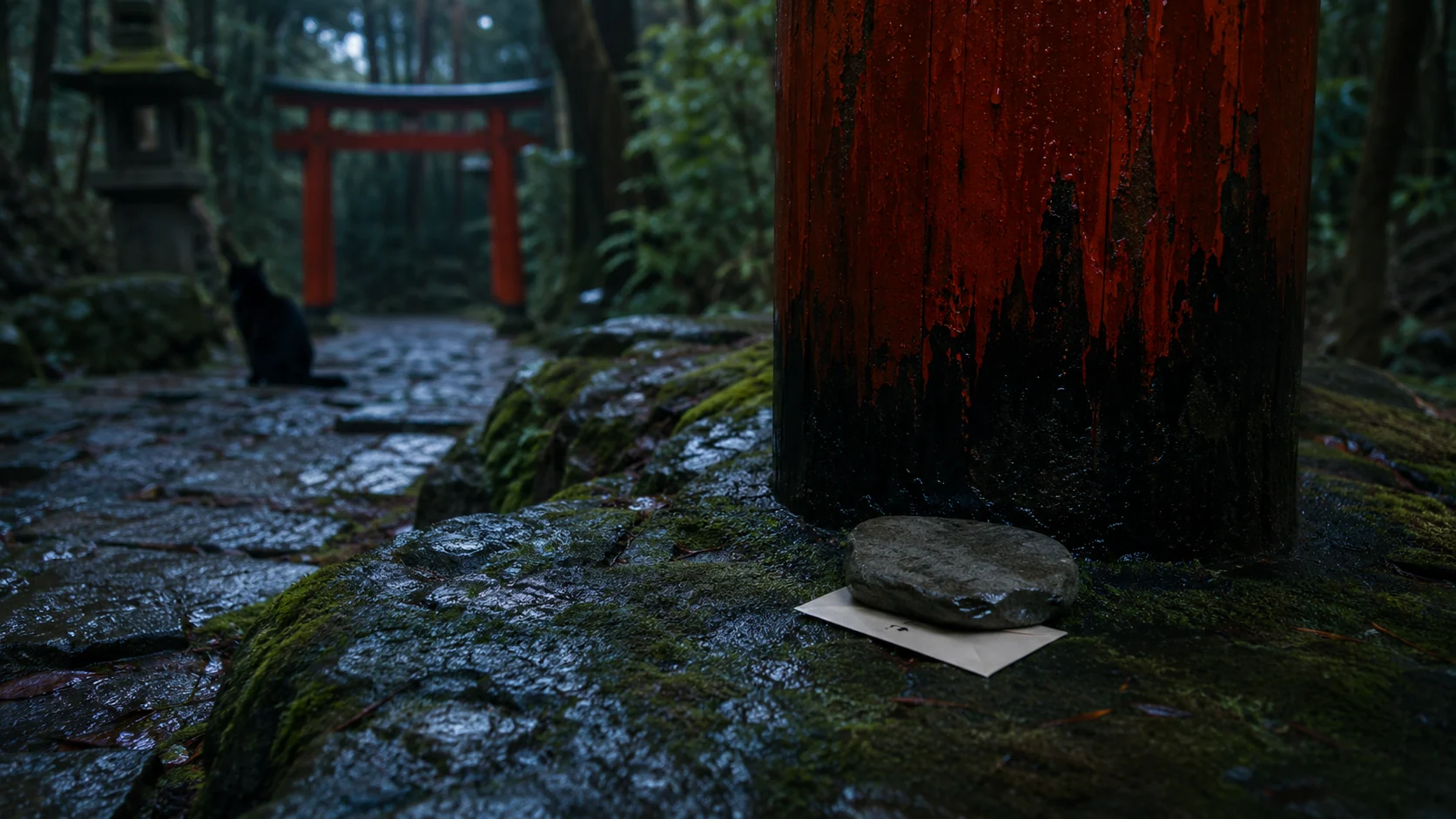
They were older, darker at the base, the names on the back of the pillars worn by rain and hands. Behind them stood a low stone wall covered in moss. Beyond the wall, a small clearing opened under the trees.
Yuki sat there.
She had taken off her coat and folded it beside her. Her sleeves were pushed above her wrists. The map lay on the ground, weighted at one corner by a small stone. She was writing on a sheet of paper balanced on her bag.
Sora stopped before she saw him.
Kuro walked into the clearing, circled once, and settled at Yuki’s feet.
Yuki looked down at the cat. Then she looked up.
Sora raised one hand.
She left the paper where it was. She stayed silent. Her eyes were dry and clear in a way that made him lower his hand.
He came closer and sat on the stone step beside the clearing, leaving enough space for a person to stand up and go.
For a while, neither of them moved.
On the main trail, faint voices rose and vanished. A bell rang once somewhere below. Kuro turned on his side and closed his eyes.
Yuki wrote another line.
Her hand paused after each word. Once, she crossed something out with such care that Sora could hear the pen move over the paper. He caught a glimpse of a single line before she folded the page:
I am sorry I could not—
The rest disappeared under her palm.
A drop of water fell from the branch above and landed near the top of the page. She moved the sheet before another drop could follow.
Sora looked away.
He had spent his life explaining what people had come to see: dates, names, customs, routes.
Yuki folded the paper once.
Then again.
The fold was uneven. She pressed it flat with both palms.
She reached into her bag, took out a small envelope, and placed the paper inside. She left it unsealed. For a moment, she held the envelope against her chest as if checking whether something had been left out.
Then she stood.
Sora stood too.
His hand went to his pocket, where a small folded train ticket had lived for years. He left it there and felt its edge against his thumb, the way he always did when someone disappeared on the mountain.
Yuki picked up her coat. She brushed a leaf from the sleeve and put it on. Her fingers missed the first button. She tried again and fastened it.
“I’m sorry,” she said.
Sora shook his head.
They walked back without hurrying.
Kuro came behind them for a few steps, then disappeared into the trees.
At the main path, the group was waiting near the lantern. The Canadian man looked relieved in a way that made him seem guilty. The sisters stopped whispering. The old woman under the clear umbrella gave Yuki a small nod.
Sora counted again.
Seventeen.
He left Yuki’s absence unexplained. He lifted the red flag he carried for crowded days and led them down the mountain.
The tour ended near the station.
People thanked him in the usual ways. They bowed, waved, checked the time, asked about lunch, asked about toilets, asked which train went to Gion. Sora answered all of it. He gave directions to the sisters. He took a photograph of the old couple under the station sign. He recommended a noodle shop to the Canadian man and told him the queue was worth it only before noon.
Yuki stood apart from the others, near the ticket machines.
The envelope had left her hand.
When the group began to break apart, Sora walked her to the platform. The train was already waiting, its doors open, warm light inside. People stepped on and off with the small urgency of public transport.
Yuki stopped before the doors.
She bowed.
A small bow. Enough.
Sora bowed back.
She entered the train and stood near the window. She reached up and took hold of a hanging strap. Through the glass, Sora watched her fingers curl around the plastic ring. Her hand was empty now. Then a man with a backpack moved between them, and the doors closed.
The train left.
Sora remained on the platform until the last carriage had passed.
When he returned to the shrine, the afternoon had thinned. The vendors were covering trays. The stones had begun to dry in pale patches. The first gates glowed with a tired red in the lowering light.
Kuro sat at the foot of the fox statue.
“You caused trouble,” Sora said.
The cat blinked.
Sora climbed alone.
He passed the lantern, the small shrine, the rope he had stepped over, the branch with the paper fortunes. He found the two older torii and the clearing behind them.
The envelope lay beneath the right pillar.
It had been placed carefully, half sheltered by the wooden base. A corner had darkened with damp. There was no name on it.
Sora crouched.
The envelope was close enough to touch.
He stayed that way for a while, one hand resting on his knee. He thought of the train ticket in his pocket.
Then he picked up a flat stone from the edge of the clearing and set it gently on the envelope so the wind would not take it. The paper disappeared under the stone except for one pale edge.
Behind him, Kuro entered the clearing and sat down.
Sora looked at the cat.
The cat looked back.
The evening bell sounded below.
Sora stood, brushed the dirt from his trousers, and returned to the path through the red gates. At the foot of the stairs the stone fox was still dark with rain. He paused, and bowed—lower than a tourist would notice.