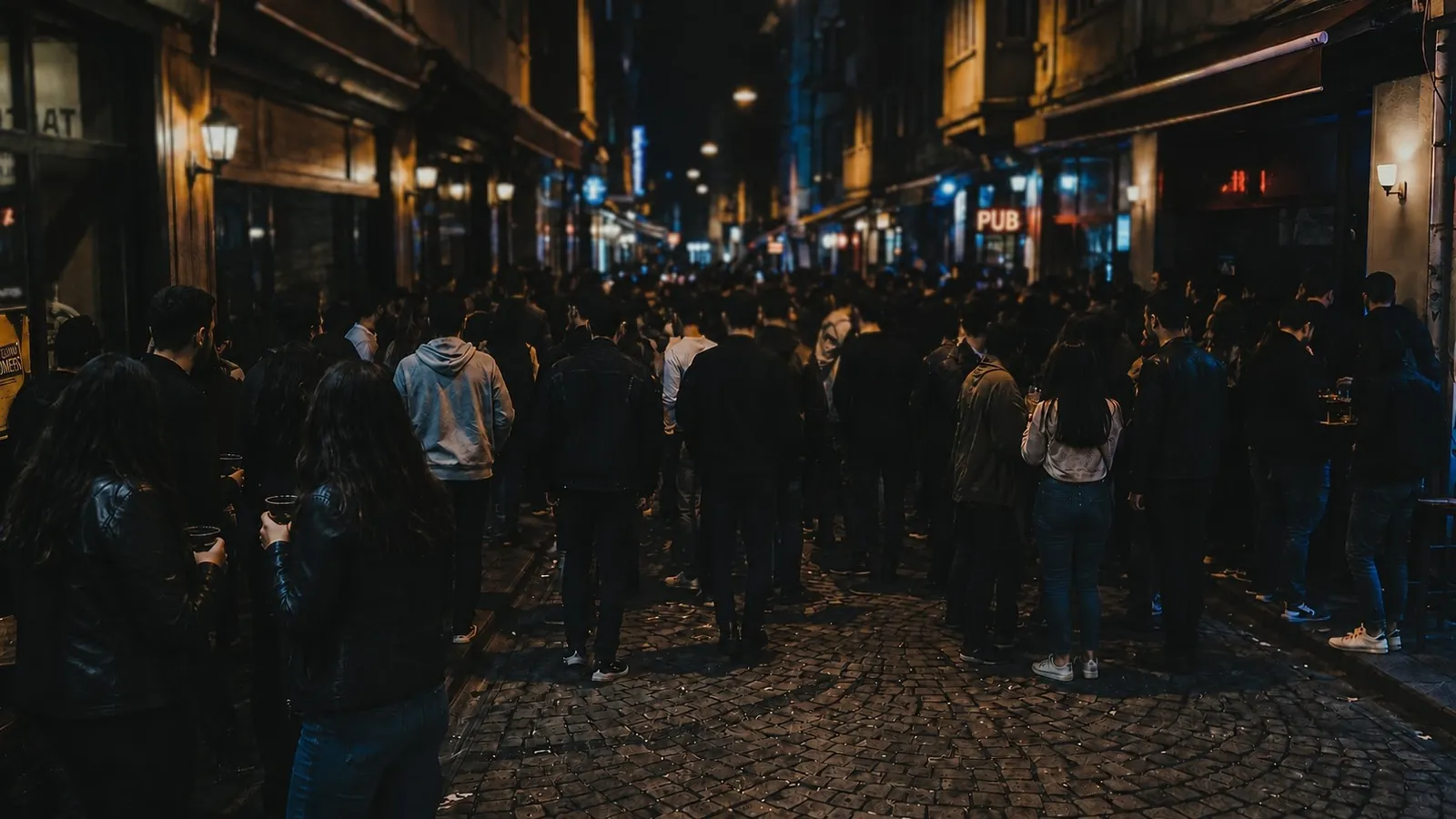
We were standing outside Teacher’s Bar on a Saturday night.
We had been sitting inside for hours—talking, drinking, breathing the same air for so long that stepping outside felt like waking up. Kadife Sokak was packed. Midnight was approaching. People spilled off the sidewalks and into the road. Laughter rose from one table and dissolved into another conversation a few meters away.
My back was to the street. I was talking to a friend.
Whatever I was saying has disappeared.
The conviction has stayed.
Then two hands landed on my shoulders.
They arrived with purpose. Firm enough to enter the body. Calm enough to make resistance feel absurd.
By the time I understood that someone was standing behind me, he had already leaned close to my ear.
In a deep, resonant voice, he said:
“You are not special. None of us are.”
Then he let go.
Before I could turn properly, he was walking away.
I watched him.
He passed between groups of people, disappeared behind shoulders into the movement of the street.
My friend was still talking beside me.
The interruption straightened my shoulders. My pulse quickened. Electricity moved through me—almost pride.
I kept looking at the place where the man had disappeared.
Years later, what I still think about is the method.
He could have said it to anyone. No one is special. The words should have returned me to the crowd, made me one more person standing outside a bar on a Saturday night.
I felt chosen.
A sentence meant to level me gave me height.
I understood the sentence.
My body understood the opposite.
Feeling good can stay innocent for a long time.
Feeling special starts making demands.
I caught the song on the radio early. It had just come out. No one knew the name yet.
I went and bought the cassette.
I played it everywhere—in bed, over meals, walking nowhere in particular. The same songs, again and again.
Finding the band made me feel like someone. I had found it. It was mine.
Then, slowly, the others arrived. People started telling me how good the band was. Some of them said it to me, carefully, as if I might not have heard.
I knew before you, I thought. I knew long before any of you.
The band had not changed. Only the number of people who knew it had.
Then I went cold on it.
The hunger to remain apart had already poisoned the pleasure.
There was a year when I became close with people who seemed to live slightly higher than the rest of us. Around them, I felt upgraded.
One evening, my oldest friend joined us.
He was the same person he had always been. I had loved him for years.
That night, I watched the others measure him.
A glance lasted too long. Someone smiled with patience.
Nothing was said.
That made it worse.
I felt myself move away from him.
For a while, I called it growth.
The same hunger entered love, too.
We were on the couch. Some show was on. A couple was fighting on screen—about something small. We watched them as you watch the street from behind a window. I felt her hand find mine on the cushion. Neither of us said anything. But the room had an agreement in it. We were not the kind who would shout over something that small. We were not the kind who would keep score. The silence between us felt like proof.
Three nights later, under the hazy yellow light of the hood in the kitchen, she was standing by the counter. The kettle had just clicked off. I was at the stove, back turned.
She said: “I’m trying to figure out how to tell you something without it sounding like I’m blaming you.”
“Tell me what?”
She went quiet. Then: “You don’t even know what it is.” She stopped. “I can’t believe you don’t even know.”
“You haven’t said anything yet.”
“I shouldn’t have to.”
I turned around. I was holding some papers. I wanted the papers to feel heavier than they were. I wanted the moment to need me more than it did.
“So say it.”
“I just tried.”
“You said you were trying to figure out how to say it. That’s not saying it.”
“And you just proved why I can’t.”
The fight lasted three minutes. We never reached the subject. Neither of us raised a voice. But the disappointment—I am still measuring it.
I stood there under the yellow light.
I felt a phantom pressure on my shoulders.
Firm enough to enter the body.