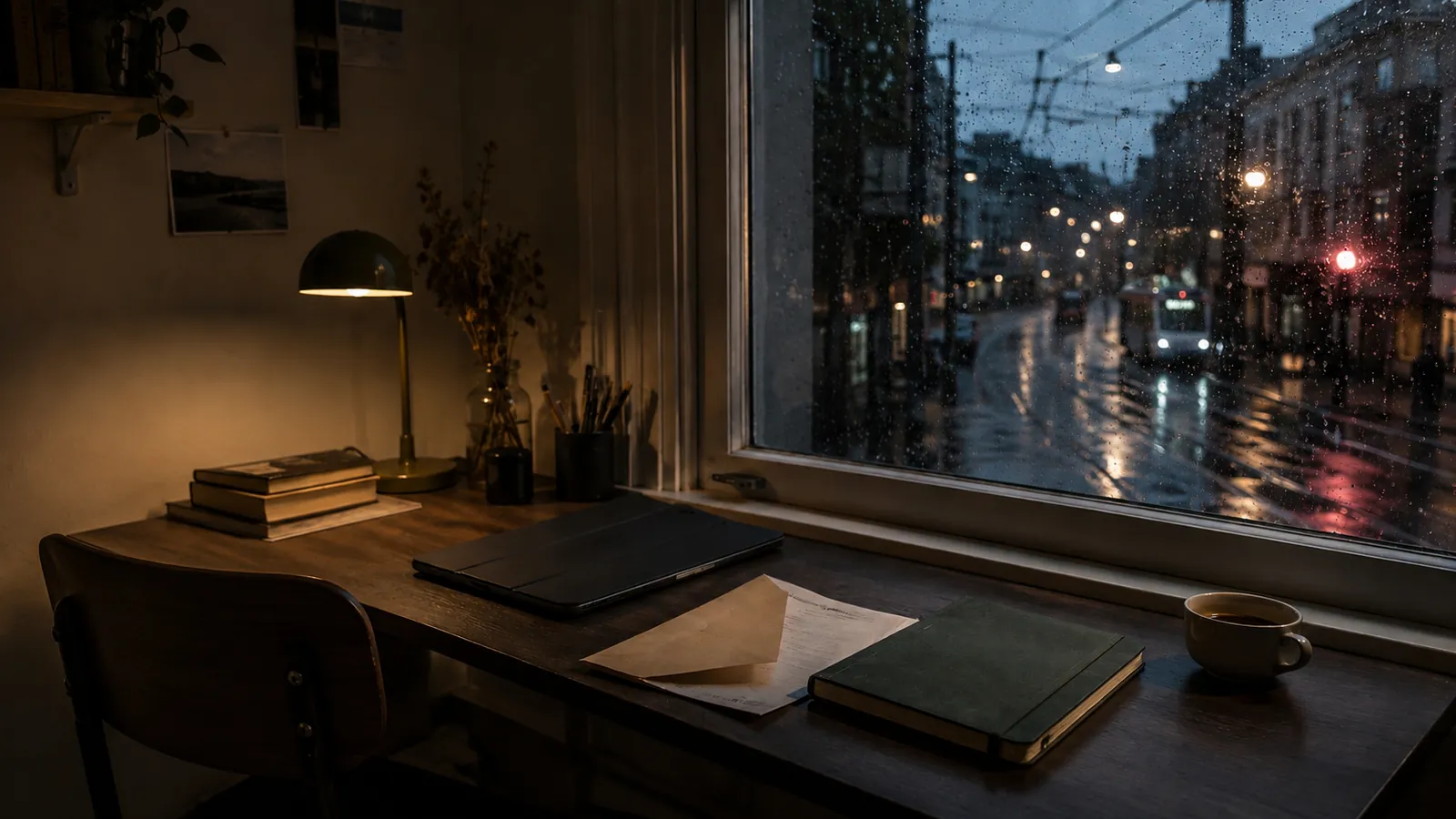
In Bologna her mother handed her the tablet across the kitchen table, in a white box with the lid still creased. The tomato sauce moved in folds on the stove and the window had gone soft with steam. Lucia ran her thumb along the cool flat of the cover. Her mother dried her hands on her apron and said she’d ruin her eyes hunching over that little phone; this one at least had a proper screen, big enough for the long things she wrote.
Her mother read the blog as if she were leaning out of the window, taking the measure of people on the street. Lucia had always done it out loud first—on the bus she would lean over and give the man across the aisle a debt and a reason for the good coat, a whole life built out of the way he held his bag. “Questa vicina, lei non è così,” her mother would say of the written ones—this neighbour, she’s not like that—and Lucia would tell her she had only written down what she saw. “Stessa cosa,” her mother said. “Ci metti sempre del tuo”—same thing; you always put something of yourself in.
That night the suitcase lay open on the floor, the clothes she wasn’t sure about in a pile she kept moving from the bed to the chair and back. She let the new screen come up white against the dark, opened a blank document, typed her name, looked at it, and deleted it letter by letter until the cursor sat alone. From the kitchen came the sound of her mother washing the last of the pans as if it were any other night.
Melbourne was wet when she arrived. Rain ran down the airport glass and followed her into the city. She dragged her bags into a room barely wider than the bed, and before she had taken off her coat she sat on the edge of it and wrote—a long post, the kind she used to write: the rain, and a man at the baggage carousel who lifted down the wrong suitcase, held it a moment, then set it back and watched it go around again. She published it with her coat still dripping onto the floor.
Most mornings she walked, a fast hour with her earbuds in—house, techno, anything with a beat and no words in it—keeping her step to it until the sweat came.
For the first weeks the tablet went everywhere. She wrote down the woman at the market who pressed each peach to her cheek before she bought it, and the tram driver who said good morning to the same empty seat and seemed content with the answer. She gave them more than she saw—a husband at sea for the peach woman, a son the driver was waiting for—because there was no one yet to tell it to, and the page would take it. She was a foreigner and so she was allowed to stare, and she took it all down.
Lucia wrote in English now. In Bologna her mother read every post with a dictionary open on the table, a finger under the line, working out what her daughter had seen.
The smell of espresso worked into her clothes and stayed there after a Greek woman named Mara took her on for the morning shifts at a café on a corner that never emptied. Mara had run the place for thirty years and spoke to the machine more gently than to her staff. “You talk to them, you don’t think,” she told Lucia the first morning, tipping her head at the line that ran to the door. “Thinking is for after.”
Lucia burned her wrist on the steam wand and made bad coffee for a week. There were three old men who came at seven and took the table by the window as if it had been built for them. They opened the paper and argued over the football as though it could still be changed. One of them asked, every morning, whether it was too early for a drink, and another always said, “Only if you call it drinking.” Then they ordered three espressos and looked hurt by them, as if Mara had decided what kind of country made a man wait until lunch for a real drink. She wrote them down on her breaks, in the back room among the sacks of beans. After a while her hands knew what to do, and her breaks filled instead with Mara’s stories and the orders shouted back. The paragraphs became sentences. The sentences became captions under photographs of wet pavement.
The people came slowly, out of the café and the lane behind it. A girl from her course who never came to the course turned up for the cheap coffee and said she learned better near food. Two brothers ran a bar where the late shifts let out and never charged her for the first drink; hospitality was cheaper than accounting, they said.
She found she could do for them what she had once done for the page. She would tip her head at a man eating alone in the corner and build him a whole evening—a wife who had the car tonight, a phone that would ring before he finished—and the table would lean in and fight over whether she had it right. One of the brothers told her she had missed her calling as a liar. The cook had a burn on his thumb and danced badly behind the bins when the rush was over, and the first time she saw it she felt the old reflex reach for something to write it on. She laughed instead and saved it for the table that night, and the cook ended up laughing at a version of himself he only half recognised. The people she used to put on the page were sitting around her now, and they took everything she had.
For a while she still wrote them down. One night she came home with a sentence half written in her head—something about the way Mara closed the till as if she were sealing a letter. She took the tablet out of her bag and put it on the table. She looked at it. Then she put it back. Another night she meant to write something down and didn’t, and after that she stopped noticing which nights those were.
By summer they closed places together. One warm night they ended up on a rooftop in Brunswick, six or seven of them, passing a bottle around. One of the brothers started a long story about his father and a stolen boat, and when it began to sag she gave the father a limp and a brother he was trying to outrun, and the thing stood up and walked; by the end the whole table swore it was true. Someone put a coat over her shoulders. Someone asked what she did, back home, and she said she used to write things down, and heard herself say used to with the boat still going around the roof. Then the song changed and the question went with it. The tablet was in her bag at the bottom of the stairs, where it had been for a long time.
The blog had not moved in months. What she put up came in flashes—a photo of the bar, a hand around a glass that was not hers. On their Sunday calls her mother held the phone too close and squinted into it. “Scorro e scorro,” she said. “Tutte queste facce che sorridono. Non trovo più le tue storie. Dov’è finita la ragazza che scriveva le cose.”—I scroll and scroll, all these smiling faces, I can’t find your stories anymore, where did the girl go who wrote things down. Lucia said she was right there, she’d put something up soon, and while she said it she pushed the tablet further down into her bag, under the books she had also stopped reading.
Then the summer turned and the rain came back. One night after a shift that had run long and loud she came home and plugged the tablet into the wall; it had died weeks ago and she had not noticed.
She bought a notebook, green, with an elastic band around it, like one she had carried at sixteen, and took it to a café where no one knew her and sat by the window to make the words come. She uncapped the pen. People passed on the wet street. After an hour the page held the date and nothing else. She capped the pen, put the notebook in her bag beside the dead tablet, and did not take it out again.
The following Tuesday there was an envelope in the mailboxes downstairs—cream, with Italian stamps and her name on the front in careful capitals. She carried it up and sat on the bed with her jacket still on and tore it open. One sheet of lined paper, the blue ink pressed hard enough to read from the back. Her mother, who had left school at fourteen and never spoken a word of English, had written it in English. There was a word crossed out and written again until the paper went soft, and one place where she had given up and left the Italian, a small arrow beside it as if Lucia could follow it back.
I know how much you love to write. So I took a pen and a paper, and I started.