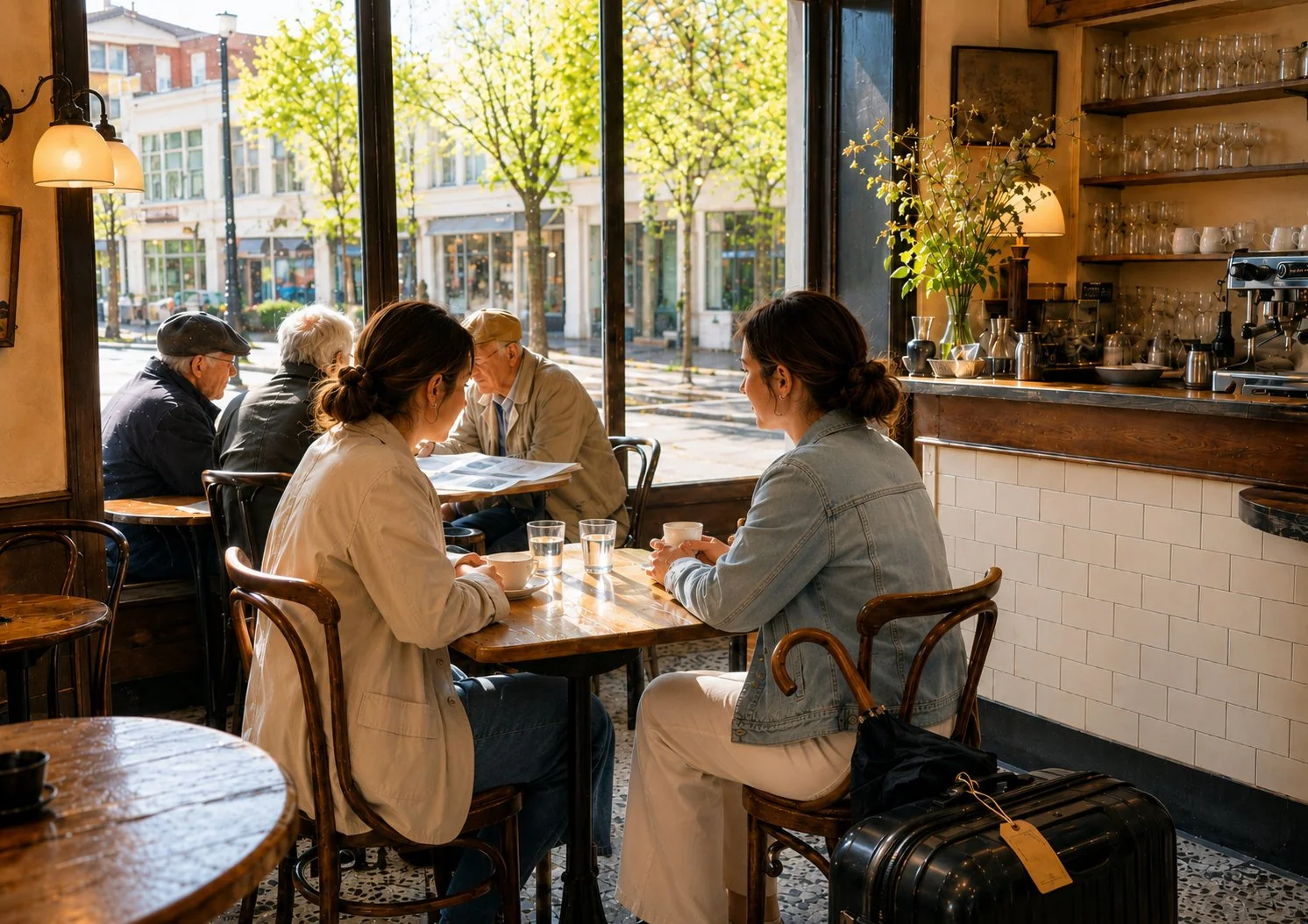
Rain runs down the café window. The three men sit at the table by the window. A newspaper lies open between them. The street door opens. Two women come in under one umbrella. Rain darkens one shoulder of each coat. One of them carries a bag with a paper tag tied to the handle. They take the table near the counter. On the shelf behind the counter, between the bottles, a plate stands upright. A line divides the glaze from edge to center. The machine clicks.
VERA. Eleven forty. The taxi comes at one.
EVA. The man by the window. The one holding his spoon like a tool. He was a sailor. Look at the hands. He still ties knots in his sleep—his wife wakes up and finds the sheet hitched to the bedpost.
VERA. He has a bus pass clipped to his umbrella.
EVA. Sailors retire. They take buses. The bus is the part that hurts.
VERA. The bag is twenty-three kilos. I weighed it twice.
EVA. You weighed it twice.
VERA. The scale drifts.
A girl carries two glasses of water to the table. A cream envelope sticks out of her apron pocket. Stamps cover one corner. The corner of a green notebook shows beside it. She goes back behind the counter.
EVA. Now her.
VERA. Don’t.
EVA. She came from somewhere with better light, and she used to write things down. Look at the notebook. Carried, not used. She stopped, and somebody noticed. That’s why the letter stays in the pocket where her hand goes.
VERA. It’s a bill.
EVA. With stamps.
VERA. People still post bills.
EVA. Not the kind you keep where you can feel it.
At the window table a man lifts his cup.
FIRST MAN. Too early?
SECOND MAN. Only if you call it drinking.
The machine stops.
EVA. I was going to—
VERA. The taxi—
They stop.
VERA. You first.
EVA. It’s gone now. Say yours.
VERA. The taxi takes the toll road if you ask. Nine minutes.
EVA. Nine minutes you’ll spend telling him about the toll road.
VERA. You’ll miss the plane.
EVA. The taxi comes at one. You said.
VERA. I’m saying it again so it stays said.
EVA. Do you remember the week we switched?
VERA. Two days.
EVA. The whole week of the swimming carnival. Nobody—
VERA. Monday and Tuesday. You sat my maths test.
EVA. And I passed it.
VERA. Fifty-one.
EVA. Fifty-one is a pass.
Eva drinks her water.
EVA. You kept the number for twenty years.
VERA. Somebody had to.
EVA. You’ll get a dog.
VERA. I won’t get a dog.
EVA. A small ugly one from the shelter on Sydney Road. You’ll say it followed you home. The receipt goes in the kitchen drawer, under the menus, where you put the things you don’t want to have decided.
VERA. That drawer has batteries in it.
EVA. The receipt goes on top of the batteries.
VERA. It won’t be ugly.
Mara carries two cups to the table. She sets them down. She straightens the sugar bowl.
EVA. Ask her.
VERA. I’m not asking her.
Eva turns to Mara.
EVA. You came on a ship. There were crates in the hold with your mother’s plates inside—that one, on the shelf. It was cracked before you ever packed it, and you brought it anyway.
Mara looks at her. She smiles. She walks back to the counter.
EVA. She’s not going to tell us.
VERA. She just did.
The rain stops. Light crosses the table.
VERA. Twelve fifty.
Eva turns her cup on its saucer. The cup goes around once, then again.
VERA. The plane lands in the morning. The light comes in from the wrong side. You stand on the kerb with the bag and the air smells of nothing you know yet. In the first week you find a café. You sit where you can see the door. By winter the woman there has your order ready before you reach the counter, and one day you tell her about your sister. The one who keeps the numbers. And you make me better than I am.
EVA. That’s not true.
VERA. It will be.
They stand. One takes the bag. The other takes the umbrella. The door opens and closes. Two cups stay on the table. The machine clicks.