← Pictures with Stories
Through Edo
The moving walk needs JavaScript. All its sourced field notes are here to read. Shinjirō and O-Fumi, who appear in them, are imagined.
Guard Gallery
Cool boards before the offices open.
Toyohara Chikanobu, Court Hearing at Fukiage (1889) · Public domain
Shinjirō leaves his house in Banchō before first light on a day early in the sixth month, while his wife O-Fumi is still asleep. Both are imagined for this walk; the castle around them is not. Ōta Dōkan built the first castle here in the middle of the fifteenth century, and Tokugawa Ieyasu entered Edo in 1590. Ieyasu repaired the run-down castle and built a great city around it, and castle and city were complete by 1636, in the time of his grandson Iemitsu.
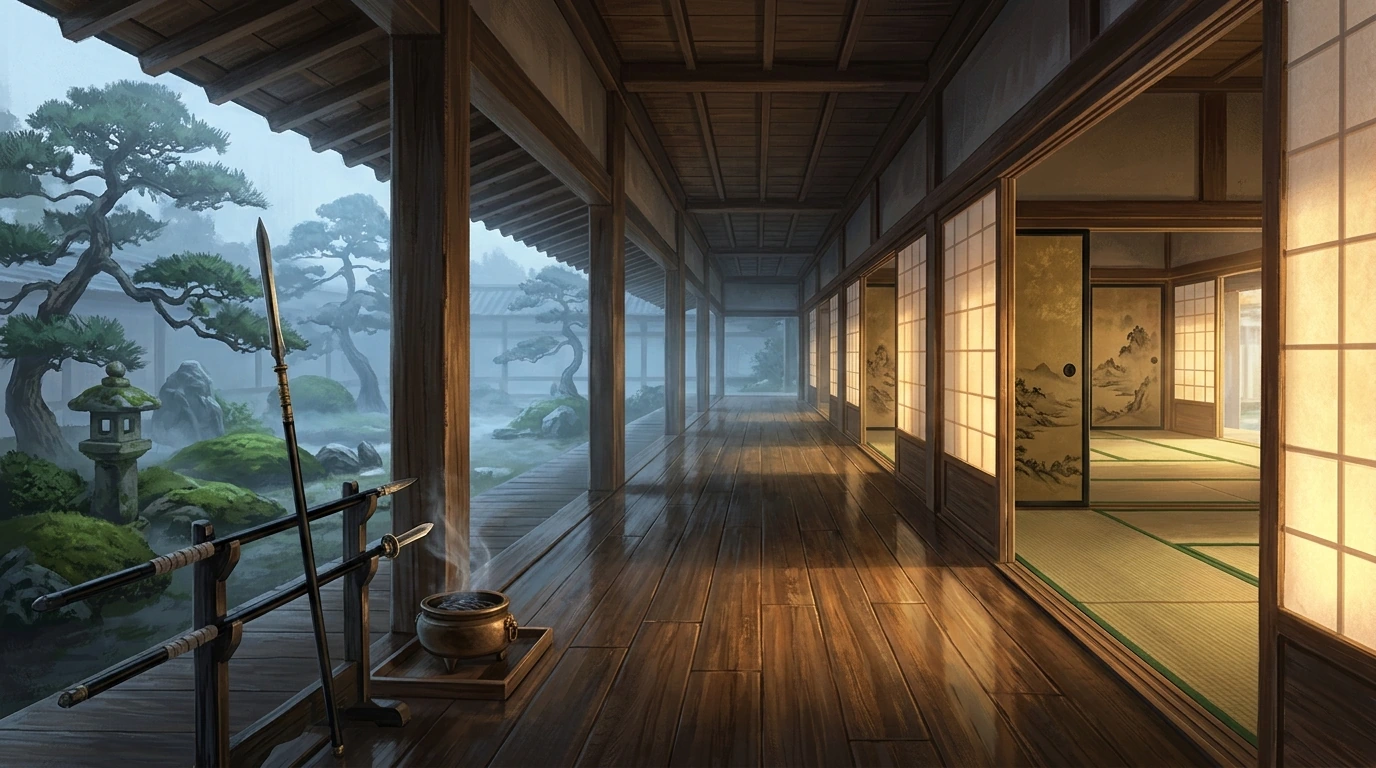
Open verandas (engawa) like this one ran along the outside of the palace rooms. At night wooden storm shutters (amado) closed the building against thieves, wind and rain; by day they slid back into a box at the end of the veranda. The guards who walked it carried two swords, inside walls that had seen no fighting for two hundred years.
Sliding screens
Paper to let in the light, painted panels to divide the rooms.
Two kinds of sliding screen are shown here. Shōji, in the sense used today, are lattices covered with thin paper that lets daylight into a room. Fusuma are opaque: a wooden frame covered with thick paper, or in the best rooms with silk or other cloth, and often a surface for paintings, as these landscapes are.
Fusuma first appeared in the Muromachi period, to divide large spaces into smaller rooms. They slide in tracks at the top and bottom and can be lifted out, so the rooms they divide can be opened into one.
Gallery floorboards
Polished boards, and a censer by the posts.
An engawa is the strip of floor beside or around the matted rooms. Some lie inside sliding rain doors; others, without them, are open to the weather (nure-en), and their boards may run lengthwise or show their cut ends.
By the posts on the left a bronze incense burner (kōro) stands on a tray. Incense burners were made of metal, pottery, horn and other materials, most of them for Buddhist use: some were set on a table, some had a handle to be carried, and some hung near an alcove.
Stone lantern
A stone lantern in a palace garden.
Stone lanterns (tōrō) came to Japan with Buddhism, as votive lights at temples and shrines. In the sixteenth century tea masters began to set them in the gardens around their tea rooms, and secular gardens took them up.
About nine main shapes and more than 75 variants are told apart, but all have a hollow upper section that holds the light. Bronze or iron lanterns hung from the eaves of palaces and temples, and in homes people used paper-covered oil lamps (andon), which became common in the Edo period.
Arms on the rack
Spears on the rack, swords at the belt.
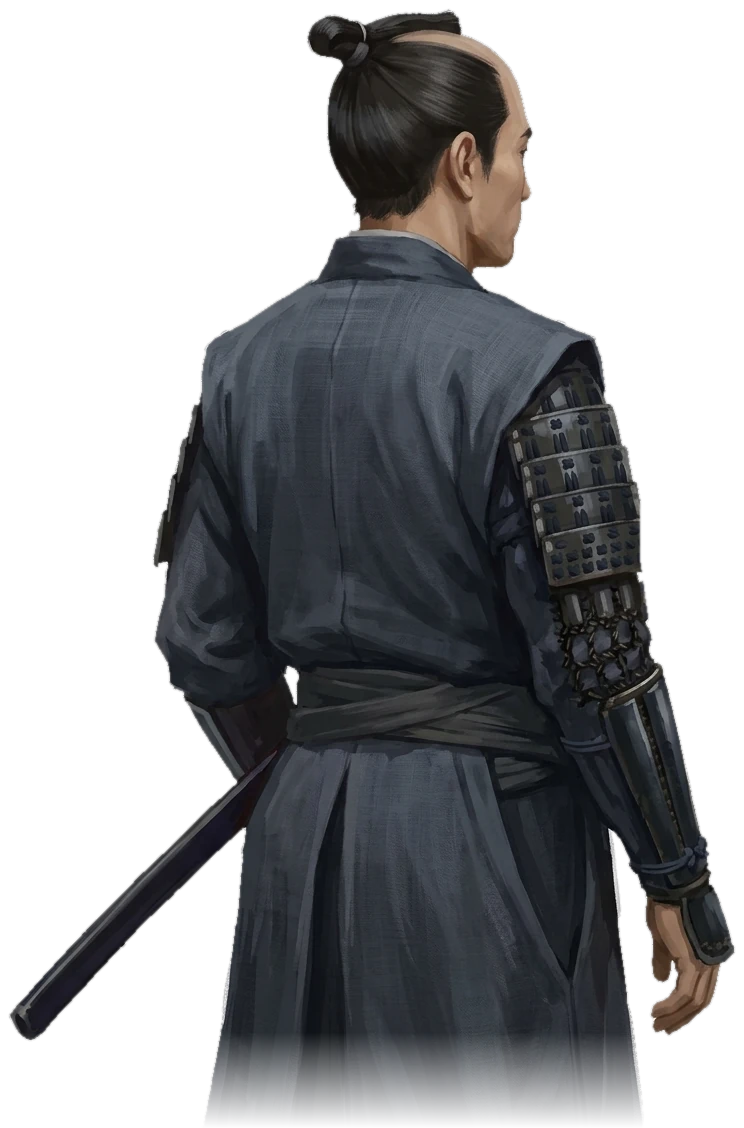
A samurai wore two swords, the long katana and the shorter wakizashi, together called daishō. The wakizashi suited fighting at close quarters, especially in towns.
A katana in the V&A, forged by Korekazu in 1860 for a gift from the shogun Tokugawa Iemochi to Queen Victoria, has never been repolished, so it still shows the finish swords were given in those years.
Inner Quarters
Beyond the guard’s post.
Shinjirō stays outside these rooms. This is an imagined look into the shogun’s own quarters; their arrangement changed with each shogun’s preferences, and the desk, garden and bedding here do not reproduce a recorded room. The name Nakaoku, used for these quarters today, does not appear in Edo-period sources and came into use only in the Meiji period.
The quarters lay between the formal halls and the women’s palace, joined to it by two corridors (Osuzurōka). The shogun rose at sunrise and went first to the women’s palace to receive the greetings of its ladies. He met his council of elders (rōjū) in the Gozanoma and spent his afternoons on government business in the Gokyūsokunoma, so that most of his day passed in these two rooms.
Courtyard & shutters
Shutters stored away by day.
At night attendants drew wooden storm shutters (amado) out of a box at the corner of the veranda (tobukuro) and slid them along the outer track until the rooms were closed. In the morning they were taken back in one by one.
Because posts carried the roof, the outer side of the rooms could stand open to the veranda and the garden by day, and the shutters were all that closed it at night.
Hidden guard recess
A recess behind the sliding panels.
A musha-kakushi, “hidden warriors”, was a small room beside the raised seat (jōdan) of a palace hall, closed off by fixed panels and ornate sliding doors with tassel handles. Guards waited inside it to protect the shogun or the highest-ranking person on the jōdan. One survives in the Ninomaru palace of Nijō Castle in Kyoto.
Some scholars think these rooms were first used for storage or sleeping, as a similar room in the guest hall of Onjōji in Shiga, built in 1601, was.
Lacquer council desk
Folded papers beside the inkstone.
Business reached the shogun through his officials. The most important go-between was the osoba goyō toritsugi, who carried matters between the shogun and the council of elders, and whose rooms were among those closest to the shogun’s own.
The arrangement of these rooms changed from one shogun to the next, following his preferences and the positions of his officials.
Armory
Weapons kept for wars no one alive had fought.
By the 1830s no one in Edo Castle had seen a battle. The last great one was fought on the Shimabara peninsula in the winter of 1637–38, when the shogunate’s armies besieged Christian rebels in Hara Castle. Weapons were still kept: castle turrets and the long galleries on the walls served in peacetime as armories and storehouses.
Armor was still made too, often in the styles of earlier centuries. A suit in the V&A was assembled in the mid-nineteenth century, when accurate reproductions of older armor were in fashion, around a helmet made in the late sixteenth.
Katana & paired swords
A hard edge on a tough core.
Katana blade (16th century) & Edo mounting with Tokugawa crest · The Met (CC0)
A katana can combine a tougher core with harder outer steel. Quenching hardens the cutting edge differently from the body of the blade. The hamon marks that hardened edge region; it is separate from the join between core and outer steel.
The katana and the shorter wakizashi were worn together as a pair (daishō). In the Edo period, as samurai became officials, the sword guard (tsuba) became a field for carving and inlay, and its designs often carried meanings: a shell (kai) stood for success, a word with the same sound.
The katana has a watercolor of its own .
Fierce war masks
An iron face with a fierce look.
The face mask (menpō) protected the face and gave its wearer a fierce look. A mask in the V&A has heavy eyebrows and a wrinkled forehead; its lower part may date from the sixteenth century, and the upper part was added in the Edo period.
The helmet (kabuto) worn with it was tied on with cords (shimeo) and had a neck guard of layered plates (shikoro) hanging from its rim.
Laced plate armor
Lacquered plates joined with silk.
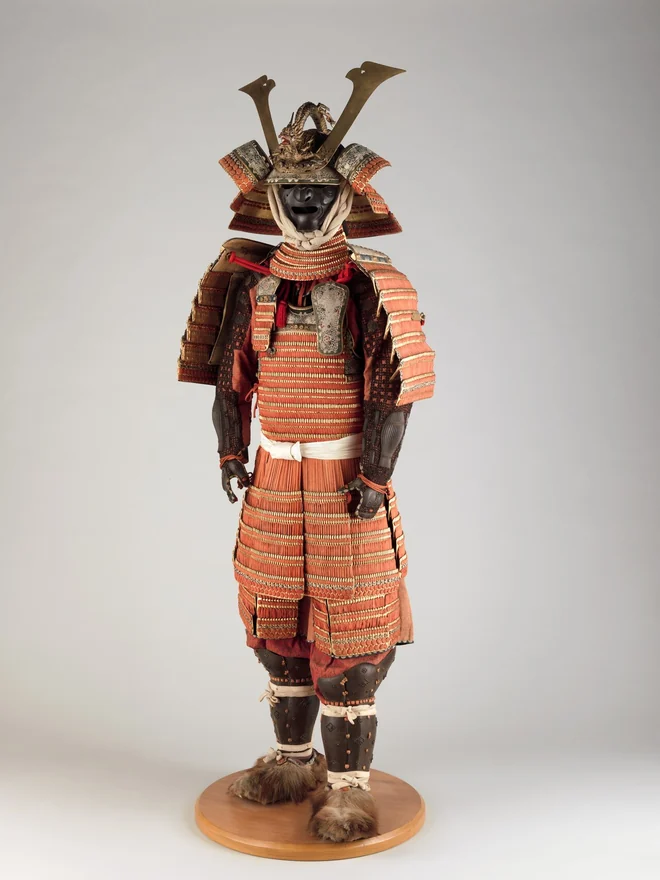
Crimson-laced gusoku armor with iron menpō mask (19th century) · The Met (CC0)
Japanese armor was built of many small plates of lacquered leather or iron, laced together in rows with silk, which let the wearer move freely when fighting from horseback with sword or bow.
In the Edo period armor was often reassembled or remade for ceremony. A suit in the V&A with what is probably the Asano family crest combines fifteenth-century parts with a helmet and shin guards added in the nineteenth century, and another still has the box it was kept in.
Spears, bows & matchlocks
Matchlocks and long spears.
Heavy iron matchlock barrel by Kazuki Nobumichi (late 18th–early 19th century) · The Met (CC0)
Firearms reached Japan with the Portuguese in the 1540s. Workshops were soon set up to make matchlock guns, and their deadly efficiency changed how wars were fought.
Spears were long. A spear (yari) in the V&A, made between 1750 and 1850, is 3.87 meters long, and a cross-bladed spear (jūmonji-yari) of the early nineteenth century has an oak shaft inlaid with mother-of-pearl and a sheath lacquered red.
Audience Hall
The largest room in the castle.
Toyohara Chikanobu, Chiyoda no On-omote · Yabusame (1897) · The Met (CC0)
The Ōhiroma, the Great Hall, ran more than fifty meters from east to west. The great ceremonies were held here, among them the New Year audiences, when lords came to greet the shogun. He sat in the upper room, and each lord sat lower down, where his family’s standing placed him.
Tokugawa Ienari was shogun from 1787 to 1837, for fifty years, and the reforms of the 1840s waited for his death in 1841. In these decades bad harvests raised the price of rice in Edo and set off riots in which crowds smashed houses (uchikowashi).
Gold-leaf murals
Ink pines and cranes on gold.
The partitions of the Ōhiroma were painted with pine trees and cranes, the most formal motifs, by painters of the highest standing.
The Kanō school served military rulers from the late Muromachi period to the early Meiji. Kanō Eitoku (1543–90) created its grand style, painted on gold-foil backgrounds, for the castles and mansions of Oda Nobunaga and Toyotomi Hideyoshi.
The raised dais
One step up, and the shogun’s rooms beyond.
Toyohara Chikanobu, Chiyoda no On-omote · Kagamibiraki (1897) · Public domain
At the head of the hall is the upper chamber (jōdan). Each chamber toward it had a higher floor and richer decoration, and the shogun sat in the highest, while each lord sat lower down, where his family’s standing placed him.
Beyond the formal halls lay the Central Palace, where the shogun lived and worked: the Gozanoma, where he met his council of elders, and the Gokyūsokunoma, where he dealt with government business in the afternoon. He rose at sunrise and went first to the Inner Palace, joined to the Central Palace by two Osuzurōka corridors, to receive the greetings of the women of the household.
Coffered ceiling
A ceiling raised over the highest seat.
The ceiling is a grid of square coffers (gōtenjō). Where it is lifted higher on curved ribs it is a coved and coffered ceiling, which marked high rank in temples and in the main rooms of great houses, and its joints are finished with metal fittings (kazari-kanagu).
In the Ōhiroma the coffered ceilings of the upper, middle and lower chambers looked like a sheet of squared paper, and they rose higher toward the upper chamber, as the floors did.
Woven floor mats
Mats of rush, edged by rank.
Tatami are mats of tightly woven rice straw covered with rush, each about 1.8 by 0.9 meters, with their long sides bound in cloth. From the Muromachi period they were laid edge to edge over whole floors.
A person’s standing could be read from the mats: their thickness and the colors and patterns of their bindings. Ordinary homes used black, dark blue or brown cloth; great houses used damask woven with gold and silver thread.
Ōtemon Gate
The main gate, where the lords came in.
Utagawa Hiroshige, Sannō Festival Procession at Kōjimachi (1856) · National Diet Library
Ōtemon was the main gate of Edo Castle, used by the shogun and the daimyō. Beside it stands a roof ornament from the old gate, a mythical sea creature that guarded against fire, with the date 1657 on its head.
The townspeople’s festivals came in another way. From the time of the third shogun, Iemitsu, the floats and portable shrines of the Sannō and Kanda festivals were allowed into the castle. In alternate years the Sannō procession entered at Hanzōmon, on the west side, passed before the shogun, and left by Takebashi.
Double-gate barbican
Two gates set at a right angle.
Inside the outer gate is a square court enclosed by stone walls, the masugata, named after the square measuring box (masu). The second, larger gate stands at a right angle to the first, so anyone coming in must stop and turn. A typical masugata measured about 9 by 14.5 meters.
The design slowed an attacker and left him open to fire from the walls and from the gatehouse above. Ōtemon’s larger gate was destroyed in an air raid during the Second World War and rebuilt in 1967.
Gatehouse turret
Turrets that stood after the keep was gone.
Turrets (yagura) stood at the corners of the stone walls and over the gates. The name is said to mean “arrow store”, and in peacetime some served as armories or as stores for rice or salt.
The castle’s keep, the largest in Japan when it was first built in 1607, burned in the Meireki fire of 1657 and was not rebuilt; the money went into rebuilding the city instead. Rebuilding it was proposed again in 1712 but never carried out.
Battered stone ramparts
Stone from Izu, laid without mortar.
The daimyō were required to contribute to building the castle, and stone for its walls was shipped from the coasts of Izu and Sagami. The old quarries remain on the Izu peninsula, and some large stones there still show lines of holes where wedges were hammered in to split them.
The walls are laid dry, without mortar, over a sloping earth bank, with the surface stones set over smaller stones, pebbles and sand. Andesite and granite, both easy to work, were the stones most used in Edo-period castles.
Inner moat & loopholes
Loopholes over the water.
The walls are pierced with loopholes (sama) for arrows, guns and even cannon. They took many shapes: arrow loopholes were narrow upright slots, and many openings were smaller on the outside than on the inside, to widen the defenders’ aim while showing them as little as possible.
Long galleries on top of the walls (tamon) had plastered walls and tiled roofs, often with loopholes. In war they hid troops; in peace they served as armories and storehouses.
Nihonbashi Bridge
The bridge every road was measured from.
Utagawa Hiroshige, Sunshower at Nihonbashi (1833–34) · The Met (CC0)
Nihonbashi was said to have been finished in 1603. It became the starting point of the Five Highways, and their milestones were measured from it. The fish markets on its north side supplied the shogunate and were the center of Edo’s fish trade, and the streets around it held government offices and famous shops.
Off duty, Shinjirō comes here in the afternoon to buy something for supper. The painting shows the bridge crowded with people, the canal with boats, and Mount Fuji in the distance.
Bronze bridge finials
Bronze jewels on the railing posts.
The posts of the railing are capped with finials (giboshi) in the shape of a pointed sacred jewel (hōju), most often made of bronze.
Because boats passed under it, the bridge was built high on stone walls and arched over the water.
Canal cargo barges
Goods from all over the country.
By the middle of the Edo period goods reached Edo from all over the country by land and sea: rice, vegetables and fruit, sake, vinegar, soy sauce, miso and dried bonito. Sake shipped from Itami and Nada (kudari-zake) was prized for its quality, and soy sauce came from Chōshi and Noda.
More than a million people are thought to have lived in Edo by the Kyōhō era (1716–36), and the lords’ alternate residence in the city made it a huge market.
Clay-walled storehouses
Storehouses built to outlast a fire.
The white storehouses (dozō) have a timber frame covered with mud 20 to 30 centimeters thick and finished in white or black plaster. Their lower walls are faced with flat tiles whose joints are covered with rounded strips of plaster (namako-kabe), named for their likeness to sea slugs (namako).
When a fire came near, the doors were shut and their joints sealed with mud kept in buckets nearby. A storehouse was expensive and slow to build, and owning one became a sign of wealth.
Mount Fuji
Fuji, seen from the middle of the city.
Mount Fuji can be seen from Nihonbashi on a clear day. Hiroshige’s Nihonbashi Bridge of about 1835–38 shows it beyond the bridge, and Hokusai’s Thirty-six Views of Mount Fuji includes a view of the busy bridge with the shogun’s castle behind it.
These were prints of famous places, published and sold by the shops that dealt in popular prints and illustrated books (ezōshi-ya).
Mount Fuji has a watercolor of its own .
Honchō Street
O-Fumi’s street of shops.
Utagawa Hiroshige, Prosperous Ōdenmachō Street (1830s) · National Diet Library
O-Fumi, thirty-one, is imagined too, and she knows this street better than her husband does. The streets around Nihonbashi were the center of downtown Edo, lined with famous shops.
Townhouses (machiya) stood on narrow, deep plots: the shop was at the front, with shutters that opened to the street to show the wares, the family lived behind, and storehouses stood at the rear. In Edo an earth-floored area often ran across the front of the house.
Fire watchtower
A tower to watch for fire.
Fire towers (hinomi-yagura) stood in Edo about one to every ten blocks: wooden frames about nine meters high on four posts, with a small roofed platform at the top from which fires could be spotted and followed.
Fire shaped the city. The Great Fire of Meireki in 1657 burned about 60 percent of Edo and killed between 30,000 and 100,000 people. Afterwards lords’ mansions and temples were moved outward, and broad roads and embankments were built to stop fires from spreading.
Indigo shop curtains
A curtain that says the shop is open.
Shops hung a curtain (noren) in the entrance, dyed with the shop’s name, trademark or crest, most often in black or dark blue. A noren in the doorway meant the shop was open.
The first noren were mats of woven straw, then hemp and above all cotton; tobacco shops favored tea-dyed cotton. The strips were sewn together only at the top, so people could pass through the split.
Woodblock printshop
Prints of the city’s famous places.
Shops called ezōshi-ya published and sold woodblock prints (ukiyo-e) and illustrated books for entertainment; in Edo they were also called jihon-don’ya, publishers of local books. Books of scholarship and religion were sold by another kind of shop, the shomotsu-ya.
Hiroshige’s series Famous Places in Edo, with its Nihonbashi Bridge of about 1835–38, came out in the years of this walk.
Machiya lattice & lanterns
Lattices on the house fronts.
Lattices (kōshi) are made of vertical and horizontal wooden strips. Latticed sliding doors (kōshido) were common in ordinary houses and gates, and Kyoto and Osaka each had lattice patterns of their own.
A townhouse usually kept its shop at the front, with shutters that could open the whole front to the street.
Back Alley
Neighbors around a shared well.
Behind the shops on the main streets lay back alleys of rented row houses (nagaya), several households under one long roof. This alley is imagined, and its upper floors and paved lane do not reproduce a measured example.
Water reached these alleys through the city’s waterworks, and each row of houses had its well, so that nobody had far to go for water.
Rowhouse doorways
Doors onto the lane.
The doors of the row houses open straight onto the lane, with tubs of water by them, kept full against fire.
Edo’s houses were wooden and close together, and the town fire brigades could not put out a large fire; they pulled down the houses in its path instead.
Communal courtyard well
The end of a pipe from the aqueduct.
A well in a row house was the end of the city’s water supply. Water from the Tamagawa aqueduct, 43 kilometers long and completed in 1653, ran under the streets in buried wooden pipes (mokuhi).
Townspeople paid for their water by the size of their house, and the fees also paid for new pipes, which had to be replaced about every twenty years. The well was where neighbors met and talked while they worked.
Steam from the bathhouse
Ten mon for a bath.
Edo’s first public bathhouse (sentō) opened in 1591, and the townspeople soon took to them. Entry for an adult was usually 10 mon; the Tenpō reforms of the 1840s fixed it at 8, with 6 for children and 4 for infants.
For much of the period men and women bathed together, until the Kansei reforms of 1787–93 banned it in Edo. The bath itself was reached through a low opening, the zakuro-guchi, that bathers had to stoop under; in Edo it was shaped like a shrine gate.
Town dogs & alley cats
Dogs once protected by law.
From 1685 the shogun Tokugawa Tsunayoshi issued edicts to protect living creatures, above all dogs, and made killing a dog a capital crime. They earned him the name “the Dog Shogun”. The dog edicts also answered the wild dogs that had multiplied in Edo.
In 1695 the shogunate built kennels for stray dogs; the one at Nakano covered about 100 hectares and at its peak held more than 80,000 dogs. Tsunayoshi’s successor lifted most of his laws after his death in 1709. Five dog statues beside the Nakano ward office mark the site of the kennels.
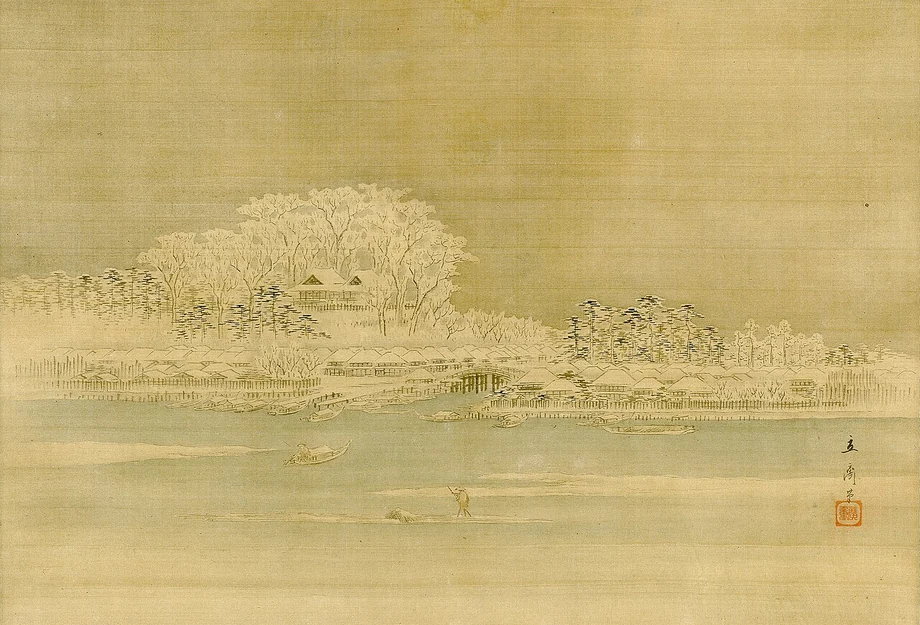
Sumida River
Supper by the river.
After his shift Shinjirō and O-Fumi walk down to the Sumida. After the great fire of 1657 Ryōgoku Bridge was built across it, and the districts of Honjo and Fukagawa on the far bank became part of the city.
The river had bridges and ferries along its length and carried much of the city’s traffic and goods. Its banks were where Edo went for the cherry blossom in spring and the cool breeze in summer.
Evening food stall
A city of single men, fed at stalls.
Edo had an unusually large male population: samurai, the retinues of lords in alternate residence, and single men sent from Kyoto, Osaka and Ise to staff the branches of merchant houses. Peddlers (botefuri) walked the streets, and open-air food stalls (yatai) stood here and there throughout the city.
Sushi, grilled eel, soba and tempura were all created or became widely popular in the Edo period.
Pleasure boats
Boats for the fireworks.
Utagawa Hiroshige, Fireworks at Ryōgoku (c. 1841) · The Met (CC0)
The fireworks over Ryōgoku Bridge could be watched from the bridge, from pleasure boats and restaurants on the river, or from distant rooftops.
The summer season at Ryōgoku opened on the twenty-eighth day of the fifth month with the river-opening ceremony (kawabiraki), and until early autumn crowds came to take the cool of the evening (yūsuzumi).
Moon & riverside willows
A month told by the moon.
Utagawa Hiroshige, Twilight Moon at Ryōgoku Bridge (1830s) · The Met (CC0)
Edo used a lunisolar calendar. A month followed the moon and had 29 or 30 days, and because twelve such months fall short of the solar year, a thirteenth month was added every two or three years.
To keep track of the seasons the year was also divided into 24 solar terms, independent of the moon. Risshun marked the beginning of spring, Rikka of summer, Risshū of autumn and Rittō of winter.
Time-bell tower
Six at sunset.
Edo used temporal hours. Day and night were each divided into six equal parts, counted from sunrise and sunset, so an hour of daylight was longer in summer than in winter.
The hours were named by the signs of the zodiac and also numbered from nine down to four: midnight and noon were nine, and sunrise and sunset were six. Japanese clockmakers built clocks that kept these changing hours.
The English word curfew
From above
A castle inside two rings of moats.
Tenpō Kaisei On’edo Ōezu (Revised Map of Edo, 1846 edition) · UBC Library
Edo Castle was ringed by an inner moat around the shogun’s compounds. Beyond it, within an outer moat, lay the lords’ residences, the townspeople’s quarters and temples and shrines. The city was laid out on a grid after the example of Kyoto, with areas set aside for samurai, for temples and shrines and for townspeople.
The keep burned in 1657 and was never rebuilt. The painting now shows its empty stone base. This is a schematic panorama: the pins connect the walk’s eight stops, with distances and positions compressed for navigation.
Spring · Months 1 to 3
New Year in the castle, the first sales in town.
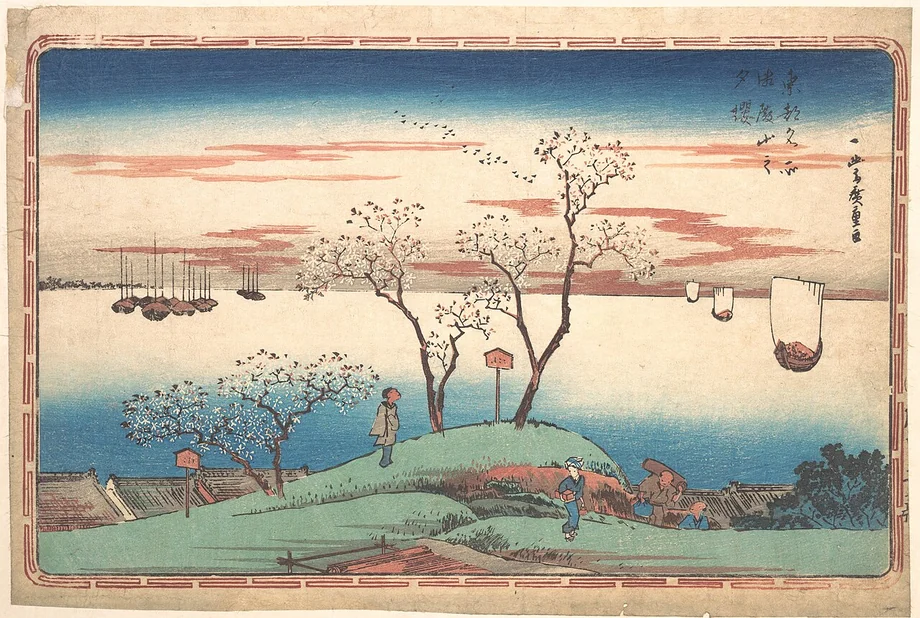
Utagawa Hiroshige, Evening Cherry Blossoms at Gotenyama (1831) · The Met (CC0)
On the first three days of the first month, lords came to the castle to give their New Year greetings to the shogun in the Ōhiroma. In town, the second day of the month was the first day of trade (hatsu-uri), the busiest of the year.
In the second month Inari shrines held their festival on the first day of the horse (hatsuuma). Before the third day of the third month the doll market at Jikkendana, near Nihonbashi, sold dolls for the girls’ festival, and then the cherry blossom drew crowds to Gotenyama and the banks of the Sumida.
Summer · Months 4 to 6
First bonito, the river opening and the Sannō festival.
Toyohara Chikanobu, Chiyoda no On-omote · Sannō Festival Viewed by the Shogun (1897) · The Met (CC0)
In the fourth month the first bonito (hatsu-gatsuo) came in, and Edo prized it. On the fifth day of the fifth month, the boys’ festival, samurai households set out flags bearing their crests, and irises were hung from the eaves as a charm.
On the twenty-eighth of the fifth month the river opening at Ryōgoku began the season of fireworks. On the fifteenth of the sixth month, in alternate years, the Sannō festival procession entered the castle at Hanzōmon, passed before the shogun, and left by Takebashi.
Matsuri Square
A summer procession below the walls.
Utagawa Hiroshige, Nagata Horse Riding Grounds at Sannō Shrine (c. 1832–38) · LACMA
Two of Edo’s festivals, Sannō in the sixth month and Kanda in the ninth, were called tenka matsuri, “festivals under heaven”, because their processions entered the castle and passed before the shogun. Each was held every other year, and the wards of the town provided the floats.
The procession kept a fixed order. It was led by the float of Ōdenmachō, a drum with a rooster on it (kankodori), after a Chinese tale of a ruler who set out a drum for complaints that nobody ever beat, so that roosters perched on it: a sign of peace. Next came Minami-Denmachō’s monkey carrying a sacred staff (gohei). Many researchers point out two mistakes in Hiroshige’s print of the Sannō procession entering at Hanzōmon, shown with the Ōtemon note: the monkey goes through the gate ahead of the rooster, and the rooster is white, the color used at the Kanda festival, where Sannō’s had five colors.
This festival is imagined: a float, musicians and a crowd below the castle walls at dusk, in no recorded square. Shinjirō and O-Fumi join the crowd as the lanterns are lit.
The torii gate has a watercolor of its own .
Festive timber float
A tall float pulled through the crowd.
A festival float (dashi) is a tall framework on four wheels, pulled through the streets to a shrine. Its top takes forms that vary from place to place, such as a shrine building, a boat or a mountain, and it is hung with lanterns, dolls, sculpture and textiles, some of them imported from Europe. Musicians ride on it and play.
A portable shrine (mikoshi) is carried on shoulders; a float is pulled. Before the Meiji period floats took part in the rites that welcomed a deity, and afterwards they became mainly parade decorations. Between festivals a float is kept in its own storehouse, the dashigura.
Townspeople & music
Music beside the float.
The Sannō festival of the Hie Shrine fell on the fifteenth day of the sixth month, and it was counted among the three biggest festivals in Edo. The same month the Kanda Myōjin held a festival of its own, the Tennō Matsuri, from the fifth to the fourteenth.
Utagawa Sadashige painted the procession between about 1830 and 1844, the years of this walk.
Castle wall & machiya
The town beside the castle wall.
The Sannō procession entered the castle at Hanzōmon, on its west side, passed before the shogun and left by Takebashi.
The castle’s stone walls were built in the early seventeenth century by lords whom the shogunate ordered to supply the labor and the stone, much of it andesite brought by sea from the Izu peninsula.
Autumn · Months 7 to 9
White robes on Hassaku, and chrysanthemum sake.
Utagawa Hiroshige, Matsuchiyama on the Sumida River (c. 1833–58) · Art Institute of Chicago
In the seventh month markets (kusaichi) sold what was needed for Obon, and on the sixteenth merchants’ employees had their day off (yabuiri). On the first day of the eighth month, Hassaku, was an important day for the shogunate, marking the day Tokugawa Ieyasu entered Edo in 1590; in the Yoshiwara the courtesans dressed in white.
On the ninth day of the ninth month, Chōyō, people drank chrysanthemum sake (kikuzake) for long life. In alternate years the festival of Kanda Myōjin filled the streets the same month.
Winter · Months 10 to 12
Maples, rake fairs and the year’s great cleaning.
Utagawa Hiroshige, Kinryūzan Temple at Asakusa (1856) · Library of Congress
The tenth month was Kannazuki, when the gods were said to leave their shrines for Izumo, and people went to see the maples at Kaian-ji in Shinagawa. In the eleventh month the theaters opened their new season with kaomise performances, and on the days of the rooster fairs sold bamboo rakes (kumade) to rake in good luck.
In the twelfth month came the great cleaning (susu-haki), and then the year-end markets (toshi-no-ichi), one of them at Asakusa, where people bought what they needed for the New Year.
Tea Pavilion
A tea room in winter.
This scene belongs to winter, when the sunken hearth was open, and lies outside the summer day of the walk. The tea room and its garden are imagined; they do not reproduce a recorded building.
Tea mattered to the shogunate. From the early seventeenth century the yearly journey of the shogun’s tea jars, bringing new tea to Edo, was one of its official annual events, and the practice of tea was part of the everyday life of the warrior class.
Moss garden & basin
A watered path and a stooping basin.
The garden on the way to a tea room is the roji, “dewy ground”. Sen Rikyū made it part of the gathering: a path of stepping stones on which guests left everyday life behind before the quiet of the room. It was planted mostly with evergreens, without bright flowers.
Just before the guests arrived, the host watered the garden so that it looked fresh. At a low basin, the tsukubai or “stooping basin”, guests washed their hands and rinsed their mouths before going in, as worshippers did at a shrine.
Sword rack & low door
A low entrance beside the sword rack.
The low door is a nijiriguchi, about 65 centimeters high and 60 wide. Sen Rikyū is credited with first using one, after a small doorway he had seen at a wharf near his home. A guest put in his hands, then his head, knelt on one knee and slipped in sideways.
Warriors left their swords on a rack outside (katanakake), usually to the left of the entrance, because the tea gathering was meant to leave the quarrels of the world outside. At Toyotomi Hideyoshi’s great tea gathering at Kitano in 1587, Rikyū’s tea room had a single sword shelf hung outside.
Sunken charcoal hearth
The kettle above the winter hearth.
The square opening in the floor is a sunken hearth (ro), usually about 44 centimeters on a side. It is used only in winter and spring; in summer and autumn it is covered with a mat or a wooden lid.
The kettle can sit over the charcoal or hang above it from a chain fixed to the ceiling. The open hearth is why this tea room belongs to winter in Edo’s year.
Poetry alcove & camellia
A scroll and a flower in the alcove.
The alcove (tokonoma) began as a place for a Buddhist painting with a vase, an incense burner and a candlestick before it. By the Muromachi period it held a Zen priest’s calligraphy beside a flower vase.
Tea masters built the alcove into the tea room and varied its size: Murata Jukō’s was about 180 centimeters wide, Takeno Jōō preferred a smaller one, and Sen Rikyū settled the forms still familiar today.