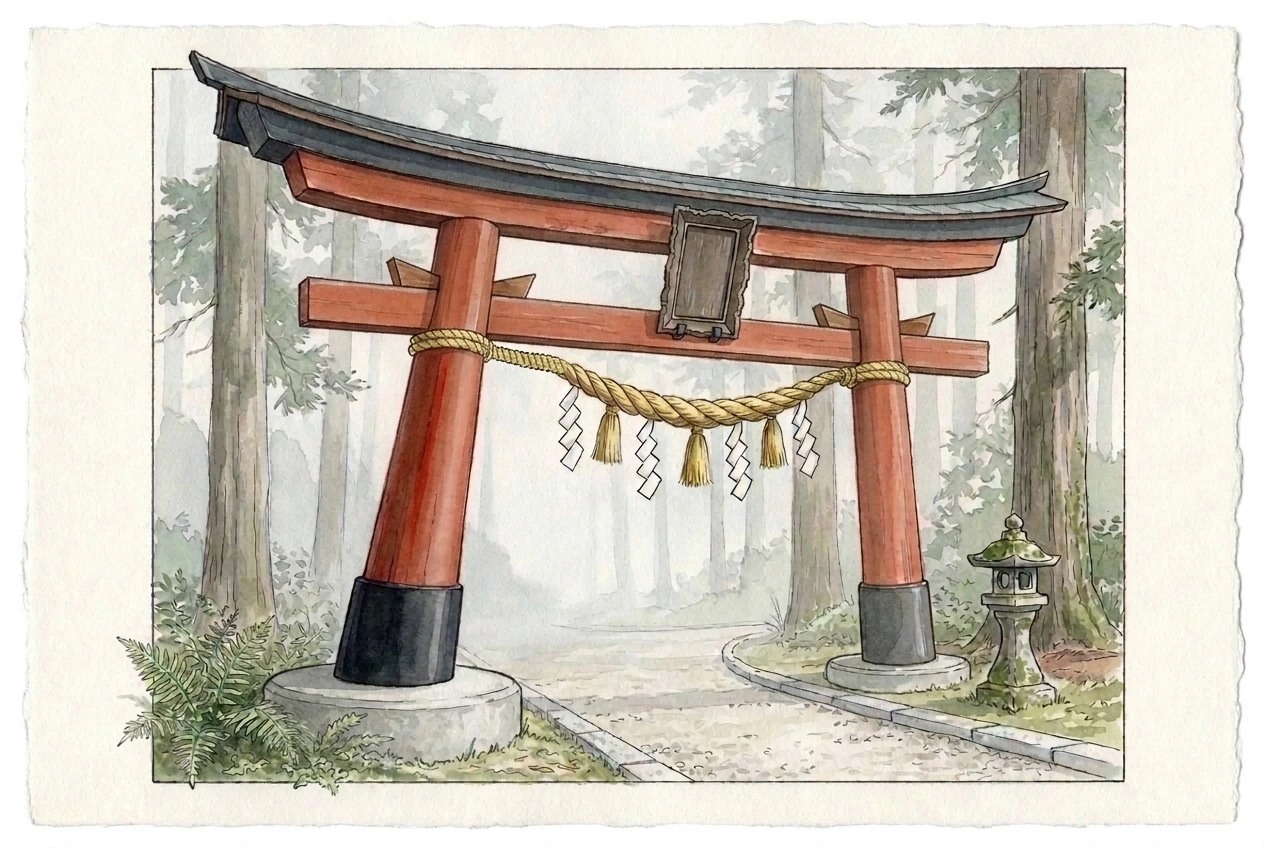
A myōjin torii is known by its top lintel (kasagi) and the second lintel fixed beneath it (shimaki), which curve upward at their ends; the ends are cut with an inward slant.
Wooden myōjin torii are often painted in vermilion and black. Stone ones were made too: the oldest, at Hachiman Shrine in Yamagata, dates from the twelfth century.
Below the lintels runs a straight tie beam (nuki) that passes through the pillars and runs on beyond them by about a fifth of its length. Where it enters each pillar, wedges (kusabi) are driven in on both sides.
At the center, between the second lintel and the tie beam, stands a short strut, either plain (tsuka) or covered by a framed panel bearing an inscription (gakuzuka), usually the shrine’s name. The panel in this painting is left blank.
A shimenawa is a straw rope hung in front of or around a place to mark it as sacred or pure, at the entrance to a shrine precinct or before its inner sanctuary. It is usually twisted to the left, and in front of a sanctuary its thick end hangs on the right. In ancient times such ropes were marks of ownership, and one way of writing the word, 七五三 (“seven-five-three”), is thought to come from the number of straw sections braided into it.
The white paper strips hanging from it are shide, folded and cut in two, four or eight. Once they were made of rough cloth from the bark of the paper mulberry; most are paper today.
The pillars of a myōjin torii lean slightly inward (uchikorobi). The height from the ground to the underside of the tie beam usually equals the distance between the pillars at their feet.
The pillars usually stand on mound-shaped or square stone bases (kamebara). Simpler gates once had their pillars sunk straight into the ground.
Visitors walking the approach to a shrine keep to the sides, because the middle of the path is meant for the deities to pass.
Stone lanterns (tōrō) came to Japan with Buddhism and were first used as votive lights at temples and shrines; later they lit the grounds of these precincts.
A torii has no doors and no wall on either side. The word means “bird perch”, and torii were once also called uefukazu-no-mikado, “roofless gate”. They stand at the entrances of Shinto shrines, separating the sacred precinct from the world around it, and they tell a shrine from a Buddhist temple at a glance.
The earliest record held to be reliable is an inventory of the properties of Ōtori Shrine in Izumi Province, dated 922, which mentions torii; by the middle of the Heian period they were certainly common. The oldest stone torii, at Hachiman Shrine in Yamagata Prefecture, dates from around the middle of the twelfth century, and the oldest wooden one, a ryōbu torii at Kubohachiman Shrine in Yamanashi Prefecture, from 1535.
Where the form came from is unclear. Some scholars compare it with the torana gateways around the Great Stupa at Sanchi in India, others with gateways in China and Korea. It may also have grown up in Japan: posts at the corners of a sacred area with a rope tied between them, then two taller posts with a rope across to make an entrance. At Ōmiwa Shrine in Nara two pillars joined only by a sacred rope still stand before the worship hall. A wooden lintel later took the rope’s place, and a tie beam below it made the simplest torii, the shinmei.
When Shinto and Buddhism drew together from the twelfth century, shrines were built inside the grounds of Buddhist temples, and torii still marked their entrances.
Torii fall into two main families. Shinmei torii have straight timbers, and until fairly recently their pillars were sunk about seven feet into the ground. Myōjin torii, like the one painted here, developed around the ninth century and are now the most common: their top lintels curve upward at the ends.
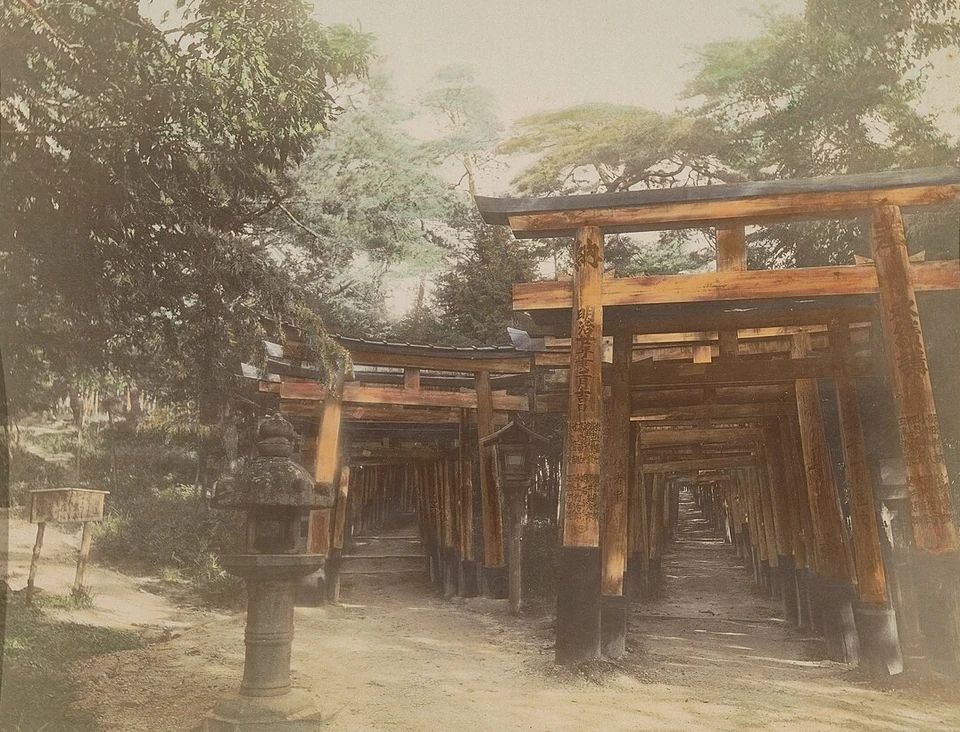
Some shrines are known for their gates. Fushimi Inari Taisha in Kyoto traces its founding to 711, and thousands of vermilion torii line the paths up the mountain behind it. Each was given by a person or a company, whose name and the date of the gift are written on the back. At Itsukushima Shrine, built by Taira no Kiyomori in 1168 on the island of Miyajima, the torii stands out in the sea.
Rows of donated vermilion torii at Fushimi Inari Taisha in Kyoto, photographed about 1887–1897, Rijksmuseum (CC0 via Wikimedia Commons).
On the approach visitors keep to the sides, because the middle is meant for the deities. At a water basin near the entrance they rinse the left hand, then the right, then pour water into a cupped hand to rinse the mouth, without drinking from the ladle.
At the offering hall they throw a coin into the box, ring the bell if there is one, bow twice, clap twice, pray for a few seconds and bow once more. Many draw a paper fortune (omikuji) and tie a bad one to a branch to leave it behind, or write a wish on a wooden plaque (ema) and leave it at the shrine.
A watercolor study of a myōjin torii on a shrine approach, with its lintels, tie beam, tablet, sacred rope and a stone lantern in one view. It is not a particular shrine’s gate. The story below includes a hand-colored Rijksmuseum photograph of the rows of donated torii at Fushimi Inari Taisha in Kyoto, taken between about 1887 and 1897.