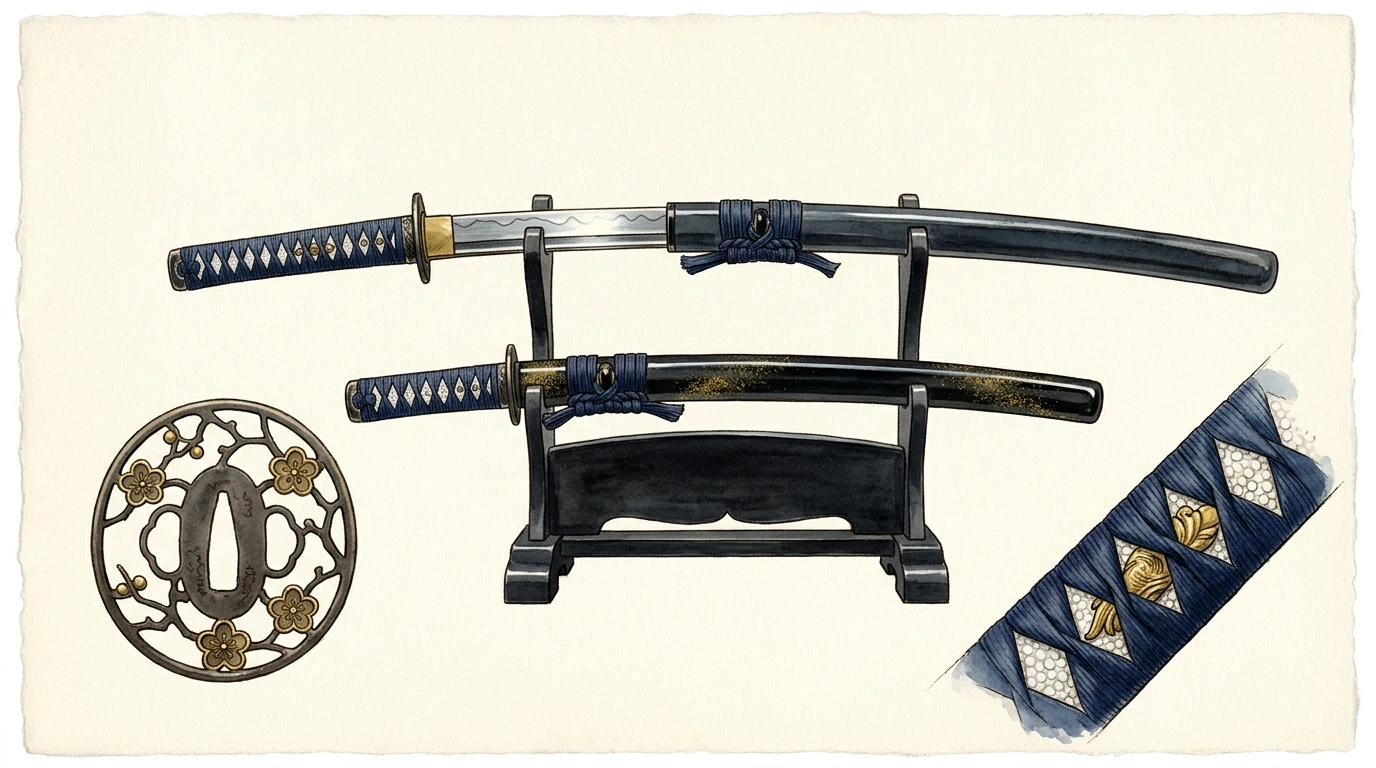
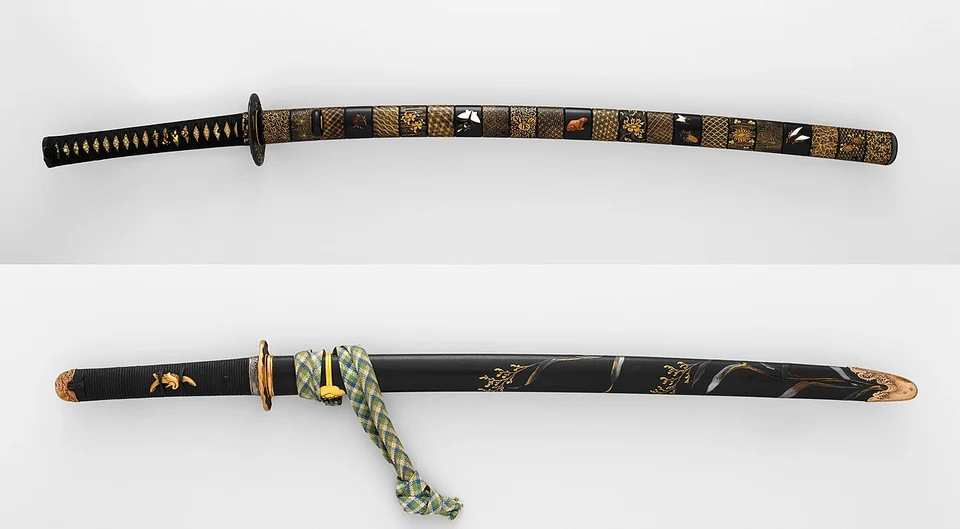
The scabbard (saya) is wood finished in lacquer, and in the Edo period its lacquer could be as finely worked as the metal fittings, with gold sprinkled into it (maki-e).
The braided cord (sageo) passes through a knob on the scabbard and was tied to the sash, so that the scabbard stayed in place when the sword was drawn.
Daishō literally means “big and little”: the long katana above, and the shorter wakizashi below.
The wakizashi suited fighting at close quarters, especially in towns. The pair marked a samurai until 1876, when the wearing of swords was banned and the samurai ceased to be a separate class.
Under the braided wrapping the wooden hilt is covered with the pale, rough skin of a ray (same), which shows through the gaps in the braid and keeps the wrapping from slipping.
The gold ornament beneath the braid is a menuki. Such fittings could carry finely worked motifs even where the hand partly covered them.
The katana gradually took the place of the longer tachi as fighting shifted toward infantry. Worn edge-up through the sash, it allowed a quick draw. Paired with the shorter wakizashi, it formed the daishō associated with samurai dress.
Under the Tokugawa, prolonged peace gave sword fittings a growing place in public display. The ruling class lived under strict rules of rank and dress; a guard, a lacquered scabbard or a hilt ornament offered room for personal taste.
A sword could remain sheathed and still tell an onlooker something about its owner. In Edo, metalworkers and lacquerers made those visible parts into works of art.
Traditional sword steel, tamahagane, came from iron sand smelted with charcoal. Its uneven carbon content required further work at the forge.
Folding and hammering evened the steel and produced its visible grain. One method enclosed a softer core in harder outer steel, balancing resilience with an edge that could be sharpened.
The smith applied clay more thinly at the edge, heated the blade and quenched it. Different cooling rates produced a hard cutting edge and softer body. Polishing revealed the hamon, the pattern of the hardened region.
Two nineteenth-century katana koshirae mountings with maki-e lacquerwork and fittings inscribed by Takamoto Hidemune, Metropolitan Museum of Art (CC0 via Wikimedia Commons).
Masamune’s name belongs to surviving blades as well as later legend. The Tokyo National Museum preserves Kanze Masamune, a fourteenth-century katana designated a National Treasure.
Sanjō Munechika’s Mikazuki Munechika, now in the Tokyo National Museum, takes its name from crescent-shaped patterns in the tempered steel. It is a tachi from the Heian period and was counted among Japan’s Five Famous Swords.
A Muramasa blade at The Met offers another way to follow a sword through time. Its sixteenth-century steel forms part of a pair with nineteenth-century mountings, once owned by the Tokugawa shogun’s family. A blade and its dress could be centuries apart.
Nagasone Kotetsu began as an armorer and turned to swordmaking around the age of fifty, settling in Edo. The craft continued to revisit its earlier forms: the Pitt Rivers Museum’s katana of about 1850–1865 belongs to a period of renewed interest in older methods and styles.
A watercolor study of an Edo-period katana above its shorter companion, the wakizashi, with enlarged views of the iron guard (tsuba) and the braided hilt (tsuka). The story below includes a museum photograph of two nineteenth-century katana mountings.