Skip to the picture
Pictures with Stories On Life & Everything

Space

The Sun

Explore the Sun’s surface and the atmosphere above it. Then follow the observations that helped us understand our nearest star.

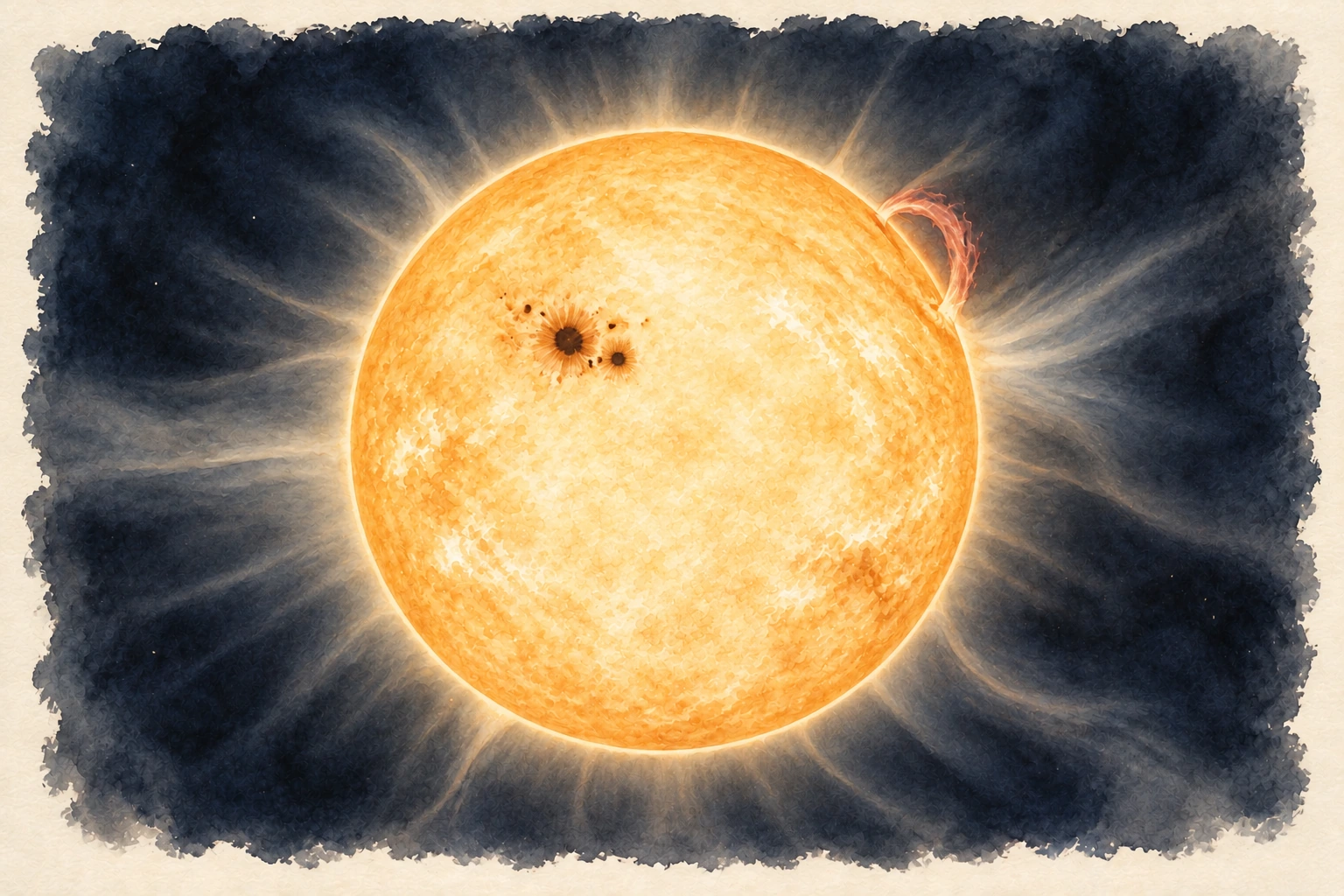
A golden watercolor Sun with a small group of dark sunspots above and left of center, a rose-colored arch above its upper-right limb, and a faint corona spreading into dark blue space.

The Sun’s visible surface and atmosphere, brought together in one illustration.

  1. The visible surface
  2. Sunspots
  3. Prominence
  4. The corona
← All pictures

← Return to Mercury

Look more closely.

Click a part of the picture to open its explanation. “Show places to look” keeps the name labels visible. On a small screen, the names are also listed beneath the picture.

“Full screen” gives the picture more room. Use “Exit full screen” or Escape to return to the page.

Tab moves between the details and Enter opens one. Escape closes an explanation first, then leaves full screen.

The visible surface

Photosphere

The layer that gives us visible light.

Most of the visible light we receive from the Sun comes from its photosphere. This is a layer of gas, with no solid ground beneath the bright face we see.

Near the disk’s edge, our line of sight passes obliquely through that layer. We see cooler, dimmer material higher up, making the limb appear darker than the center.

Close observations reveal granules, the tops of convection cells. Hot material rises in their bright centers, cools and sinks along darker edges. Individual granules are far too small to be mapped in this whole-Sun painting; its mottled brushwork is only a suggestion of an active surface.

Sunspots

Magnetism on the surface

Dark by comparison with their surroundings.

The dark centers are called umbrae. Lighter, streaked penumbrae surround them. Strong magnetic fields restrict the transport of heat toward the surface, so these areas become cooler than the nearby photosphere.

They still glow intensely. Their darkness comes from the contrast with the hotter material around them. Seen in ultraviolet or X-rays, the active regions above sunspots can be very bright because magnetic fields hold hot gas higher in the atmosphere.

The number of spots rises and falls over the roughly 11-year solar activity cycle. Their appearance helps scientists follow changes in the Sun’s magnetic activity.

Prominence

Plasma above the limb

Material held above the surface.

The arch represents a prominence, relatively cool, dense plasma held in the hot corona by magnetic fields. Its shape follows the field that supports it.

Against the dark sky beyond the limb, this material appears bright. Seen against the solar disk, a similar structure can appear as a dark filament. The viewpoint changes its appearance.

Prominences may persist for days or longer, and some erupt. This painting shows a supported arch. Its visibility beside the bright photosphere combines different observing methods into one illustration.

The corona

The outer atmosphere

A faint atmosphere at a higher temperature.

The wispy glow represents the corona. During a total solar eclipse, the Moon hides the much brighter photosphere and this outer atmosphere becomes visible around it. Instruments can also block the bright disk to study the surrounding gas.

The corona can reach temperatures of a million degrees Celsius or more, far above the photosphere. Explaining how energy heats it remains an active area of research.

Its streamers and loops change with the Sun’s magnetic activity. Some coronal material escapes into space as the solar wind. Here the faint light is strengthened so its structure can be explored beside the disk.

What the light told us

The spots in this picture would move if we watched the Sun over successive days. Following sunspots across the disk gave astronomers a way to detect the Sun’s rotation. The movement also reveals that different parts turn at different rates. The equatorial region goes around faster than the poles. That is possible because the Sun is made of gas and plasma, with no rigid surface holding it to one pace.

NASA Marshall · The Photosphere (opens in a new tab)

Light also carries evidence of what a star contains. In her 1925 doctoral thesis, Cecilia Payne used stellar spectra and the physics of ionization to study the abundance of elements. Her results pointed to enormous quantities of hydrogen and helium. That challenged the prevailing idea that stars had a composition much like Earth’s. The astronomer Henry Norris Russell urged caution, and Payne qualified the conclusion in her thesis. Four years later, Russell’s own work supported it. The bright disk above is the visible layer of a star made mostly of those two elements.

Harvard–Smithsonian Wolbach Library · Cecilia Payne’s Doctoral Thesis (opens in a new tab)

The source of the light lies much deeper than the layer we can see. In the core, at about 15 million degrees Celsius, nuclear reactions fuse hydrogen into helium and release energy. Energy moves outward through the radiative zone and then the convection zone before reaching the photosphere. The visible surface shown here is about 5,500 degrees Celsius. It is the place from which much of the visible light escapes, far above the core that powers it.

NASA Science · Layers of the Sun (opens in a new tab)NASA Science · Sun Facts (opens in a new tab)

The faint corona brought another surprise. Its spectrum contained bright lines that did not match known materials, so astronomers proposed an element called coronium. The explanation turned out to be extreme heat. At temperatures above a million degrees Celsius, atoms lose many of their electrons. Heavier elements, including iron, can still retain a few, and those highly ionized atoms produce the unfamiliar lines. The delicate glow around the disk comes from gas hotter than the visible surface beneath it.

NASA Marshall · The Corona (opens in a new tab)

For a long time, the corona was studied from a distance. On April 28, 2021, Parker Solar Probe passed through a boundary where measurements showed that it had entered the magnetically dominated solar atmosphere. It sampled particles and magnetic fields directly. The phrase ‘touching the Sun’ describes that passage through the corona. There was no solid ground to land on. Farther out, escaping coronal material becomes the solar wind, carrying the Sun’s influence through the region we have been exploring.

NASA · Entering the Solar Atmosphere (opens in a new tab)NASA Science · Layers of the Sun (opens in a new tab)
About this picture and its sources

An educational composite based on solar observations. The photosphere, prominence and faint corona are shown together so each can be explored. Their visibility and relative brightness combine views normally obtained with different filters or during an eclipse; this is not a single view through an ordinary telescope. Gold and rose are watercolor choices. The Sun’s visible light is white. Features are arranged rather than copied from one observation, and the brush texture does not resolve individual granules. The corona is made more visible than it would be beside the unobscured disk.