Skip to the picture
Pictures with Stories On Life & Everything

Space

Through the Solar System

Begin near Earth. Follow the worlds into their closer views.

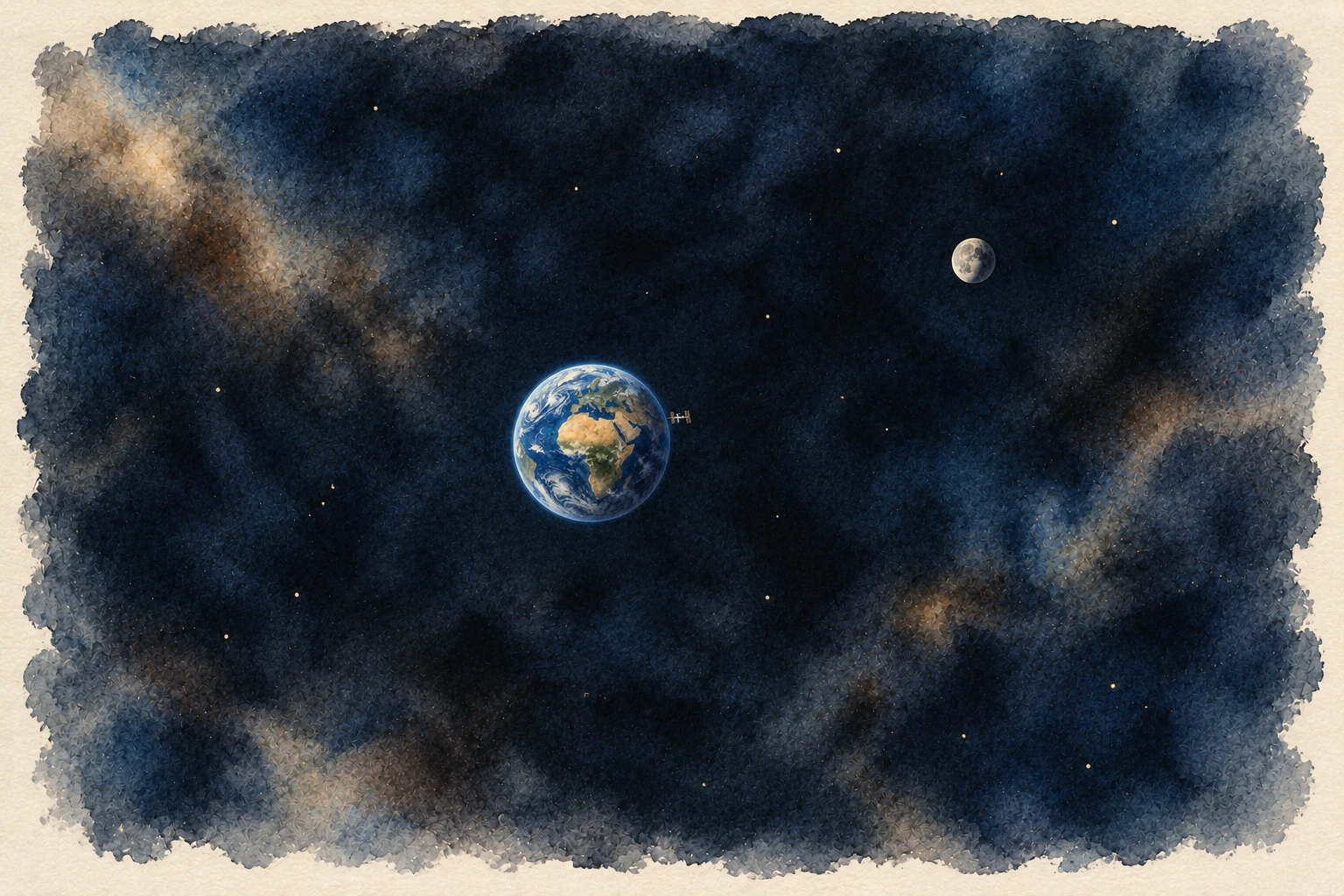
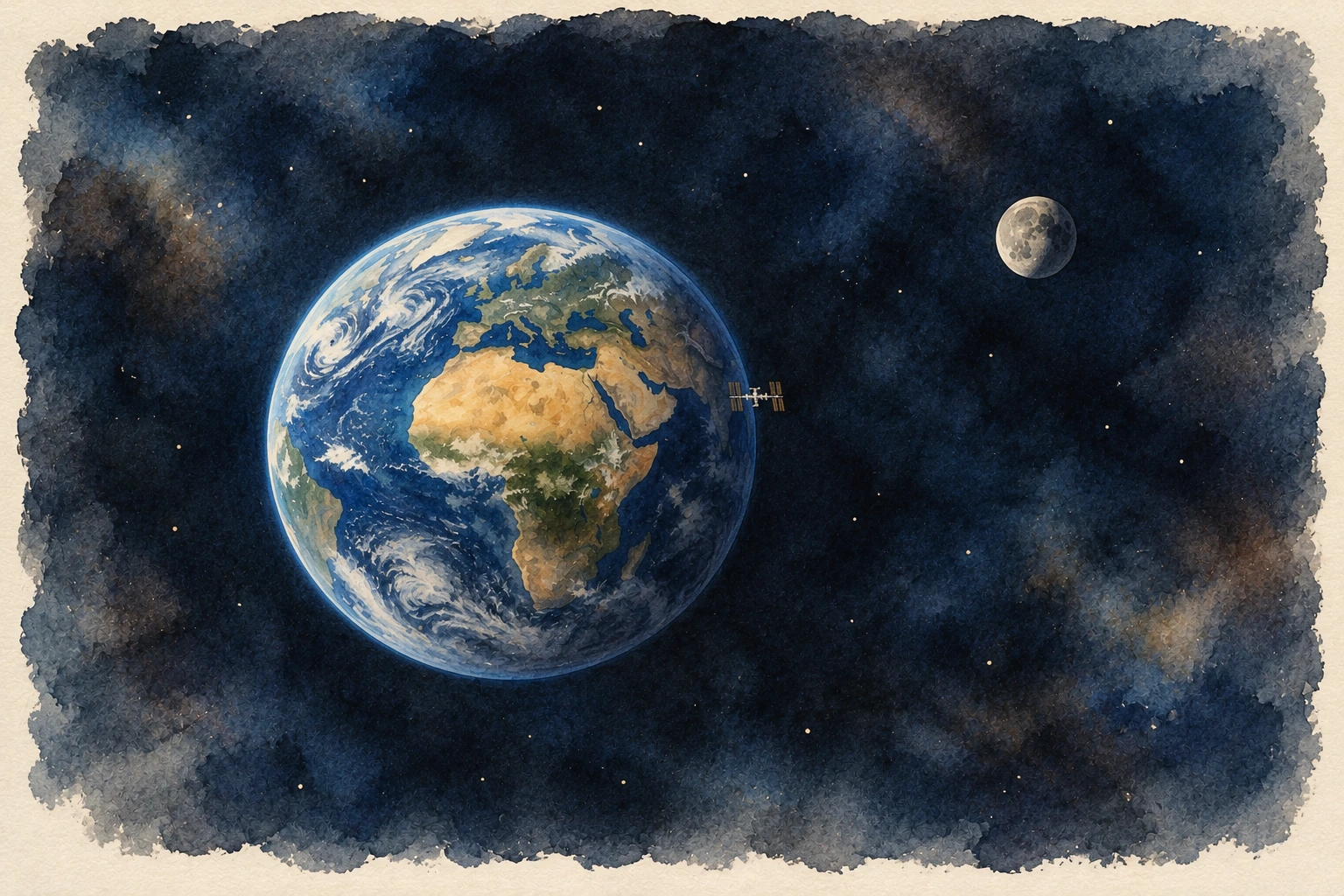
A wide watercolor view of Earth, a small gray Moon and the International Space Station, separated by indigo space.
Travel to Earth Travel to the Moon
A closer watercolor view of Earth with Africa, blue oceans and cloud bands. The Moon and space station remain visible.
Travel to the Moon
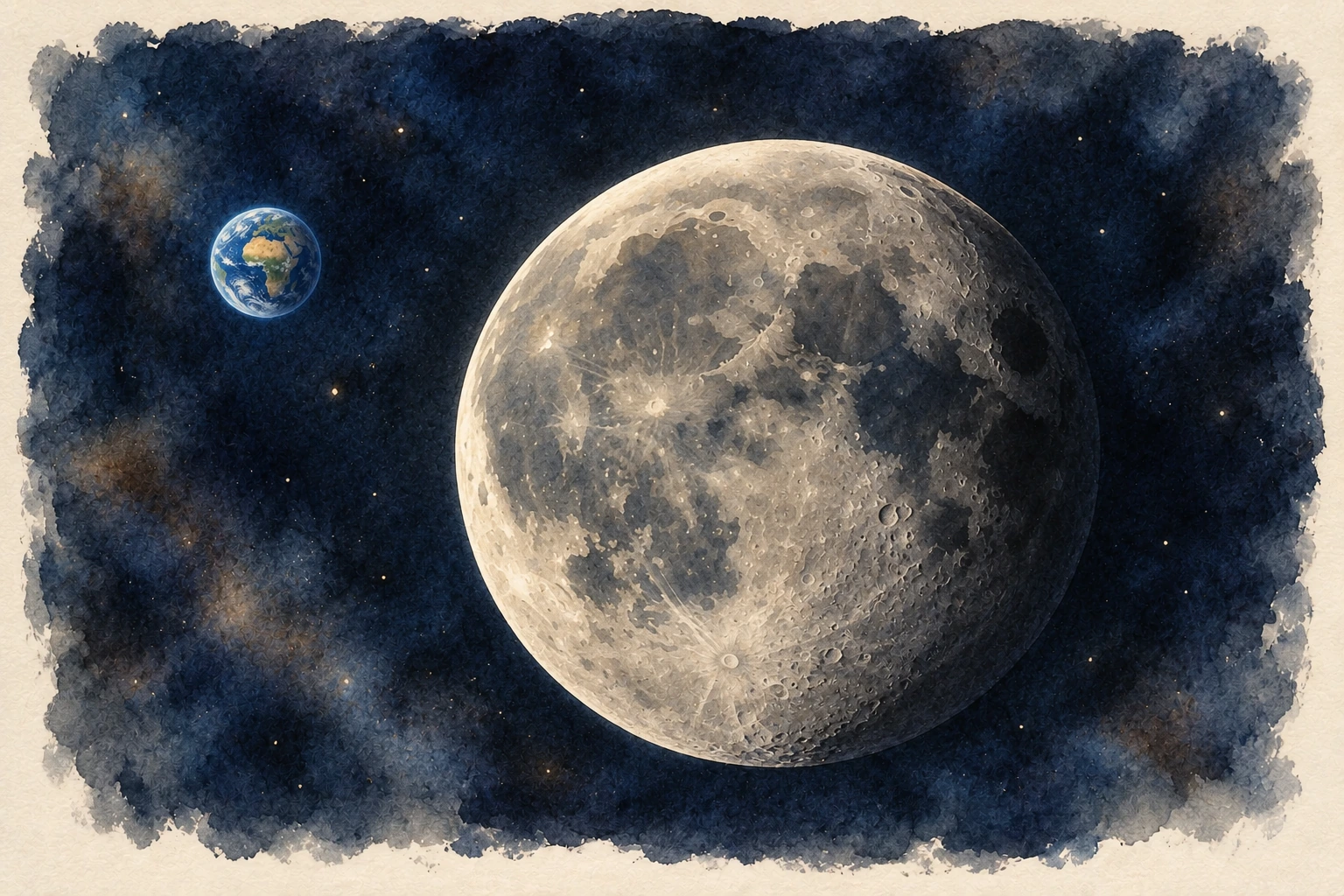
A large watercolor Moon with dark lava plains and lighter cratered highlands, with a small blue Earth to the left. A tiny rust-colored Mars to the upper right marks the next destination.
Travel to Earth Travel to Mars
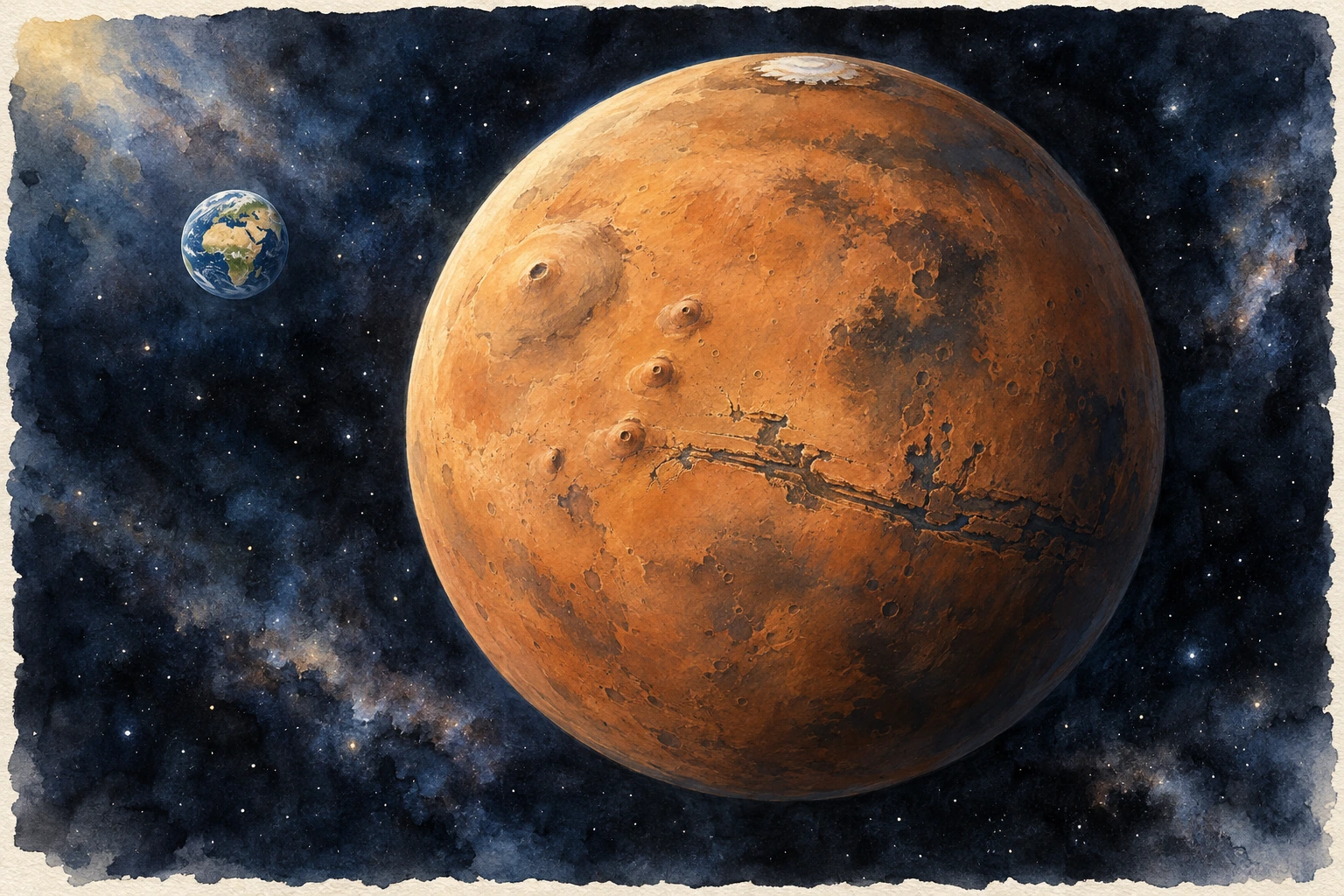
Watercolor Mars with a broad Olympus Mons at upper left, smaller Tharsis volcanoes, a branching canyon across its lower middle and a pale north polar cap. A small blue Earth is visible to the left, and a tiny striped Jupiter at upper right marks the next destination.
Travel to Earth Travel to Jupiter
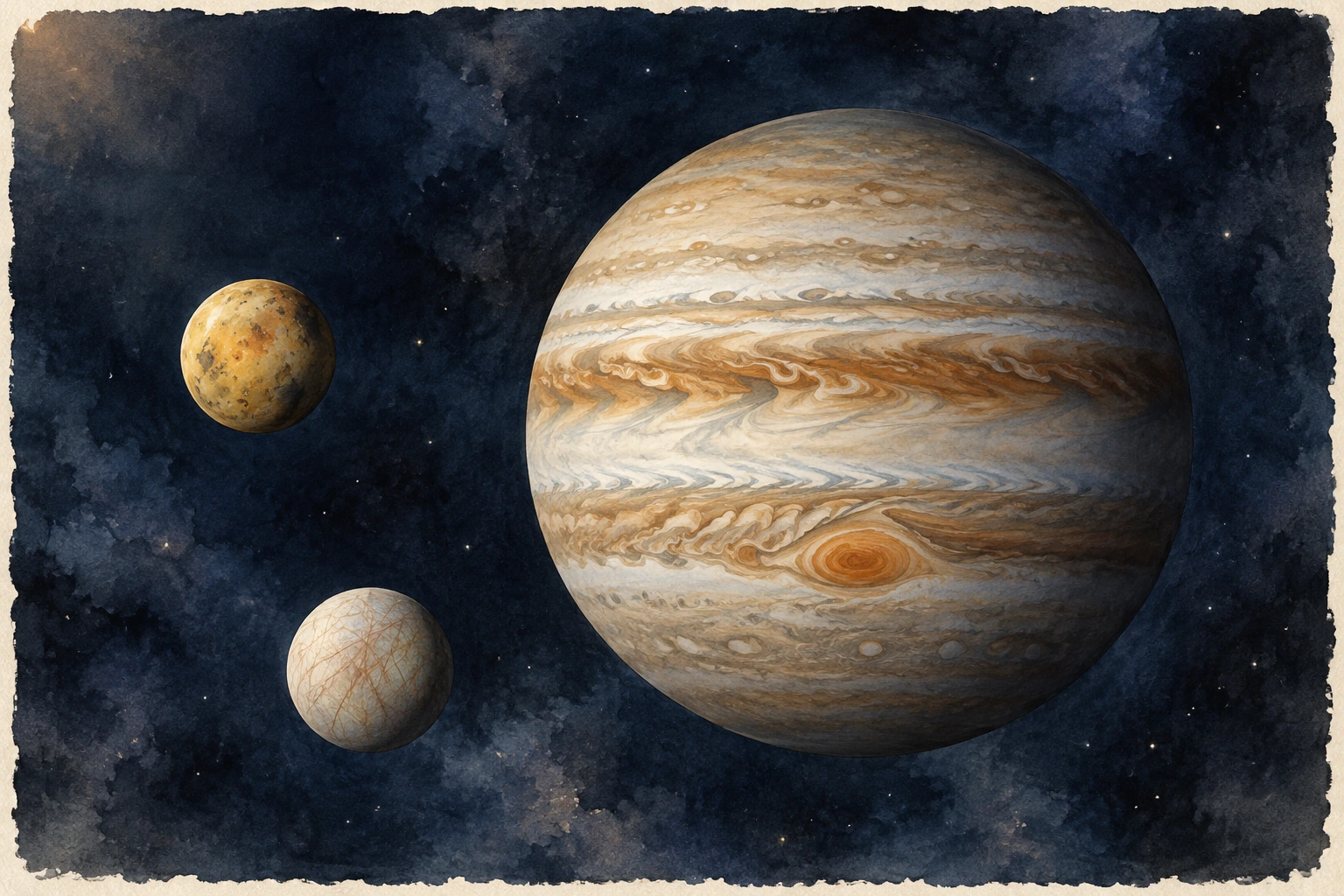
Watercolor Jupiter with cream and brown cloud bands and an orange-red oval storm below its equator. Ochre-yellow Io is to the left, and pale fractured Europa is below it. A tiny Mars at upper left offers a return.
Travel to Mars

Look more closely.

Touch a world to go there. Its name label opens information. Other labels reveal details in the scene. “Show places to look” keeps all the labels visible and shows a list of destinations and details. You can travel through the picture or use the links beneath it, back to the previous world or on to the next.

“Full screen” gives the picture more room. Use “Exit full screen” or Escape to return to the page.

Tab moves between the details and Enter opens one. Escape closes an explanation first, then leaves full screen.

Earth

Earth

The ground, seen from space.

Earth is the third planet from the Sun and the largest of the four rocky inner planets. Its English name comes from a Germanic word meaning “the ground.”

The watercolor brings together the blue ocean, land and white cloud bands. Their shapes are an interpretation of Earth, with Africa facing us.

Oceans

Earth · Oceans

Mountains beneath the Atlantic.

The blue water west of Africa is the Atlantic Ocean. Beneath it runs the Mid-Atlantic Ridge, part of a mountain system that extends for nearly 65,000 kilometers around Earth. More than 90% of that system lies underwater.

Along the ridge, tectonic plates move apart. Molten rock rises into the opening and cools into new ocean crust. The Mid-Atlantic Ridge spreads at roughly two to five centimeters a year, gradually adding seafloor between the continents.

Oceans cover about 71% of Earth. Much of the ground beneath them is hidden from this view, including the volcanic ridges where the surface is being made.

Atmosphere

Earth · Atmosphere

Most weather fits into a shallow layer.

Follow the pale blue curve around Earth. The atmosphere becomes thinner with height, gradually fading into space. Most familiar weather takes place near the bottom, in the troposphere, whose average height is only about 12 kilometers. It reaches higher over the equator and is shallower over the poles.

The white cloud bands belong mainly to this lowest layer. Above them, the stratosphere contains the ozone layer, which absorbs harmful ultraviolet radiation from the Sun.

Farther up, the International Space Station travels through the extremely thin air of the thermosphere. The visible blue edge gives us a sense of the atmosphere, while its outer reaches extend well beyond that narrow band.
ISS

Earth orbit · International Space Station

Sixteen sunrises in a day.

The station’s rectangular solar wings supply electrical power to its living and working spaces. This small outpost circles Earth about once every 90 minutes, giving its crew roughly 16 sunrises and sunsets in 24 hours.

Inside, a released object floats beside an astronaut because both are falling with the station. Earth’s gravity keeps pulling them inward, while their sideways motion carries them around the planet. This continuous free fall produces the condition called microgravity.

Bodies adapt to that environment. Muscles and bones do less work supporting a person’s weight, so astronauts exercise for at least two hours a day to help limit the resulting losses.

The Moon

The Moon

Why one face keeps returning.

The familiar dark and light regions stay on the side of the Moon that faces Earth. The Moon turns once on its axis in the same time that it completes one orbit around us. This is synchronous rotation, also called tidal locking.

Over time, Earth’s gravity deformed the rotating Moon. Friction within the changing shape dissipated energy and slowed its spin until rotation and orbit became synchronized.

Sunlight still moves across both hemispheres. The far side has day and night, just as the near side does. The phases we see show how much of the sunlit half is facing us. Across the real gap between Earth and the Moon, about 30 Earth-sized planets would fit.

Lava plains

The Moon · Maria

The dark plains were once lava.

Look at the broad dark areas between the lighter highlands. They are called maria, Latin for seas. Ancient lava spread into large impact basins and cooled into plains of basalt.

Basalt reflects less sunlight than the rocks in the surrounding highlands. The difference in brightness tells us something about the surface itself. These patches keep their character as the Sun moves across them, while the line between lunar day and night changes with the phases.

The Moon as a whole reflects only about a tenth of the sunlight that reaches it. Much of its surface is dark gray. Its closeness to Earth allows that modest amount of reflected light to make a full Moon bright enough to cast shadows.

Craters

The Moon · Impacts

An old surface keeps the impacts.

The round depressions in the highlands record collisions with objects traveling through space. The Moon’s sparse atmosphere offers little protection, and a large impact can excavate a crater far wider than the object that made it.

On Earth, water and wind wear down craters, while plate tectonics reshapes and recycles the surface. Lunar craters can remain recognizable for billions of years. Later impacts and the solar wind gradually alter them, so even a relatively fresh-looking crater may be hundreds of millions of years old.

The repeated bombardment also breaks rock into smaller fragments and fine dust. This loose covering is called regolith. Both the craters and the material around them preserve evidence of the collisions that shaped the Moon.

Mars

Mars · The red surface

Rust carried across a planet.

Mars owes much of its reddish color to oxidized iron minerals in its dust. Over billions of years, erosion broke down iron-bearing material, and winds spread the fine grains across the planet.

That dust also holds clues to earlier conditions. A 2025 study compared spacecraft observations with laboratory-made Mars dust and found a close match with ferrihydrite, a water-bearing form of iron oxide.

Ferrihydrite commonly forms in cool water. The result suggests that some of the material responsible for Mars’s familiar color formed during a much wetter period, before being carried across the surface.

Olympus Mons

Mars · Olympus Mons

A mountain built by flowing lava.

The broad rise to the left of the other volcanoes is Olympus Mons. About 600 kilometers across, this shield volcano was built by overlapping lava flows. Its slopes are gentle, with a steep scarp around the outer edge.

The depressions at its summit are calderas. As underground magma chambers emptied, the ground above collapsed. Later eruptions and collapses produced overlapping depressions.

Orbital images let scientists read the order of events. A lava flow that covers another must be younger. The mountain preserves many such crossings, so its surface records repeated episodes of building and collapse.

Valles Marineris

Mars · Valles Marineris

A canyon opened by a stretching crust.

The long broken band across the lower part of the globe is Valles Marineris, a canyon system about 4,000 kilometers long. Its connected troughs extend east from the Tharsis volcanic region.

Scientists think the crust stretched and fractured as the neighboring volcanic plateau rose. Parts of the ground dropped, opening deep troughs. Erosion later widened and reshaped them.

Some canyon walls have collapsed in enormous landslides. Orbital images show debris spread below the slopes, together with layers and dark deposits on the canyon floor. The outline we see brings together several processes acting over a long time.

North polar cap

Mars · The north polar cap

Ice that changes with the seasons.

The pale patch near the northern limb marks the north polar cap. A core of water ice persists through the northern summer. In winter, a wider seasonal covering of carbon dioxide frost and ice grows around it.

As sunlight returns, carbon dioxide ice changes directly into gas, a process called sublimation. The bright area retreats and exposes darker terrain, including a ring of sand dunes.

At the edges, spacecraft have photographed layers containing different mixtures of ice and dust. These deposits preserve changes in the Martian climate. The small white patch in this view is the top of a much longer record.

Jupiter

Jupiter

A world with nowhere to land.

Jupiter is the fifth planet from the Sun and the largest in the solar system, about eleven times as wide as Earth. The striped globe shows its upper clouds. Beneath them lies an enormous body made mostly of hydrogen and helium.

Pressure and temperature rise with depth, compressing hydrogen into liquid. There is no solid surface where a spacecraft could land. Farther inside, the pressure is great enough for hydrogen to conduct electricity like a metal.

Juno’s measurements suggest that even the core has an indistinct boundary. Heavier material appears partly mixed into the surrounding hydrogen, giving Jupiter what researchers call a dilute core.

Cloud bands

Jupiter · Belts and zones

Winds that reach deep into Jupiter.

The pale stripes are called zones, and the darker stripes are belts. They follow Jupiter’s eastward and westward winds. Along their boundaries, the clouds curl into smaller swirls and eddies.

Juno measured tiny variations in Jupiter’s gravity to investigate how far these flows extend. The results showed that the winds reach roughly 3,000 kilometers below the cloud tops, carrying a substantial part of the planet’s atmosphere with them.

Jupiter turns once in about ten hours. Its rapid rotation helps organize the winds into the long bands visible here. Their familiar pattern is the outward sign of motion extending far below what a camera can see.

Great Red Spot

Jupiter · The Great Red Spot

A storm that changes shape.

The rusty oval below Jupiter’s equator is the Great Red Spot. It is an anticyclone, a storm circulating around a region of high pressure, held between two strong jet streams. Astronomers have monitored it for more than 150 years.

Hubble observations from December 2023 to March 2024 showed the storm stretching and squeezing over a roughly 90-day cycle. Its shape, brightness and motion changed together. Those observations did not establish what caused the oscillation.

The oval in the painting represents a changing weather system. Comparing images taken at different times lets researchers follow its behavior, including the long-term shrinking recorded by Hubble.

Io

Jupiter’s moons · Io

A moon heated by its orbit.

Io’s yellow and rusty surface carries sulfur-rich deposits and dark volcanic areas. Eruptions repeatedly cover older ground, making this small rocky moon the most volcanically active world in the solar system.

Jupiter pulls strongly on Io, while Europa and Ganymede repeatedly disturb its orbit. The resulting slightly elliptical path makes Jupiter’s tidal pull vary. Io flexes as it travels, and this movement generates heat inside the moon.

That heat feeds volcanic activity. Fresh flows and deposits can cover impact craters, continually changing the surface. The mottled colors in this view belong to a landscape that is being renewed.

Europa

Jupiter’s moons · Europa

Clues to an ocean under the ice.

The pale surface of Europa is water ice crossed by reddish-brown fractures. Its relatively small number of impact craters suggests that the surface has been renewed over geological time.

A particularly strong clue to what lies below came from the Galileo spacecraft. It measured a magnetic response around Europa as Jupiter’s magnetic field swept past. Scientists interpret that response as evidence for an electrically conducting layer beneath the ice, most plausibly a global ocean of salty water.

The evidence for an ocean is strong, but the ocean itself has not been directly observed. The cracked shell visible here is the boundary through which scientists investigate that hidden interior.

About this picture and its sources

Five connected watercolor scenes lead from Earth’s vicinity to Earth, the Moon, Mars and Jupiter. Recognizable worlds and the direction of sunlight continue across the views. These are scientific illustrations with simplified features. Sizes, distances and viewpoints are arranged for exploration; they do not show a live sky, an exact surface map or a spacecraft flight path. The ISS is enlarged so its structure can be seen. Martian relief is emphasized to make the volcanoes and canyon visible. Io and Europa are enlarged separately to show their surfaces; their sizes and separations are not to scale. Jupiter’s cloud patterns are an interpretation of a changing atmosphere.

The illustration was made with help from AI, using the references below for the scientific features.