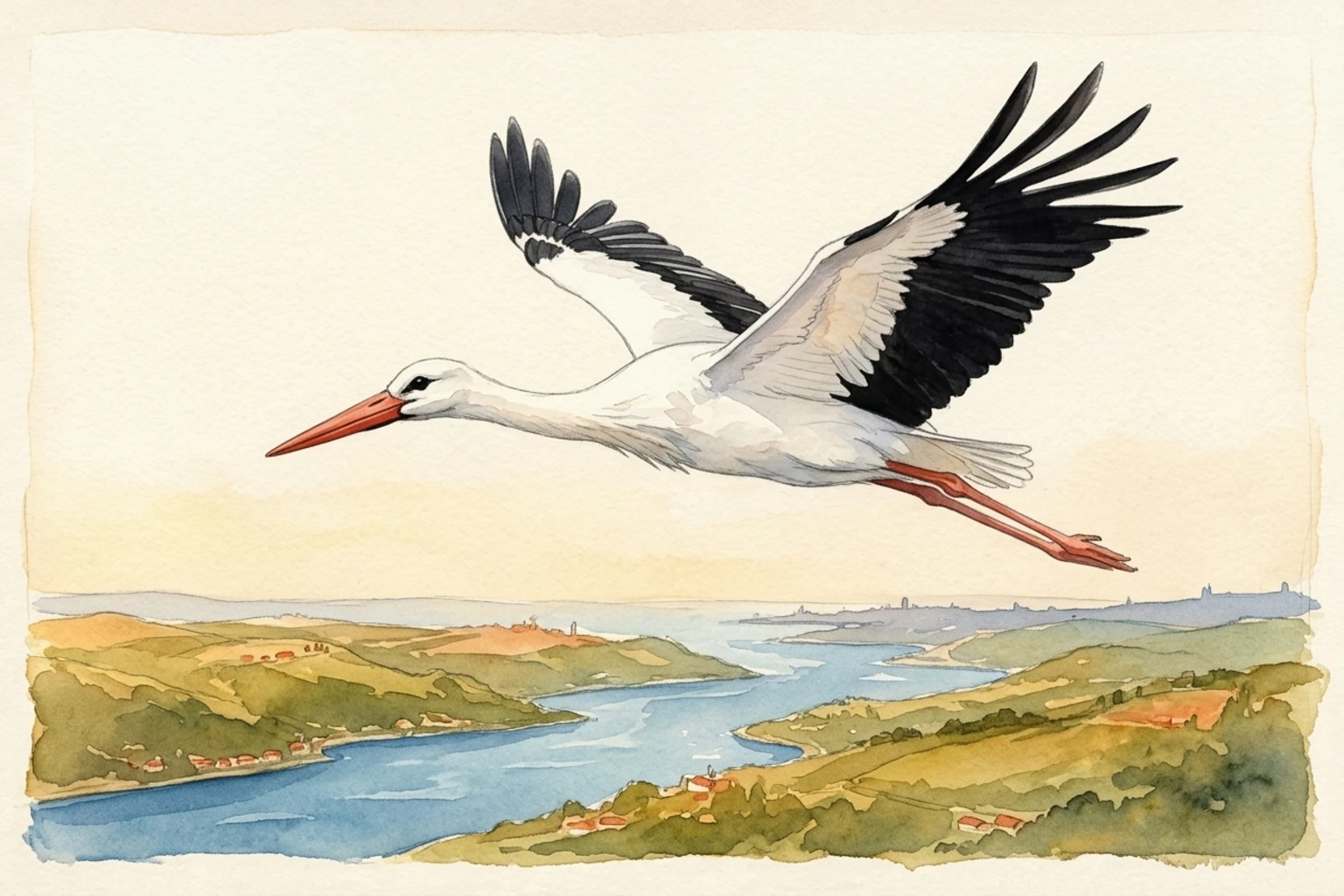
A white stork’s broad wings and separated outer primary feathers are built for thermal soaring. The bird circles inside a rising column of warm air to gain height, then glides forward for kilometers before entering the next thermal.
While the body and inner wing coverts are white, the outer flight feathers that bear the heaviest aerodynamic load are black. The pigment melanin strengthens feather keratin, making dark wingtips more resistant to mechanical abrasion and wear over a migration that can exceed ten thousand kilometers.
In the air, a white stork holds its neck stretched straight forward, a silhouette that sets it apart at a glance from herons and egrets, which fold their necks back into an S-curve.
It was through the neck that the 1822 stork found near Klütz carried an African wooden spear all the way to northern Germany. At least two dozen other “arrow storks” were recorded in Europe in the decades that followed, each carrying hunting weapons from its winter quarters in Africa.
The red of an adult white stork’s bill and legs comes from carotenoid pigments in its food, including crustaceans and amphibians. Fledglings leave the nest with dark grey bills that turn red as they mature.
Adult white storks have a reduced vocal organ and rarely use a voiced call. At the nest, they greet a mate by bending the neck backward until the crown rests on the back and clattering the upper and lower mandibles together.
On the ground, long unfeathered legs let the stork walk through marshes and wet meadows while hunting by sight. In flight, the legs trail behind the tail, keeping the body streamlined.
Rising columns of warm air form over sun-heated ground and weaken over water. Because crossing a wide sea forces a soaring bird into costly flapping flight, white storks bypass the open Mediterranean.
Eastern European storks follow the land to the straits instead. Over the Bosphorus in İstanbul, hundreds of thousands pass in flocks each spring and late summer, climbing on the thermals of one shore until they are high enough to glide across the water to the other.
Until the nineteenth century, the disappearance of storks and swallows each autumn was an open question in Europe. Because few naturalists had followed the birds south, serious accounts still repeated Aristotle’s old suggestion that some birds spent the winter asleep in mud at the bottom of lakes and marshes.
On 21 May 1822, a white stork was shot on the estate of Bothmer near Klütz, in northern Germany. Pierced vertically through its neck was an eighty-centimeter wooden spear with an iron tip. Examination showed the weapon came from central Africa. The stork had survived the wound on its wintering grounds and flown thousands of kilometers back to the Baltic coast with the shaft in place. Preserved in the Zoological Collection of the University of Rostock as the Rostocker Pfeilstorch, the bird gave physical proof of long-distance migration.
Satellite and GPS tracking have since mapped the journey in detail. A white stork weighs three to four kilograms and has a wingspan of about two meters; flapping across long distances costs far more energy than gliding on rising warm air. Experienced adults rely on thermals over land and avoid wide sea crossings, funneling eastern European populations across the Bosphorus over İstanbul each spring and late summer on their way between Europe and Africa.
A watercolor illustration of a white stork in thermal flight over the Bosphorus. The bird is shown close in the upper sky while the strait and hills lie far below, bringing the anatomy of soaring flight and the geography of the crossing into one view.