Skip to the picture
Pictures with Stories On Life & Everything

Astronomy

The quasar

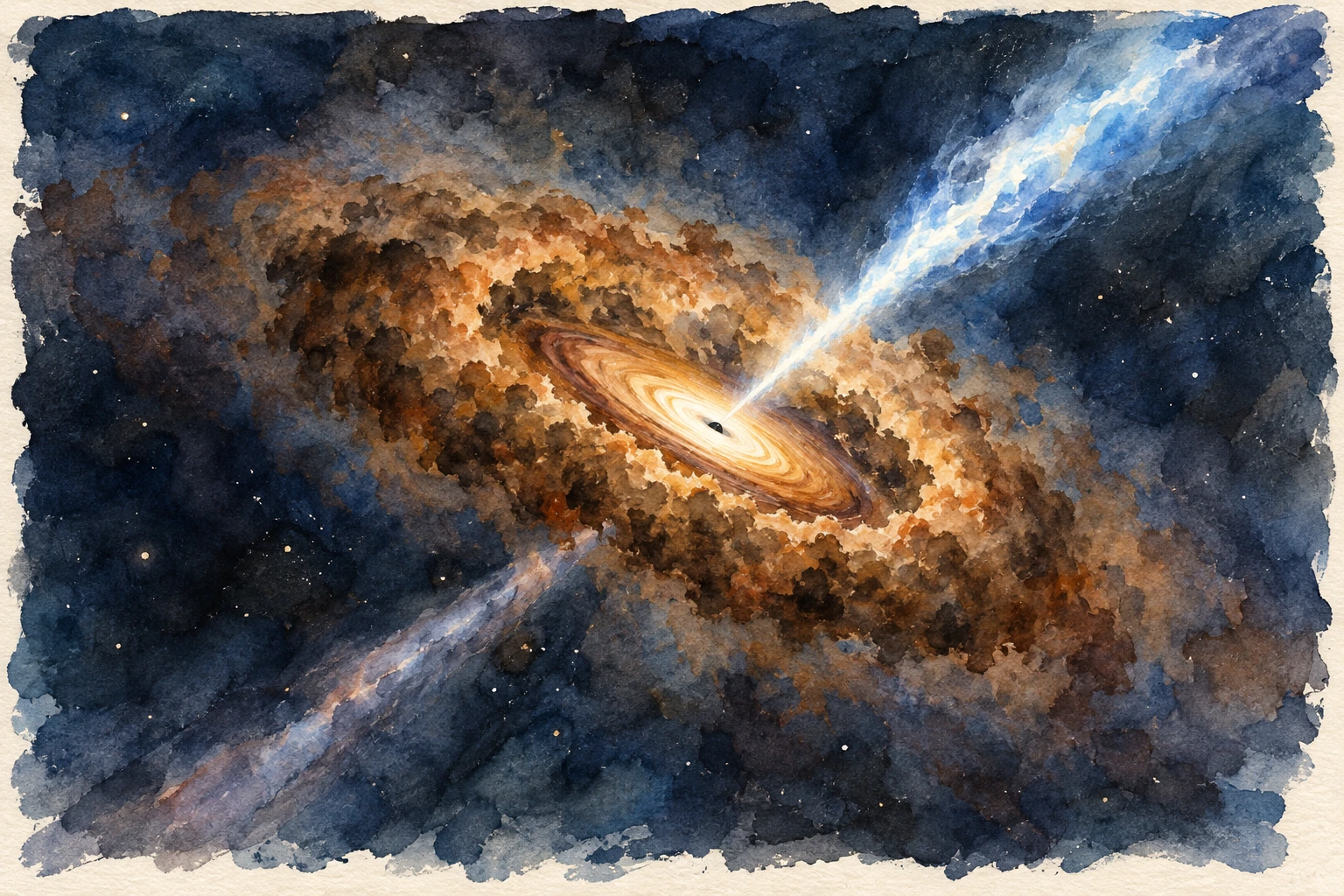
Look at the bright disk, then follow the jets in both directions.

A watercolor quasar with a small dark center inside a bright tilted golden disk, surrounded by a rough brown ring of dust. A bright blue-white jet extends toward the upper right and a fainter jet toward the lower left, against indigo space with irregular cream paper edges.

A reconstruction of a quasar’s central engine, with two particle jets.

  1. The hot disk
  2. The small dark center
  3. The bright jet
  4. The faint jet
  5. The dusty ring
← All pictures

Look more closely.

Click a part of the picture to open its explanation. “Show places to look” reveals the available details. On a small screen, match the numbers in the picture to the names beneath it.

“Full screen” gives the picture more room. Use “Exit full screen” or Escape to return to the page.

Tab moves between the details and Enter opens one. Escape closes an explanation first, then leaves full screen.

The hot disk

Accretion disk

Falling gas powers the light.

Gas gathers into a disk as it circles a supermassive black hole. As it moves inward, gravitational energy is released and the gas heats up. The disk becomes so luminous that a small region at the center of a galaxy can outshine the galaxy’s stars.

This helps explain the early puzzle of quasars. A telescope could record a point of light that looked like a star, while the object’s distance implied an extraordinary energy output. The small bright disk in this reconstruction shows where much of that energy is released.

The small dark center

Supermassive black hole

The black hole sits inside the light.

A quasar’s central black hole can contain millions or billions of times the Sun’s mass. Material around it gives off the light we receive before crossing the event horizon. Once light passes inside that boundary, it cannot escape to an outside observer.

The dark mark here indicates the black hole’s location. Its size has been adjusted for the illustration. It is not an observed shadow, and it gives us no view of the interior.

The bright jet

Particles and magnetic fields

Some of the material is sent outward.

Some quasars launch narrow streams of particles from the region around their black holes. Strong magnetic fields help organize these jets, which can travel close to the speed of light. Their launch region lies outside the event horizon. The particles have not escaped from inside the hole.

Jets from supermassive black holes can extend hundreds of thousands of light-years. This painting shows only a short stretch. Many quasars have no powerful jets; how the flow of gas, magnetic fields and black-hole spin produce one remains an active subject of research.

The faint jet

Doppler beaming

The other direction can be harder to see.

The same system can send material in opposite directions and still appear strongly one-sided. When a jet points partly toward us and moves very fast, relativity increases the brightness we receive. The jet traveling away appears dimmer.

This effect is called Doppler beaming. The unequal brightness in the watercolor represents that viewing effect. A faint counterjet does not by itself mean the black hole is sending less material that way.

The dusty ring

Gas, dust and viewing angle

Dust can hide the bright center.

Farther from the hot inner disk, dust can survive. A thick, uneven ring of dusty gas surrounds the engine in this reconstruction. Depending on our viewing angle, it can obscure the bright center and change the kind of active galaxy we appear to see.

ESO’s infrared observations of Messier 77 traced heated dust around a hidden central engine. Observations of another active galaxy, NGC 3783, also found substantial dust above and below the expected ring. The torus is a useful model; real dust distributions can be more complicated than a neat doughnut.

The star that was too far away

In the early 1960s, the radio source 3C 273 had a visible counterpart that looked like a star, with a faint jet beside it. Its spectrum was puzzling. In 1963, Maarten Schmidt recognized familiar hydrogen lines at wavelengths much longer than expected. The lines had been shifted toward the red. Interpreting that shift through the expansion of the universe placed the object far beyond our galaxy.

Maarten Schmidt · 3C 273: A Star-Like Object with Large Red-Shift (1963) (opens in a new tab)

Distance changed what that point of light meant. The light from 3C 273 has taken roughly 2.5 billion years to reach us. To appear so bright from so far away, its source had to be exceptionally luminous. The name quasar preserves the early impression, shortened from “quasi-stellar radio source.” Astronomers came to understand these objects as intensely bright galactic centers powered by gas falling toward supermassive black holes. Some of that gas produces the disk and jets reconstructed above.

NASA Hubble · The Closest-Ever Look at a Quasar (opens in a new tab)NASA Hubble · Quasars (opens in a new tab)

The surrounding galaxy was difficult to see through the central glare. Hubble helped reveal the galaxies that quasars inhabit. In observations reported in 2024, astronomers used Hubble’s coronagraph to block the bright center of 3C 273 and examine its surroundings more closely. Structures near the core became visible, along with its long jet. The black circle in those telescope images belongs to the instrument’s mask.

NASA Hubble · The Closest-Ever Look at a Quasar (opens in a new tab)NASA Hubble · Quasars (opens in a new tab)

The painting brings parts of the system together at sizes that make them readable. Observations show the galactic surroundings and jets, while scientific models help reconstruct the much smaller central engine. The bright disk sits deep inside a far larger galaxy. The jet continues beyond this sheet, and the tiny dark mark at its origin represents a black hole inferred from what happens around it.

ESO · The inner part of an active galactic nucleus (opens in a new tab)NASA Science · Anatomy of a Black Hole (opens in a new tab)NASA Hubble · The Closest-Ever Look at a Quasar (opens in a new tab)
About this picture and its sources

This watercolor is a reconstruction of a quasar with jets, based on NASA and ESO descriptions and scientific illustrations of active galactic nuclei. It does not depict a particular observed quasar. The disk, central dark region and dusty ring are shown at adjusted relative sizes so each can be explored. The galaxy and the jets’ full lengths are outside this close view. Colors, brushwork and apparent detail are artistic choices. The small dark mark indicates the black hole’s location; it is not a measured image of its shadow.

The illustration was made with help from AI, using the references below for the scientific features.