Skip to the picture
Pictures with Stories On Life & Everything

Space

The Crab Nebula

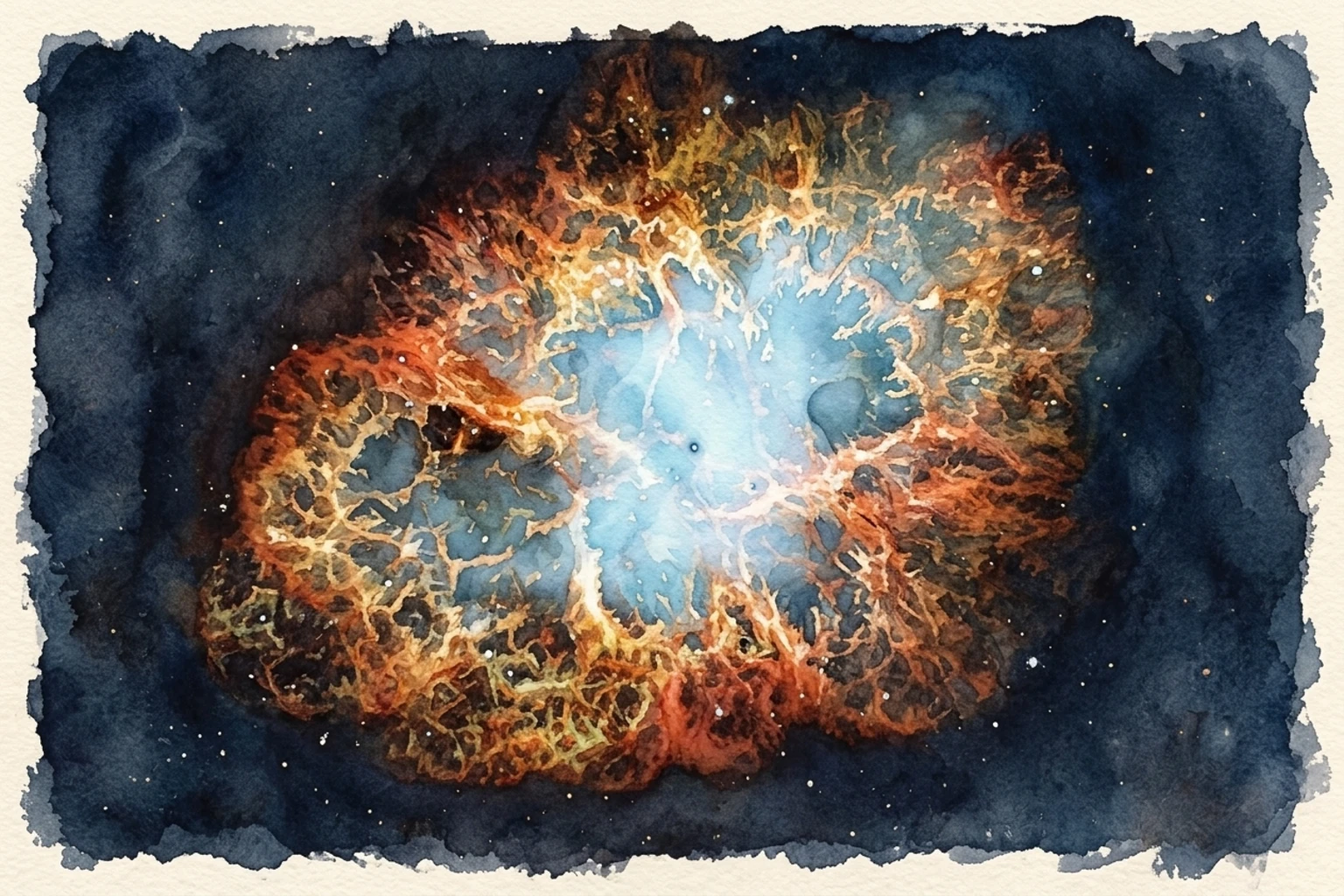
Look at the outer web of filaments, then move inward to the blue glow and the point at its center.

A watercolor Crab Nebula with a web of orange and red filaments around a blue interior glow and a central point of light, against dark space with cream paper edges.

The Crab Nebula (Messier 1), the remnant of a supernova seen on Earth in 1054.

  1. The tangled filaments
  2. The blue inner glow
  3. The spinning heart
  4. The dark bays
← All pictures

Look more closely.

Click a part of the picture to open its explanation. “Show places to look” keeps the name labels visible. On a small screen, the names are also listed beneath the picture.

“Full screen” gives the picture more room. Use “Exit full screen” or Escape to return to the page.

Tab moves between the details and Enter opens one. Escape closes an explanation first, then leaves full screen.

The tangled filaments

Supernova remnant

The shattered star is still expanding.

The branching web around the outside of the nebula is the debris of the star that exploded. The filaments contain ionized hydrogen, helium, carbon, oxygen, nitrogen, neon, iron and sulfur, racing outward at roughly 1,500 kilometers per second. More than nine centuries after the light of the explosion reached Earth, the shell spans about eleven light-years across.

Astronomers measured that outward motion by comparing photographs taken decades apart. Tracing the expansion backward placed the start of the blast in the middle of the eleventh century, matching the position and date of the guest star recorded in 1054.

The blue inner glow

Synchrotron light

Electrons spiraling in a magnetic field.

Inside the cage of filaments, the nebula shines with a continuous blue-white glow. In 1953, the astrophysicist Iosif Shklovsky proposed that this light is synchrotron radiation, emitted by electrons spiraling at nearly the speed of light around magnetic field lines.

Synchrotron radiation is strongly polarized. Optical measurements made in the mid-1950s confirmed that the light from the Crab’s interior is polarized just as predicted, proving that a magnetic field threads the cloud and is continually supplied with high-energy electrons.

The spinning heart

Neutron star

A collapsed core powers the cloud.

Near the center of the blue glow sits the Crab Pulsar, the crushed core left behind when the star collapsed. It packs more than the Sun’s mass into a sphere roughly twenty kilometers across and completes about thirty rotations every second.

Radio astronomers detected its pulses in 1968, and optical observations in 1969 showed a star near the center of the nebula flashing at the same rate. As the neutron star’s magnetic field spins, it drives a wind of relativistic particles outward. That loss of spin energy keeps the inner nebula shining today.

The dark bays

Older gas and dust

An earlier ring pinches the glow.

Along the eastern and western edges of the interior, darker indentations curve inward like bays on a shoreline. They are places where the blue synchrotron glow stops short.

In 1992 astronomers proposed that the bays mark a belt of gas the star shed around its equator before it exploded, whose magnetic field holds back the pulsar’s wind. Later studies have found more bays and offered other explanations, and their cause is still debated.

A star with a date

In July 1054, court astronomers of the Song dynasty in China recorded a bright “guest star” in the constellation Taurus, near the star Zeta Tauri. For twenty-three days it shone brightly enough to be seen in daylight, and it remained visible in the night sky until April 1056. Japanese records from Kyoto independently noted the same new star. Few objects in deep space have a birth date written down by eyewitnesses on Earth.

Nicholas U. Mayall & Jan H. Oort · Further Data Bearing on the Identification of the Crab Nebula with the Supernova of 1054 A.D. (1942) (opens in a new tab)NASA Hubble · Messier 1 (The Crab Nebula) (opens in a new tab)

Whether the star was also recorded around the Mediterranean remains disputed. In 1978, a paper in Nature proposed that a passage by the Christian Arab physician Ibn Butlān, who travelled from Cairo to Constantinople in 1054, referred to the same supernova while linking a celestial sign to an epidemic along the Nile. A 2024 historical and astronomical reassessment examined the textual transmission and astronomical details of Ibn Butlān’s account and questioned whether it describes the 1054 supernova at all.

Kenneth Brecher, Elinor Lieber & Alfred E. Lieber · A Near-Eastern Sighting of the Supernova Explosion of 1054 (1978) (opens in a new tab)Koji Murata & Hisashi Hayakawa · Was the Supernova of 1054 CE Recorded in Constantinople? A Historical and Astronomical Reassessment (2024) (opens in a new tab)

The fading star left a cloud too dim for the naked eye. The English astronomer John Bevis noted it in 1731. In August 1758, Charles Messier came across the patch of light while searching for the predicted return of Halley’s Comet. Because the cloud did not move against the background stars, Messier saw that it was a fixed nebula and made it the first entry⁠—M1⁠—in his catalogue. In the 1840s, a sketch drawn from observations at Birr Castle by William Parsons, the third Earl of Rosse, suggested the legs of a crustacean and gave the object the name Crab Nebula.

NASA Hubble · Messier 1 (The Crab Nebula) (opens in a new tab)ESA/Hubble · Most Detailed Image of the Crab Nebula (heic0515a) (opens in a new tab)

In the twentieth century astronomers connected the cloud with the star. Comparing telescope plates taken years apart showed the outer filaments expanding, and working backward from their speed pointed to an explosion around the middle of the eleventh century. In 1968, radio astronomers found a pulsar at the center of the remnant. The discovery showed that the 1054 supernova had left a spinning neutron star behind, and that its rotational energy continues to light the nebula from within.

Nicholas U. Mayall & Jan H. Oort · Further Data Bearing on the Identification of the Crab Nebula with the Supernova of 1054 A.D. (1942) (opens in a new tab)David H. Staelin & Edward C. Reifenstein · Pulsating Radio Sources near the Crab Nebula (1968) (opens in a new tab)NASA Chandra X-ray Observatory · The Crab Nebula (opens in a new tab)
About this picture and its sources

A watercolor interpretation of the Crab Nebula, informed by Hubble Space Telescope optical images of the outer filaments and inner synchrotron glow. The colors and brushwork are artistic choices made to keep the filaments, the blue interior, the side bays and the central pulsar’s location distinct.