Skip to the picture
Pictures with Stories On Life & Everything

Animals · Cats

The black cat

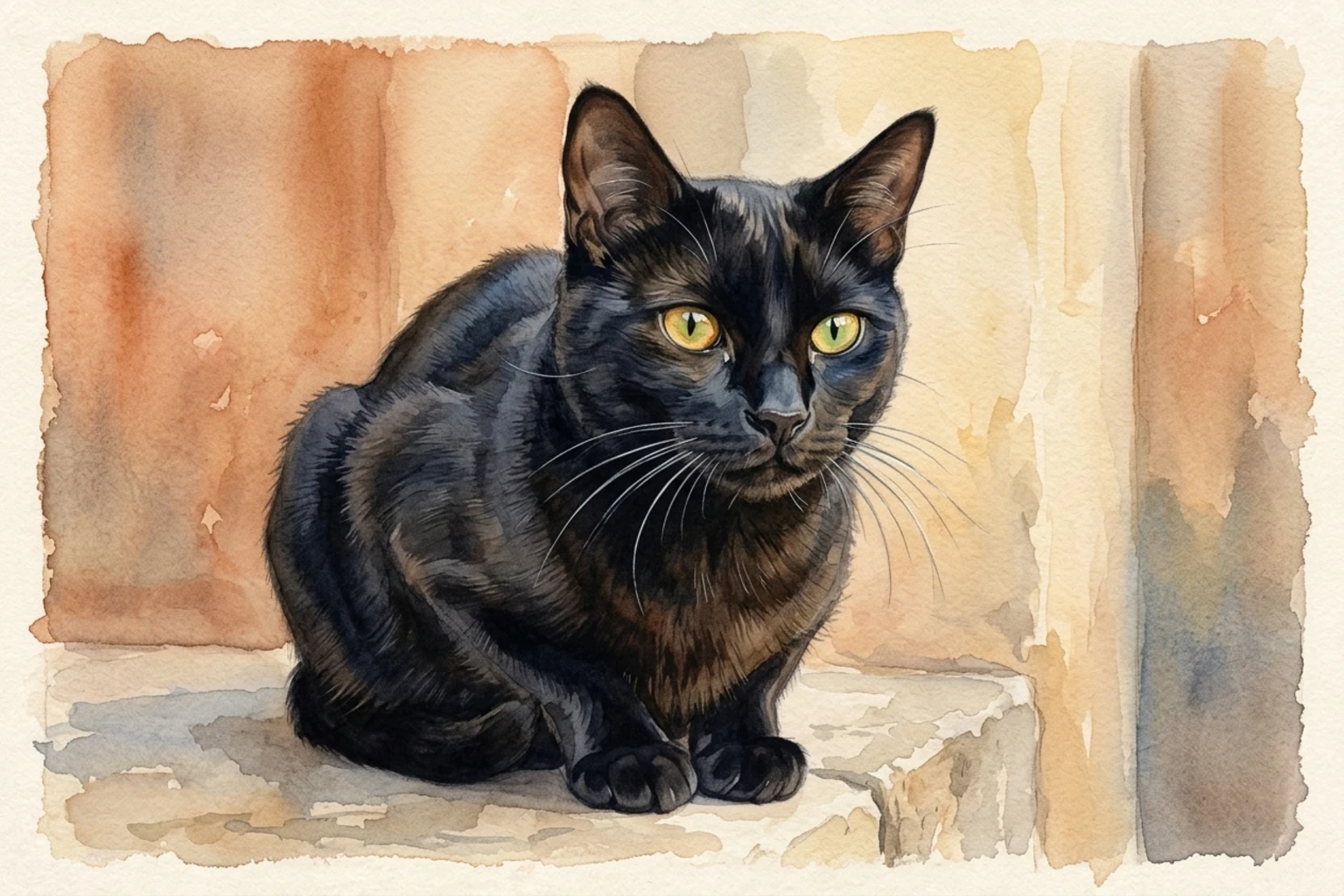
Look at the coat and the eyes, then move to the whiskers. Each part of the portrait has a story to tell.

A watercolor black cat sitting on a stone ledge against an ochre wall, looking forward with green eyes and white whiskers.

A black domestic cat (Felis catus) at rest on a stone ledge, modeled on Moris.

  1. The black coat
  2. The vertical pupils
  3. The light behind the eye
  4. The slow blink
  5. The whiskers
← All pictures

Look more closely.

Click a part of the picture to open its explanation. “Show places to look” keeps the name labels visible. On a small screen, the names are also listed beneath the picture.

“Full screen” gives the picture more room. Use “Exit full screen” or Escape to return to the page.

Tab moves between the details and Enter opens one. Escape closes an explanation first, then leaves full screen.

The black coat

Melanism & the Bombay

A two-letter change in a gene, and the breeding of the Bombay.

In domestic cats, a solid black coat traces to a deletion of two base pairs in the agouti signaling protein gene (ASIP). That change turns off the banded tabby pattern and fills each hair from root to tip with dark eumelanin pigment.

When Nikki Horner bred the Bombay between the 1950s and 1970s, she combined the black coat and heavy frame of the American Shorthair tomcat with the short satin fur and social temperament of the sable Burmese, a relative of the Siamese.

The vertical pupils

Ambush vision

A slit measures distance close to the ground.

A domestic cat’s pupil narrows to a vertical slit in bright light and opens wide in darkness, changing its area more than a hundredfold so the retina can work in both daylight and night shadow.

A 2015 study of more than two hundred land species found that vertical slit pupils belong mostly to ambush predators whose eyes sit close to the ground. A vertical opening keeps vertical edges sharp for judging distance with both eyes while letting horizontal lines blur with depth.

The light behind the eye

Tapetum lucidum

A mirror gives dim light a second pass.

When light catches a black cat’s eyes at night, they shine out of the dark. The reflection comes from the tapetum lucidum, a layer of reflective cells behind the retina.

In cats, those cells hold regular arrays of rodlets rich in riboflavin and zinc. Light that passes through the retina without being absorbed hits this layer and bounces back through the photoreceptors a second time, helping the cat see in dim light and producing the green-gold eyeshine.

The whiskers

Tactile map

Hairs that read the air and the dark.

A cat’s whiskers, or vibrissae, are rooted about three times deeper than ordinary coat hairs. Each follicle sits inside a blood-filled capsule supplied with nerve endings that register slight bends and vibrations.

Because a cat’s eyes cannot focus on objects closer than about twenty-five centimeters from its nose, the whiskers take over at close range. Moved forward around the muzzle, they map nearby surfaces in the dark and help a strong, agile body judge the width of an opening.

From superstition to the living room

Black cats have carried opposite reputations in folklore. In medieval and early modern Europe, popular belief tied them to witchcraft as witches’ familiars or as shapes a witch might take at night. Across much of continental Europe and later North America, a black cat crossing a road came to mean bad luck. Sailors and coastal communities often held the reverse. British crews kept a black ship’s cat for fair weather, and in parts of Britain and Japan a black cat has long been welcomed as good fortune.

Encyclopædia Britannica · Familiar (Folklore and Witchcraft) (opens in a new tab)Cats Protection UK · Why Are Black Cats Unlucky⁠—or Lucky? (opens in a new tab)

In the 1950s, a breeder named Nikki Horner in Louisville, Kentucky set out to breed a domestic cat with the look of a black panther. Working from the 1950s into the 1970s, she crossed black American Shorthair tomcats with sable Burmese cats, a line related to the Siamese. The result was a muscular cat with a close black coat and copper eyes. Horner named the breed the Bombay after the black leopards of India, and the Cat Fanciers’ Association recognized it for championship status in 1976.

The Cat Fanciers’ Association (CFA) · Bombay Breed Profile (opens in a new tab)The International Cat Association (TICA) · Bombay Breed Standard and History (opens in a new tab)

Domestic cats are social animals that form strong bonds with the people they live with. Behavioral experiments show that most cats form secure attachments to their owners, looking to them for reassurance in unfamiliar rooms and often choosing human company over food or toys. They learn household routines quickly and dislike being left alone for long. Those traits are especially marked in the Bombay, which follows its people from room to room and expects to be part of the household.

Kristyn R. Vitale, Alexandra C. Behnke & Monique A. R. Udell · Attachment Bonds Between Domestic Cats and Humans (2019) (opens in a new tab)Kristyn R. Vitale Shreve, Lauren R. Mehrkam & Monique A. R. Udell · Social Interaction, Food, Scent or Toys? A Formal Assessment of Domestic Cat Preferences (2017) (opens in a new tab)The Cat Fanciers’ Association (CFA) · Bombay Breed Profile (opens in a new tab)The International Cat Association (TICA) · Bombay Breed Standard and History (opens in a new tab)
About this picture and its sources

A watercolor portrait modeled on Moris, painted in dark washes so the outline of the coat and the green eyes remain clear against the stone wall.