Skip to the picture
Pictures with Stories On Life & Everything

The black hole

Look closely at the light around the dark center. Each part of the picture has something to explain.

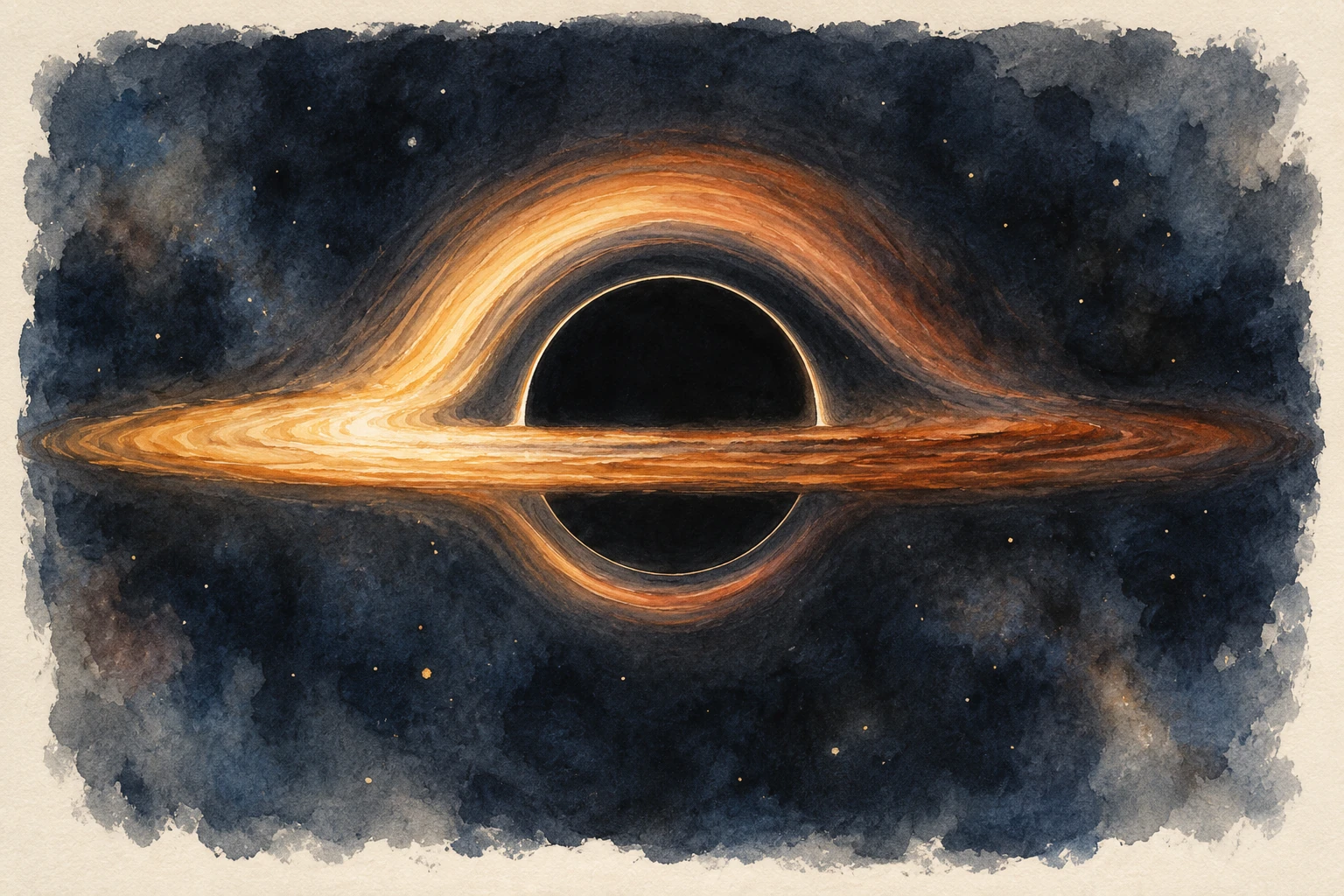
A watercolor black hole with a dark round center, a thin golden disk crossing in front, a broad arch above and a smaller arc below. The left side of the disk is brighter.

A black hole with a thin disk of hot gas, seen nearly edge-on.

  1. The hot disk
  2. Light from behind
  3. The dark center
  4. The thin light ring
  5. The brighter side
← All pictures

Look more closely.

Click a part of the picture to open its explanation. “Show places to look” reveals the available details. On a small screen, match the numbers in the picture to the names beneath it.

“Full screen” gives the picture more room. Use “Exit full screen” or Escape to return to the page.

Tab moves between the details and Enter opens one. Escape closes an explanation first, then leaves full screen.

The hot disk

Accretion disk

The gas gives us something to see.

The bright band is gas moving around the black hole. Matter collects in a thin disk and gradually travels inward. This process is called accretion. The hot gas emits the light that makes the surroundings visible.

A black hole can also be alone, with little material nearby to feed such a disk. This picture shows one with gas around it, giving us a view we would lose if the gas were gone.

Light from behind

Gravitational lensing

The far side comes into view.

The gas belongs to a flat disk. Light from its far side follows the curved paths of space-time near the black hole and reaches us above the dark center. The disk appears to rise into an arch.

Look below the foreground band too. Another path brings light from the underside of the far side into view there. Our viewing angle changes these shapes. Looking straight down on the disk would give a very different picture.

The dark center

Black hole shadow

The dark center is a shadow.

Light that passes through the event horizon cannot reach us again. Nearby paths of light are also bent by gravity. Together, these effects create the dark region called the black hole’s shadow.

The shadow looks larger than the event horizon within it. That horizon is a boundary beyond which even light cannot escape. The dark shape in this painting marks the shadow; its edge does not give us a view of the horizon itself.

The thin light ring

Photon ring

Light that took a longer way.

The fine rim around the shadow represents a photon ring. It contains highly distorted images of the disk, made by light that traveled around the black hole more than once before escaping toward us.

In the model there are multiple rings, becoming thinner and fainter closer to the shadow. The painting simplifies them into a narrow line. The broad arch farther out is another image of the disk, with a different path to our eyes.

The brighter side

Doppler beaming

Motion changes the light we receive.

The left side is brighter in this view because the gas there is moving toward us. Close to the black hole, its orbital speed is high enough for relativity to change the brightness of the light we receive. The receding side appears dimmer.

This effect is called Doppler beaming. The contrast depends on our angle to the moving gas. Viewed from directly above the disk, that difference between approaching and receding sides would disappear.

The story behind the picture

In 1978, Jean-Pierre Luminet calculated how a black hole surrounded by a thin gas disk would look. He used an IBM 7040 computer at the Paris-Meudon Observatory, feeding it punched cards. To turn the numbers into an image, he placed ink dots on negative image paper, more densely where his calculation predicted more light, then reversed the image. The image first appeared in November 1978 in La Recherche, a French popular science magazine, and then in a technical journal in 1979. It already showed the distorted disk and unequal brightness that make this shape recognizable. Our watercolor is a new interpretation, separate from Luminet’s original image.

Jean-Pierre Luminet · Seeing Black Holes: From the Computer to the Telescope (opens in a new tab)

On 10 April 2019, the Event Horizon Telescope collaboration released the first image of a black hole’s shadow, at the center of the galaxy M87. Eight radio telescopes had collected the measurements in 2017; their combined data were used to reconstruct the image. A bright, uneven ring surrounded a dark center, broadly agreeing with the features predicted by earlier models. It was an observed image made from radio light. The painted disk above shows a different viewing angle, using an illustration to make individual paths of light easier to explore.

Event Horizon Telescope · The First Black Hole Image (2019) (opens in a new tab)Jean-Pierre Luminet · Seeing Black Holes: From the Computer to the Telescope (opens in a new tab)

Long before a telescope could show this shape, equations had suggested stranger possibilities. In 1935, Albert Einstein and Nathan Rosen described a mathematical bridge between two sheets of space. Later idealized black-hole solutions allowed connections to other regions of space-time, inspiring the idea of a passage to another universe. Whether such connections could form and remain stable in nature is another question. Observed black holes have not been shown to be wormholes or gateways.

Einstein & Rosen · The Particle Problem in the General Theory of Relativity (1935) (opens in a new tab)NASA Goddard · Ask an Astrophysicist: Black Holes (opens in a new tab)NASA Science · Black Holes (opens in a new tab)

The interior raises a question of its own. In the simple, non-rotating model pictured here, general relativity predicts a central singularity, where matter reaches infinite density. Astronomers do not know whether this describes something physical or marks a limit of the mathematics. Quantum effects may become essential there. The dark center in the painting represents the shadow seen from outside; it does not show the singularity.

NASA Science · Universe Glossary: Singularity (opens in a new tab)

A white hole reverses the classical black-hole idea: matter and light can leave it, while nothing can enter. Stephen Hawking discussed white holes in his 1976 paper on black-hole thermodynamics, examining their relationship to black holes through time reversal. This was a theoretical argument. No white hole has been confirmed by observation, and a possible connection to a black hole remains speculative.

Stephen Hawking · Black Holes and Thermodynamics (1976) (opens in a new tab)NASA Goddard · Ask an Astrophysicist: Black Holes (opens in a new tab)

Quasars once entered this speculation too. Some scientists considered whether their extraordinary brightness might come from white holes. Observations instead support a different explanation. A quasar is the intensely luminous active center of a galaxy, powered by gas falling toward a supermassive black hole. The light comes from material around the hole, before it crosses the event horizon. The black hole and the quasar name different parts of that system.

NASA Goddard · Ask an Astrophysicist: Black Holes (opens in a new tab)NASA Hubble · Quasars (opens in a new tab)
About this picture and its sources

A watercolor interpretation of a non-rotating black hole, based on NASA visualizations by Jeremy Schnittman and Robert Hurt. The colors and brushwork are artistic choices; the picture represents the arrangement of the light qualitatively.

The illustration was made with help from AI, using the references below for the scientific features.